

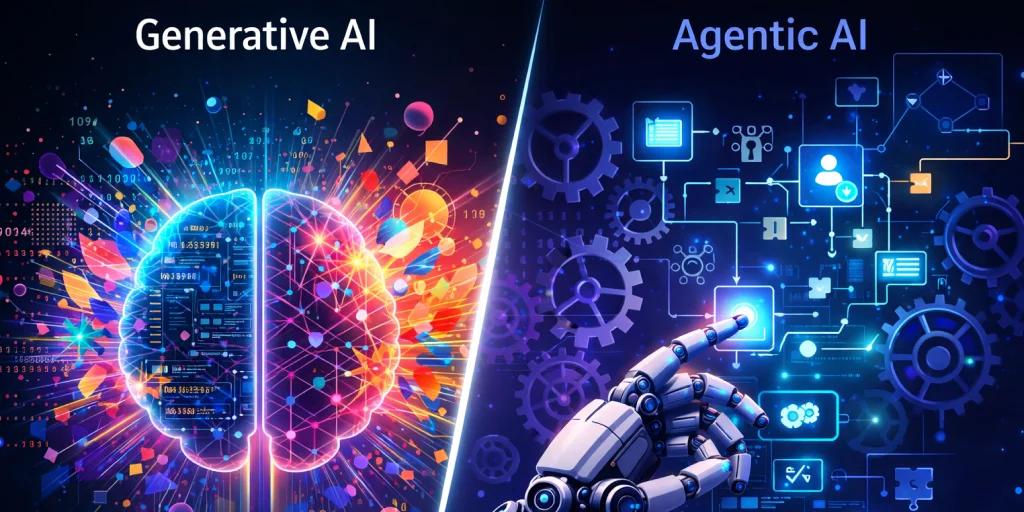
Artificial intelligence has crossed a threshold. We are no longer talking about models that generate—text, images, or code when prompted. The conversation has now transitioned toward systems that decide, plan, execute, and adapt—systems that behave less like tools and more like collaborators. This change has a name and that is: Agentic AI.
Agentic AI is swiftly becoming one of the most discussed and invested-in areas of applied AI, in fact, this is across enterprises, research labs, startups, and developer communities. It is changing the manner of how software is built, how work is automated, and how humans interact with intelligent systems. Due to this, demand for Agentic AI certification and training courses by industry experts has surged globally.

But with popularity comes noise. There are dozens of platforms that now claim to teach Agentic AI, often using the same buzzwords and overlapping tool names. For learners, professionals, and organizations, the real challenge is no longer where to learn Agentic AI—but where to learn it properly. This guide will help you to solve that problem.
What is Agentic AI, in real terms?
Agentic AI refers to artificial intelligence systems that are designed to operate as autonomous agents. These are entities that can perceive their environment, reason about goals, plan multi-step actions, use tools or APIs, and evaluate outcomes with minimal human intervention.
Unlike traditional AI workflows or single-response chatbots, agentic systems:
- Break down complex objectives into steps
- Decide what to do next rather than waiting for prompts
- Interact with external systems (databases, APIs, applications)
- Coordinate with other agents
- Adapt based on intermediate results and feedback
In simple terms, Agentic AI is about behavior, not just output.
This distinction is crucial to understand. A prompt-based system answers questions. An agentic system completes tasks.
Read Also: Rise of Agentic AI: Redefining Work, Skills, and the Future of Jobs in India
Why Agentic AI is being talked about everywhere
The growing attention around Agentic AI is not accidental. It is driven by a convergence of technical maturity and real-world necessity.
Large Language Models (LLMs) have improved dramatically in reasoning, usage of tools, and context handling. At the same time, organizations are facing pressure to automate workflows that are too complex for traditional scripts but too repetitive for humans. Agentic AI sits precisely at this intersection.
Today, agentic systems are being explored and deployed for:
- Enterprise knowledge retrieval using multi-agent RAG pipelines
- Autonomous customer support and operations workflows
- AI-powered software engineering assistants
- Business process automation across—CRM, ERP, and analytical tools
- Research assistance and decision support
Major AI education providers and technology companies have responded by launching specialized Agentic AI certifications and training programs, signaling that this is no longer experimental—it is becoming a professional discipline.
Recent global developments accelerating Agentic AI adoption
Globally, the Agentic AI ecosystem has moved from conceptual frameworks to structured platforms, certifications, and production deployments.
Leading AI education organizations have introduced focused agentic curriculum emphasizing reasoning loops, tool orchestration, and evaluation pipelines. The enterprise vendors have already started to conceptualize role-based certifications, considering Agentic AI to be an integral technology capability. Technology providers are incorporating agentic frameworks directly into their technology platforms. This makes agent development more accessible yet also more complex. This demand is fueling the need for professionals who can not only work with agent frameworks but design, test, monitor, and govern them.
At the same time, developer communities have embraced agent-based architectures through open-source frameworks such as—LangChain, LangGraph, AutoGen, CrewAI, and MCP-style tool protocols. These are not academic experiments—they are being used in production pilots across industries. The result is a clear signal: Agentic AI skills are moving from optional to essential.
Why students and professionals should invest in Agentic AI now
For students, Agentic AI represents a chance to enter the AI workforce with skills that go beyond surface-level model usage. Acquiring the knowledge about agentic systems helps students demonstrate— systems thinking, architectural awareness, and practical problem-solving—qualities employers increasingly prioritize.
For working professionals, particularly software engineers, data scientists, solution architects, and AI product managers, Agentic AI is a natural evolution. It builds on existing technical foundations while opening doors to higher-impact roles focused on automation, orchestration, and intelligent system design.
Three factors that make decision to pursuing agentic AI correct are:
- Early specialization advantage: Agentic AI is still forming as a discipline. Professionals who build real agentic systems today will define best practices tomorrow.
- High business relevance: Organizations are actively experimenting with agentic workflows to reduce costs, improve efficiency, and scale decision-making.
- Skill scarcity: While many people can prompt an LLM, far fewer can design autonomous systems that operate reliably in production environments.
Choosing the right training program at this stage can positively influence long-term career trajectories.
Read Also: Agentic AI vs Generative AI
Top Agentic AI Certification and Training Courses by Industry Experts
Not all Agentic AI courses are equal. Some focus on conceptual overviews, others on tool tutorials, and a smaller number on full-stack agent engineering. The programs below have been selected based on:
- Curriculum depth and relevance
- Industry or institutional credibility
- Practical exposure to agent design and deployment
- Alignment with real-world use cases
These are not marketing picks. They are programs that meaningfully contribute to agentic competence.
Agentic AI – DeepLearning.AI
This program, developed under the leadership of Andrew Ng's education platform, focuses on the foundational principles of agentic systems. It introduces learners to agent workflows, planning and execution loops, and tool integration using modern agent frameworks.
Key focus areas include:
- Agent reasoning patterns
- Multi-step task execution
- Tool calling and orchestration
- Evaluation of agent outputs
The course is available as part of a subscription model costing $25-50 monthly or $300 annually. It is particularly well-suited for developers and ML practitioners who want a strong conceptual and practical starting point.
Agentic AI Training Course – Edureka
Edureka's Agentic AI course is positioned as a short, intensive bootcamp aimed at working professionals. It emphasizes hands-on learning with popular agent frameworks and cloud platforms.
What stands out:
- Live instructor-led sessions
- Exposure to LangChain, AutoGen, CrewAI, and RAG pipelines
- Capstone-style projects
- Coverage of agent observability tools
It costs around $266. This course appeals to professionals seeking fast upskilling with structured guidance.
Engineering Agentic AI Systems: From Concepts to Practice – IIIT Hyderabad
This academically rigorous program bridges theory and applied engineering. Offered by IIIT Hyderabad's Division of Flexible Learning, it treats Agentic AI as a systems discipline rather than a tooling exercise.
Curriculum highlights:
- Agent architectures and control loops
- Decision-making under uncertainty
- Multi-agent coordination
- Production concerns and AgentOps
The pricing of this program is: ~$632 for Indian students, $1,440 for international students. This is particularly valuable for engineers and architects aiming for depth and long-term expertise.
IBM RAG and Agentic AI Professional Certificate – IBM via Coursera
IBM's professional certificate frames Agentic AI within an enterprise context, combining retrieval-augmented generation with agent-based workflows.
Key strengths:
- Enterprise-oriented design patterns
- Integration of RAG with agent reasoning
- Use of LangChain and LangGraph
- Structured multi-course progression
The program can be taken via Coursera, where the subscription-based pricing makes it cost-effective for most professionals. This certification is well-suited for professionals working in or targeting large organizations.
AI Engineer – Agentic Track: The Complete Agent & MCP Course – Udemy
This highly practical course focuses on building agents end-to-end using modern frameworks and protocols.
What learners gain:
- Hands-on projects
- Exposure to MCP-style tool protocols
- Multi-agent system design
- Rapid experimentation and iteration
The program costs around $10 after discounts. It is ideal for self-driven learners who prefer project-heavy learning.
Agentic AI Business Solutions Architect – Microsoft
Microsoft's role-based certification positions Agentic AI as an enterprise architecture discipline rather than a standalone development skill. The learning path is built around designing, governing, and scaling agentic systems within real business environments.
Important areas covered:
- Agentic solution architecture
- Business workflow automation using AI agents
- Security, compliance, and governance
- Integration with cloud services and enterprise tools
This program costs around $165. This certification is best suited for solution architects, technical leads, and professionals responsible for aligning AI systems with organizational goals.
Agentic AI Professional Certification – NVIDIA
NVIDIA's Agentic AI's certification reflects the growing importance of agent-based systems in high-performance and enterprise AI deployments. The certification validates a professional's ability to design, build, and evaluate agentic systems in production contexts.
Program emphasis includes:
- Agent orchestration and coordination
- System performance considerations
- Monitoring and observability
- Production-readiness and reliability
This credential is especially valuable for experienced AI engineers looking for vendor-backed recognition. There is a certification exam for this which is supported by NVIDIA's Deep Learning Institute (DLI). It offers courses separately and priced independently from the certification exam.
LangChain Academy and LangGraph Courses – LangChain
LangChain Academy offers official training from the creators of one of the most widely used agent frameworks. These courses focus on practical implementation and best practices drawn directly from real-world usage.
Learners explore:
- LangChain fundamentals
- LangGraph-based agent workflows
- State management and long-running agents
- Agent observability with LangSmith
LangChain Academy provides its courses for free, while third-party courses on platforms like Coursera and Udemy have variable pricing. These programs are ideal for developers actively building agentic systems and wanting authoritative guidance from the framework maintainers.
AI Agents with LangChain and LangGraph – Udacity
This course focuses on designing and deploying agentic workflows using graph-based architectures. It emphasizes clarity in reasoning flows and control over agent behavior.
Core learning outcomes:
- Graph-based agent orchestration
- Planning and state transitions
- Practical deployment patterns
- Real-world project implementation
Udacity's clearly defined approach makes this suitable for learners who prefer guided, outcome-oriented learning paths.
Designing Agentic Systems with LangChain – DataCamp
DataCamp's agent-focused modules are designed for hands-on, interactive learning. The courses emphasize experimentation and iteration within notebooks and controlled environments.
Focus areas include:
- Agent design patterns
- Prompt engineering for agents
- Vector databases and retrieval pipelines
- Tool integration and evaluation
The course is included as part of subscription plans that are offered by DataCamp. This option works well for practitioners who want modular, bite-sized learning combined with practical exercises.
How Agentic AI training translates into real-world systems
Understanding agentic systems requires more than reading about them. The strongest programs expose learners to real scenarios that mirror how agents are deployed in production.
Case Study 1: Multi-Agent RAG System for Enterprise Knowledge Retrieval
Challenge:
Organizations with large internal document repositories struggle with information fragmentation, leading to slow-decision making and inconsistent answers.
Agentic Solution:
A multi-agent architecture was implemented:
- A retrieval agent queried vector databases
- A validation agent cross-checked sources
- A response agent synthesized verified answers
Result:
Employees received accurate, citation-backed responses autonomously, significantly reducing search time and manual verification.
This use case reflects what learners build in advanced Agentic AI courses focusing on RAG and multi-agent coordination.
Case Study 2: Autonomous Workflow Agent for Business Operations
Challenge:
Manual handling of requests across CRM systems, ticketing platforms, and email channels caused delays and errors.
Agentic solution:
An autonomous agent was designed to:
- Interpret incoming requests
- Decide next actions using predefined policies
- Call APIs across enterprise systems
- Notify stakeholders automatically
Result:
Operational efficiency improved, response times decreased, and the system demonstrated how agentic AI extends beyond chat interfaces into real business workflows.
A practical checklist to evaluate Agentic AI programs and talent
As the number of Agentic AI courses grows, learners and employers need a simple way to assess quality and relevance.
A 3-step evaluation framework
- Agent autonomy and reasoning
Does the program teach agents that plan, reason, and act over multiple steps?
- Tool and system integration
Are learners exposed to APIs, vector databases, RAG pipelines, and multi-agent coordination?
- Production readiness
Does the curriculum address monitoring, evaluation, cost control, and failure handling?
Programs that meet all three criteria are far more likely to produce professionals capable of building reliable agentic systems.
What it takes to become a strong Agentic AI professional in today’s market
Having expertise in Agentic AI is more than just being knowledgeable about large models of language or frameworks. A proficient individual in Agentic AI knows how autonomous systems function when deployed in real-world settings.
To achieve that, students must first be competent in basic agent design concepts such as goal decomposition, planning algorithms, memory, and feedback. These concepts provide a foundation for any system that can reason, act, or adapt.
Second, tool and system integration is required. It is becoming increasingly common to require systems that interact with APIs, databases, vector stores, and other applications and services that comprise an organization’s overall capabilities to solve their task or answer their questions. Indeed, knowledge of retrieval augmented generation (RAG), tool calling, and multi-agent
Another critical aspect is production readiness. Professionals need to understand and learn to manage observability, logging, and agent governance. Importance is also given to initialization readiness, while explainability is not a crucial part of the course content.
Ultimately, good practitioners of Agentic AI possess architectural judgment, an awareness of when to apply either one or multiple agents, or when to apply autonomy in conjunction with human supervision in line with business or ethical constraints.
People who develop strength in such areas go from experimentation to being able to provide scalable agentic solutions that are reliable and scalable.
Read Also: Is Agentic AI the Future of Cyber Defense?
Conclusion: Choosing substance over noise in the age of Agentic AI
Agentic AI marks a turning point in how intelligent systems are built and used. As software evolves from reactive tools to autonomous collaborations, the skills required to design, control, and trust these systems are becoming central to modern AI practice.
The certifications and training programs outlined in this guide reflect different philosophies and goals—from rapid upskilling to deep architectural mastery. What unites the strongest of them is a focus on applied understanding, real-world relevance, and responsible system design.
In a landscape crowded with promotional pages and shallow comparisons, depth matters. Programs that teach how agents reason, integrate with tools, and operate reliably under uncertainty prepare learners not just for today's tools, but for tomorrow's systems.
Investing in Agentic AI education now is not about chasing trends. It is about aligning your skills with the future of intelligent software—autonomous, accountable, and deeply embedded in how work gets done.

Priyank Jha
Priyank is a Senior Content Developer and Strategist at SNVA Veranda. Earlier, he worked as a data scientist, where he gained extensive experience in developing data-driven solutions, advanced analytics, and strategic decision-making processes. His expertise includes data analysis, business intelligence, and implementing data-centric strategies that drive organizational growth and innovation. In addition to his data science experience, Priyank has over 10 years of experience in the banking and financial services sector. He has worked across various roles and operational levels, gaining in-depth knowledge of financial operations, customer service management, and business processes.
Learn how we research, review, and update our content. Editorial Standards & Review Process.

Latest Blogs
8 PhD in Business Careers: Academic and Industry Paths After Graduation (2026 Guide)
 Is an Online DBA Worth It? Salary, ROI, and Career Benefits (2026 Guide)
 PhD vs DBA: Which Doctorate Is Right for You? (2026 Complete Guide)
 How to Compare Online DBA Programs: A Step-by-Step Guide Before You Apply
  Doctor of Business Administration Careers: Jobs, Salary & Growth in 2026
 Why Does a DBA Make More Sense Than a PhD?
 DBA vs PhD: Which Doctoral Degree Holds Higher Academic Value?
 Online DBA Degree Explained: Curriculum, Admission, and Career Opportunities (2026 Guide)
Featured Courses



Artificial intelligence has crossed a threshold. We are no longer talking about models that generate—text, images, or code when prompted. The conversation has now transitioned toward systems that decide, plan, execute, and adapt—systems that behave less like tools and more like collaborators. This change has a name and that is: Agentic AI.
Agentic AI is swiftly becoming one of the most discussed and invested-in areas of applied AI, in fact, this is across enterprises, research labs, startups, and developer communities. It is changing the manner of how software is built, how work is automated, and how humans interact with intelligent systems. Due to this, demand for Agentic AI certification and training courses by industry experts has surged globally.
But with popularity comes noise. There are dozens of platforms that now claim to teach Agentic AI, often using the same buzzwords and overlapping tool names. For learners, professionals, and organizations, the real challenge is no longer where to learn Agentic AI—but where to learn it properly. This guide will help you to solve that problem.
What is Agentic AI, in real terms?
Agentic AI refers to artificial intelligence systems that are designed to operate as autonomous agents. These are entities that can perceive their environment, reason about goals, plan multi-step actions, use tools or APIs, and evaluate outcomes with minimal human intervention.
Unlike traditional AI workflows or single-response chatbots, agentic systems:
- Break down complex objectives into steps
- Decide what to do next rather than waiting for prompts
- Interact with external systems (databases, APIs, applications)
- Coordinate with other agents
- Adapt based on intermediate results and feedback
In simple terms, Agentic AI is about behavior, not just output.
This distinction is crucial to understand. A prompt-based system answers questions. An agentic system completes tasks.
Read Also: Rise of Agentic AI: Redefining Work, Skills, and the Future of Jobs in India
Why Agentic AI is being talked about everywhere
The growing attention around Agentic AI is not accidental. It is driven by a convergence of technical maturity and real-world necessity.
Large Language Models (LLMs) have improved dramatically in reasoning, usage of tools, and context handling. At the same time, organizations are facing pressure to automate workflows that are too complex for traditional scripts but too repetitive for humans. Agentic AI sits precisely at this intersection.
Today, agentic systems are being explored and deployed for:
- Enterprise knowledge retrieval using multi-agent RAG pipelines
- Autonomous customer support and operations workflows
- AI-powered software engineering assistants
- Business process automation across—CRM, ERP, and analytical tools
- Research assistance and decision support
Major AI education providers and technology companies have responded by launching specialized Agentic AI certifications and training programs, signaling that this is no longer experimental—it is becoming a professional discipline.
Recent global developments accelerating Agentic AI adoption
Globally, the Agentic AI ecosystem has moved from conceptual frameworks to structured platforms, certifications, and production deployments.
Leading AI education organizations have introduced focused agentic curriculum emphasizing reasoning loops, tool orchestration, and evaluation pipelines. The enterprise vendors have already started to conceptualize role-based certifications, considering Agentic AI to be an integral technology capability. Technology providers are incorporating agentic frameworks directly into their technology platforms. This makes agent development more accessible yet also more complex. This demand is fueling the need for professionals who can not only work with agent frameworks but design, test, monitor, and govern them.
At the same time, developer communities have embraced agent-based architectures through open-source frameworks such as—LangChain, LangGraph, AutoGen, CrewAI, and MCP-style tool protocols. These are not academic experiments—they are being used in production pilots across industries. The result is a clear signal: Agentic AI skills are moving from optional to essential.
Why students and professionals should invest in Agentic AI now
For students, Agentic AI represents a chance to enter the AI workforce with skills that go beyond surface-level model usage. Acquiring the knowledge about agentic systems helps students demonstrate— systems thinking, architectural awareness, and practical problem-solving—qualities employers increasingly prioritize.
For working professionals, particularly software engineers, data scientists, solution architects, and AI product managers, Agentic AI is a natural evolution. It builds on existing technical foundations while opening doors to higher-impact roles focused on automation, orchestration, and intelligent system design.
Three factors that make decision to pursuing agentic AI correct are:
- Early specialization advantage: Agentic AI is still forming as a discipline. Professionals who build real agentic systems today will define best practices tomorrow.
- High business relevance: Organizations are actively experimenting with agentic workflows to reduce costs, improve efficiency, and scale decision-making.
- Skill scarcity: While many people can prompt an LLM, far fewer can design autonomous systems that operate reliably in production environments.
Choosing the right training program at this stage can positively influence long-term career trajectories.
Read Also: Agentic AI vs Generative AI
Top Agentic AI Certification and Training Courses by Industry Experts
Not all Agentic AI courses are equal. Some focus on conceptual overviews, others on tool tutorials, and a smaller number on full-stack agent engineering. The programs below have been selected based on:
- Curriculum depth and relevance
- Industry or institutional credibility
- Practical exposure to agent design and deployment
- Alignment with real-world use cases
These are not marketing picks. They are programs that meaningfully contribute to agentic competence.
Agentic AI – DeepLearning.AI
This program, developed under the leadership of Andrew Ng's education platform, focuses on the foundational principles of agentic systems. It introduces learners to agent workflows, planning and execution loops, and tool integration using modern agent frameworks.
Key focus areas include:
- Agent reasoning patterns
- Multi-step task execution
- Tool calling and orchestration
- Evaluation of agent outputs
The course is available as part of a subscription model costing $25-50 monthly or $300 annually. It is particularly well-suited for developers and ML practitioners who want a strong conceptual and practical starting point.
Agentic AI Training Course – Edureka
Edureka's Agentic AI course is positioned as a short, intensive bootcamp aimed at working professionals. It emphasizes hands-on learning with popular agent frameworks and cloud platforms.
What stands out:
- Live instructor-led sessions
- Exposure to LangChain, AutoGen, CrewAI, and RAG pipelines
- Capstone-style projects
- Coverage of agent observability tools
It costs around $266. This course appeals to professionals seeking fast upskilling with structured guidance.
Engineering Agentic AI Systems: From Concepts to Practice – IIIT Hyderabad
This academically rigorous program bridges theory and applied engineering. Offered by IIIT Hyderabad's Division of Flexible Learning, it treats Agentic AI as a systems discipline rather than a tooling exercise.
Curriculum highlights:
- Agent architectures and control loops
- Decision-making under uncertainty
- Multi-agent coordination
- Production concerns and AgentOps
The pricing of this program is: ~$632 for Indian students, $1,440 for international students. This is particularly valuable for engineers and architects aiming for depth and long-term expertise.
IBM RAG and Agentic AI Professional Certificate – IBM via Coursera
IBM's professional certificate frames Agentic AI within an enterprise context, combining retrieval-augmented generation with agent-based workflows.
Key strengths:
- Enterprise-oriented design patterns
- Integration of RAG with agent reasoning
- Use of LangChain and LangGraph
- Structured multi-course progression
The program can be taken via Coursera, where the subscription-based pricing makes it cost-effective for most professionals. This certification is well-suited for professionals working in or targeting large organizations.
AI Engineer – Agentic Track: The Complete Agent & MCP Course – Udemy
This highly practical course focuses on building agents end-to-end using modern frameworks and protocols.
What learners gain:
- Hands-on projects
- Exposure to MCP-style tool protocols
- Multi-agent system design
- Rapid experimentation and iteration
The program costs around $10 after discounts. It is ideal for self-driven learners who prefer project-heavy learning.
Agentic AI Business Solutions Architect – Microsoft
Microsoft's role-based certification positions Agentic AI as an enterprise architecture discipline rather than a standalone development skill. The learning path is built around designing, governing, and scaling agentic systems within real business environments.
Important areas covered:
- Agentic solution architecture
- Business workflow automation using AI agents
- Security, compliance, and governance
- Integration with cloud services and enterprise tools
This program costs around $165. This certification is best suited for solution architects, technical leads, and professionals responsible for aligning AI systems with organizational goals.
Agentic AI Professional Certification – NVIDIA
NVIDIA's Agentic AI's certification reflects the growing importance of agent-based systems in high-performance and enterprise AI deployments. The certification validates a professional's ability to design, build, and evaluate agentic systems in production contexts.
Program emphasis includes:
- Agent orchestration and coordination
- System performance considerations
- Monitoring and observability
- Production-readiness and reliability
This credential is especially valuable for experienced AI engineers looking for vendor-backed recognition. There is a certification exam for this which is supported by NVIDIA's Deep Learning Institute (DLI). It offers courses separately and priced independently from the certification exam.
LangChain Academy and LangGraph Courses – LangChain
LangChain Academy offers official training from the creators of one of the most widely used agent frameworks. These courses focus on practical implementation and best practices drawn directly from real-world usage.
Learners explore:
- LangChain fundamentals
- LangGraph-based agent workflows
- State management and long-running agents
- Agent observability with LangSmith
LangChain Academy provides its courses for free, while third-party courses on platforms like Coursera and Udemy have variable pricing. These programs are ideal for developers actively building agentic systems and wanting authoritative guidance from the framework maintainers.
AI Agents with LangChain and LangGraph – Udacity
This course focuses on designing and deploying agentic workflows using graph-based architectures. It emphasizes clarity in reasoning flows and control over agent behavior.
Core learning outcomes:
- Graph-based agent orchestration
- Planning and state transitions
- Practical deployment patterns
- Real-world project implementation
Udacity's clearly defined approach makes this suitable for learners who prefer guided, outcome-oriented learning paths.
Designing Agentic Systems with LangChain – DataCamp
DataCamp's agent-focused modules are designed for hands-on, interactive learning. The courses emphasize experimentation and iteration within notebooks and controlled environments.
Focus areas include:
- Agent design patterns
- Prompt engineering for agents
- Vector databases and retrieval pipelines
- Tool integration and evaluation
The course is included as part of subscription plans that are offered by DataCamp. This option works well for practitioners who want modular, bite-sized learning combined with practical exercises.
How Agentic AI training translates into real-world systems
Understanding agentic systems requires more than reading about them. The strongest programs expose learners to real scenarios that mirror how agents are deployed in production.
Case Study 1: Multi-Agent RAG System for Enterprise Knowledge Retrieval
Challenge:
Organizations with large internal document repositories struggle with information fragmentation, leading to slow-decision making and inconsistent answers.
Agentic Solution:
A multi-agent architecture was implemented:
- A retrieval agent queried vector databases
- A validation agent cross-checked sources
- A response agent synthesized verified answers
Result:
Employees received accurate, citation-backed responses autonomously, significantly reducing search time and manual verification.
This use case reflects what learners build in advanced Agentic AI courses focusing on RAG and multi-agent coordination.
Case Study 2: Autonomous Workflow Agent for Business Operations
Challenge:
Manual handling of requests across CRM systems, ticketing platforms, and email channels caused delays and errors.
Agentic solution:
An autonomous agent was designed to:
- Interpret incoming requests
- Decide next actions using predefined policies
- Call APIs across enterprise systems
- Notify stakeholders automatically
Result:
Operational efficiency improved, response times decreased, and the system demonstrated how agentic AI extends beyond chat interfaces into real business workflows.
A practical checklist to evaluate Agentic AI programs and talent
As the number of Agentic AI courses grows, learners and employers need a simple way to assess quality and relevance.
A 3-step evaluation framework
- Agent autonomy and reasoning
Does the program teach agents that plan, reason, and act over multiple steps?
- Tool and system integration
Are learners exposed to APIs, vector databases, RAG pipelines, and multi-agent coordination?
- Production readiness
Does the curriculum address monitoring, evaluation, cost control, and failure handling?
Programs that meet all three criteria are far more likely to produce professionals capable of building reliable agentic systems.
What it takes to become a strong Agentic AI professional in today’s market
Having expertise in Agentic AI is more than just being knowledgeable about large models of language or frameworks. A proficient individual in Agentic AI knows how autonomous systems function when deployed in real-world settings.
To achieve that, students must first be competent in basic agent design concepts such as goal decomposition, planning algorithms, memory, and feedback. These concepts provide a foundation for any system that can reason, act, or adapt.
Second, tool and system integration is required. It is becoming increasingly common to require systems that interact with APIs, databases, vector stores, and other applications and services that comprise an organization’s overall capabilities to solve their task or answer their questions. Indeed, knowledge of retrieval augmented generation (RAG), tool calling, and multi-agent
Another critical aspect is production readiness. Professionals need to understand and learn to manage observability, logging, and agent governance. Importance is also given to initialization readiness, while explainability is not a crucial part of the course content.
Ultimately, good practitioners of Agentic AI possess architectural judgment, an awareness of when to apply either one or multiple agents, or when to apply autonomy in conjunction with human supervision in line with business or ethical constraints.
People who develop strength in such areas go from experimentation to being able to provide scalable agentic solutions that are reliable and scalable.
Read Also: Is Agentic AI the Future of Cyber Defense?
Conclusion: Choosing substance over noise in the age of Agentic AI
Agentic AI marks a turning point in how intelligent systems are built and used. As software evolves from reactive tools to autonomous collaborations, the skills required to design, control, and trust these systems are becoming central to modern AI practice.
The certifications and training programs outlined in this guide reflect different philosophies and goals—from rapid upskilling to deep architectural mastery. What unites the strongest of them is a focus on applied understanding, real-world relevance, and responsible system design.
In a landscape crowded with promotional pages and shallow comparisons, depth matters. Programs that teach how agents reason, integrate with tools, and operate reliably under uncertainty prepare learners not just for today's tools, but for tomorrow's systems.
Investing in Agentic AI education now is not about chasing trends. It is about aligning your skills with the future of intelligent software—autonomous, accountable, and deeply embedded in how work gets done.
Latest Blogs
8- PhD in Business Careers: Academic and Industry Paths After Graduation (2026 Guide)
- Is an Online DBA Worth It? Salary, ROI, and Career Benefits (2026 Guide)
- PhD vs DBA: Which Doctorate Is Right for You? (2026 Complete Guide)
- How to Compare Online DBA Programs: A Step-by-Step Guide Before You Apply
- Doctor of Business Administration Careers: Jobs, Salary & Growth in 2026
- Why Does a DBA Make More Sense Than a PhD?
- DBA vs PhD: Which Doctoral Degree Holds Higher Academic Value?
- Online DBA Degree Explained: Curriculum, Admission, and Career Opportunities (2026 Guide)
Priyank Jha
Priyank is a Senior Content Developer and Strategist at SNVA Veranda. Earlier, he worked as a data scientist, where he gained extensive experience in developing data-driven solutions, advanced analytics, and strategic decision-making processes. His expertise includes data analysis, business intelligence, and implementing data-centric strategies that drive organizational growth and innovation. In addition to his data science experience, Priyank has over 10 years of experience in the banking and financial services sector. He has worked across various roles and operational levels, gaining in-depth knowledge of financial operations, customer service management, and business processes.
Learn how we research, review, and update our content. Editorial Standards & Review Process.