


PRINCE2 certification remains highly valuable in 2026, especially for professionals who are operating within corporate governance, government departments, regulated sectors, and hybrid project delivery frameworks. A worldwide study conducted by PeopleCert (official certification body for PRINCE2) shows that 68% of participants said that they have felt an improvement in their career, and 50% have had an increment in their salary directly attributing to their PRINCE2 certification. But, its value is highly conditional. It is based on various factors such as your geographical region, your industry, and how effectively you are utilizing its latest updates.
What is PRINCE2 in 2026?
PRINCE2 (Projects IN Controlled Environments) is a structured, process-based approach to Project Management. As we move forward into 2026, the framework has outgrown the stigma attached to its rigid nature throughout history. With the adoption of the 7th edition of PRINCE2 and PRINCE2 Agile framework, this framework serves as an important link between those organizations needing strict executive control and quick deliveries.
Unlike methodologies which focus entirely on implementation in a day-to-day scenario, PRINCE2 emphasizes on factors such as governance, responsibility, risk, and continuous justification of the business case.
What Has Changed Recently in PRINCE2?
Launched in 1996, the PRINCE2 framework is owned and maintained by PeopleCert, which acquired AXELOS in 2021 to manage the entire global certification ecosystem.
Here are the two critical operational updates defining the framework:
1. The 7th Edition Overhaul (Current Standard)
PRINCE2 framework underwent its most significant revision in over a decade with the launch of the PRINCE2 7th Edition. All examinations happening globally are based strictly on this updated standard. The important changes, as notified by PeopleCert's official framework documentation, include:
People Management: Integrated human leadership and team dynamics into the core of the methodology.
Modern Integration: Included explicit instructions on how to employ AI, technology and data tools, and digital methods of delivery.
Sustainability Indicator: Brought in sustainability as an additional performance variable, along with time, cost, and quality.
Framework Alignment: Improved compatibility with Agile, Lean, and ITIL 4-based frameworks for services management.
Structural Renaming: Changed the classical 7 Themes into the 7 Practices to reflect active application over passive theory.
2. Mandatory 3-Year Renewal Cycle
To maintain active certification status, professionals must complete one of two pathways before their credential expires:
Examination Pathway: Take and pass the latest version of PRINCE2 exam at relevant intervals of 3 years.
CPD Pathway: Ensure that one holds a valid PeopleCert Plus membership and earn 20 CPD points yearly across professional activities.
Quantitative ROI Breakdown for PRINCE2
The financial and professional ROI indicators for PRINCE2 certification are well-defined in all modern industries.
Cost of Investment
The total cost involved in earning a PRINCE2 certification depends largely on the mode you choose to learn and the region where you are based.
PRINCE2 Foundation (~£295/$395 exam fee): This certification depicts that you possess knowledge of fundamental PRINCE2 terminology and concepts. Even though this is a mandatory prerequisite to the next level, a Foundation certification alone very seldom satisfies employers who are looking for senior or hands-on project manager positions.
PRINCE2 Practitioner (~£445/$565 exam fee): At this stage, the certification tests your ability to implement the framework in practical situations, deal with project risks, and direct team stages. This is the specific credential that carries heavy employment weight and drives career progression.
Total Investment: If we add the pricing of both exams, study material, and formal training expenses, you will need anywhere between £800 to £1,200 ($1,000 to $1,500).
Maintenance: The validity of practitioner certification is 3 years. In order to maintain the certification, you have either to take the exam again or earn CPD credits via a PeopleCert Plus membership.
Verdict: The financial return easily justifies the upfront cost against median industry salary of $100,000+ — but only if you are aiming at regions (like the UK, Europe, and Australia) and sectors where employers actively mandate PRINCE2.
Market Value & Salary Multipliers
Data from PeopleCert's official impact surveys indicates clear upward mobility for certified professionals. Professional skepticism toward certifications is understandable; however, global data independently shows strong, continued demand for project management expertise:
Job Growth: According to BLS, Project Management job growth is expected to increase at a rate of 6% between 2021 and 2034 — this is higher than the national average.
Global Demand: Project Managers are listed as the 12th fastest-growing job in the world, according to the World Economic Forum. And PMI predicts that there will be a global need for 29.8 million new project professionals by 2035.
Compensation: According to the Bureau of Labor Statistics (BLS), the median yearly compensation for Project Management Specialists is $100,750.
Practical Relevance: A survey conducted by PeopleCert in December 2024 found that 50% of professionals in the UK got a pay rise after certification. Out of those, 64% attributed the rise to PRINCE2 certification. Moreover, 62% indicated job security and 84% used the approach daily/weekly at work.
Geography and Industry Alignment
The return on investment relies heavily on where you work and the industry you operate within.
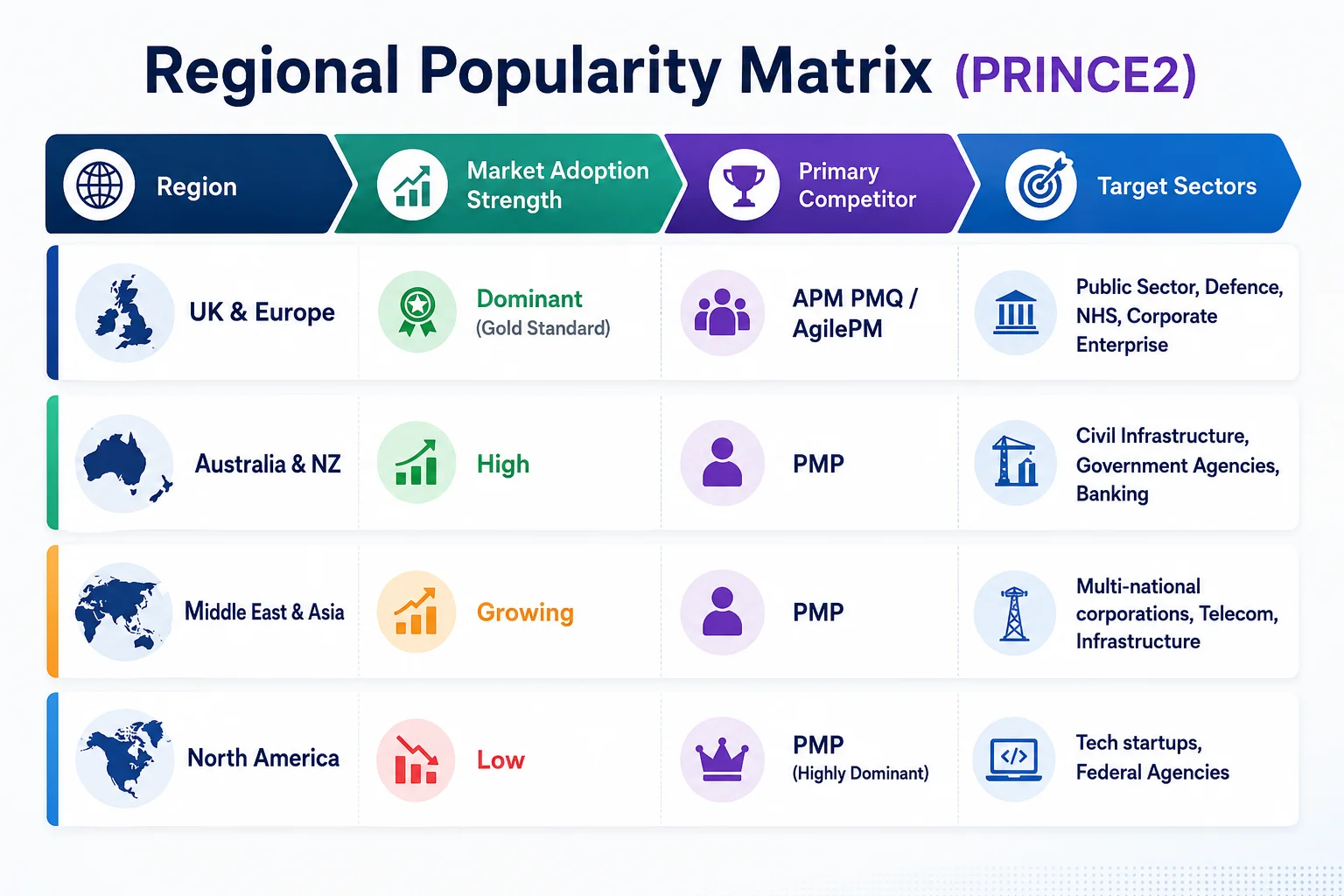
Regional Popularity Matrix
The hiring data from major platforms like Indeed has indicated the regional demand which is divided as follows:
Sector-by-Sector Utility
Sectors with High ROI: Government organizations, public sector agencies, aerospace industry, civil engineering, telecommunications, and manufacturing. These sectors need thorough phase-gate reviews, structured reporting, and documented accountability.
Sectors with Low ROI: Startups focused purely on technology and digital creative agencies which are small in size. These organizations operate solely through unstructured or continuous agile loops where rigid governance structures can add friction rather than value.
Case Study: Multi-Layered Project Governance in Action
When analyzing actual implementation, the mechanics of PRINCE2 are best seen in the PeopleCert 7th Edition structural blueprints. These architectural guidelines demonstrate how big companies and government organizations insulate their projects from business interruptions.
Problem: Large-scale organizational programs invariably experience cross-disciplinary conflicts, ambiguous responsibilities, and serious "scope creep" where unsanctioned feature additions increase expenditures.
PRINCE2 7th Edition Application: Instead of considering execution as one continuous process, organizations apply the Five Integrated Elements (Principles, People, Practices, Processes, and Project Context). The project is segmented into discrete management phases. At each phase boundary, the project manager needs to show progress to the Project Board, which deliberately takes into account the business, user, and supplier perspectives — before any further budget is released.
Outcome: Through the allocation of distinct tolerances to factors such as cost, time, and quality (Management by Exception concept), the day-to-day delivery team works with maximum autonomy. At the same time, the executive stakeholders have complete veto power at fixed date reviews. This hierarchy successfully bridges the gap between executive oversight and technical team execution.
Comparative Analysis: PRINCE2 vs. Competitors (2026 Metrics)
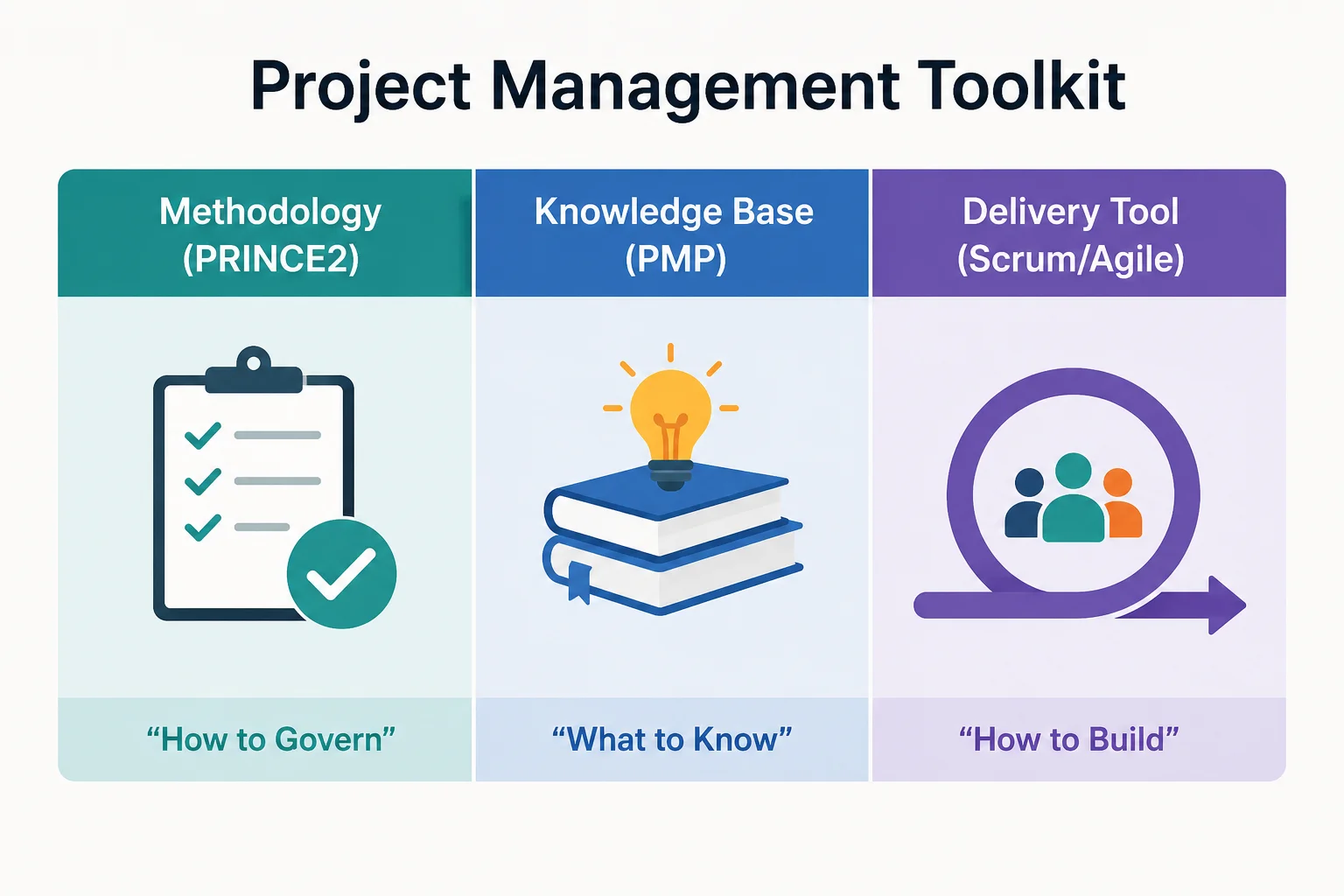
Choosing the appropriate certification path will depend upon whether the organization requires a knowledge-based, governance-based, or iterative delivery-based approach to managing projects.
The table below presents a side-by-side comparison between the dominant global project management credentials:
Evaluation Attribute | PRINCE2 (7th Edition) | PMP (Project Management Professional) | Agile / Scrum (e.g., CSM, PSM) |
Core Classification | Process-based Methodology | Comprehensive Knowledge Base | Iterative Delivery Toolkit |
Primary Philosophy | "How to Govern & Control" | "What to Know & Understand" | "How to Build & Adapt" |
Structural Focus | Defines exact roles, steps, processes, and mandatory documentation templates. | Evaluates broad domains (People, Process, Business Environment) without a fixed step-by-step process. | Focuses entirely on team-level execution, velocity, and rapid feedback loops. |
Business Case Focus | Mandatory. Projects must be shut down if the business case loses commercial viability. | Mentioned as a critical input, but lacks a built-in process for ongoing executive review. | Implicitly managed through the Product Backlog, but lacks formal corporate governance. |
Geographic Dominance | UK, Europe, Australia, and New Zealand | North America, Middle East, and parts of Asia. | Global (highly concentrated in technology and product startups). |
Mandatory Training Hours | None | 35 Hours (Contact Hours) | 21 Hours (For PMI-ACP); For Scrum - it requires a mandatory 14–16 hour (2-day) training course for CSM, whereas PSM has no mandatory training hours and can be fully self-studied. |
Prerequisites | None for Foundation level. Direct entry path for career switchers. | Requires 36-60 months of unique project leadership experience + a 4-year degree. | None. Requires attending a short 2-day course for foundational certifications. |
Renewal Cycle | 3 Years (via exam or logging 20 annual CPD points via PeopleCert Plus). | 3 Years (via logging 60 Professional Development Units (PDUs) via PMI). | 2 Years (via small fee or logging Continuing Education units, varying by body). |
Final Verdict: Should You Get Certified?
The PRINCE2 certification remains a highly effective career tool. However, it is not a universal fit. The investment of time and capital yields the highest return for specific professional paths:
Career Stage Match
Entry Level Switchers: Since there are no prerequisite skills needed for Foundation level, it is a clear indicator on your resume that you are aware of structured corporate delivery systems.
Mid-level Practitioners: In case your aim is to become PMO leader or enterprise-wide program manager, Practitioner level will act as a mandatory gatekeeper in corporate job description.
Experienced Professionals: Current project managers can legitimize their experience by taking a certification that recognizes the structured workflows they already use daily.
Market and Industry Match
Geographic Demands: This certification is important for professionals targeting roles within UK, European, Middle Eastern, Australian, or Commonwealth organizations where the framework is heavily embedded.
Regulated Sectors: It is highly valuable if you work in government, defence, aerospace, healthcare, or civil infrastructure fields where fixed process governance, compliance, and strict procurement cultures are non-negotiable.
Who Should Skip It?
Do not invest if you operate purely in flat, decentralized organizations that run solely on continuous development cycles without corporate oversight.
Avoid it if your target market is exclusively North American tech companies, where a PMP or an advanced Scrum Master credential carries greater historical weight.
Latest Blogs
8 Is PRINCE2 Certification Still Worth It in 2026? An Honest ROI Breakdown
 Top 20 Toughest Exams in the World 2026: Students Guide
 $100 Billion AI Automation Boom: Why Businesses Are Investing More in 2026
 CISSP vs. CISA: Which Cybersecurity Certification Controls Your Career?
 What is Continual Learning in AI and Machine Learning?
  What are the Major Benefits of Online DBA Programs?
 CMAT 2027: Exam Date, Syllabus, Exam Pattern, Preparation Tips & FAQs
 Why Is Nursing in Demand in 2026? Trends Driving the Need for More Nurses

Priyank Jha
Priyank is a Senior Content Developer and Strategist at SNVA Veranda. Earlier, he worked as a data scientist, where he gained extensive experience in developing data-driven solutions, advanced analytics, and strategic decision-making processes. His expertise includes data analysis, business intelligence, and implementing data-centric strategies that drive organizational growth and innovation. In addition to his data science experience, Priyank has over 10 years of experience in the banking and financial services sector. He has worked across various roles and operational levels, gaining in-depth knowledge of financial operations, customer service management, and business processes.