

Have you ever wondered what the hardest exam in the world looks like? Not just a tough school test — but an exam so difficult that only a small fraction of people who attempt it actually pass?
In 2026, millions of students around the globe are persevering through textbooks, skipping sleep, and sacrificing weekends for one shot at exams that can change their entire life. Some of these tests have a pass rate below 1%. Some of these exams last multiple days. And a few of them are so legendary that the countries where they are held literally pause air traffic and halt stock markets to let students focus.
This article brings to you the Top 20 Toughest Exams in the World in 2026. These exams have been ranked by difficulty, competition level, pass rates, and real-world impact. Whether you are a student curious about your future or someone who loves a good challenge read on.
What Actually Makes an Exam "The World's Toughest"?
Before we dive into the list of those exams, it is important to mention that a difficult exam does not necessarily have to comprise complex questions. The world's hardest exams share a combination of factors that are quite important:
Cut-throat competition — millions of applicants competing for only several hundred places
Low pass rates — sometimes less than 1% pass the exam
Vast syllabus — years of content is compressed into a few hours of testing
High stakes — in many cases one's future career and even social status depend on a single result
Prolonged preparation period — some of the exams require studying for 2 to 6 years
Taking all this into consideration, here is the list of top 20 World's Toughest Exams of 2026.
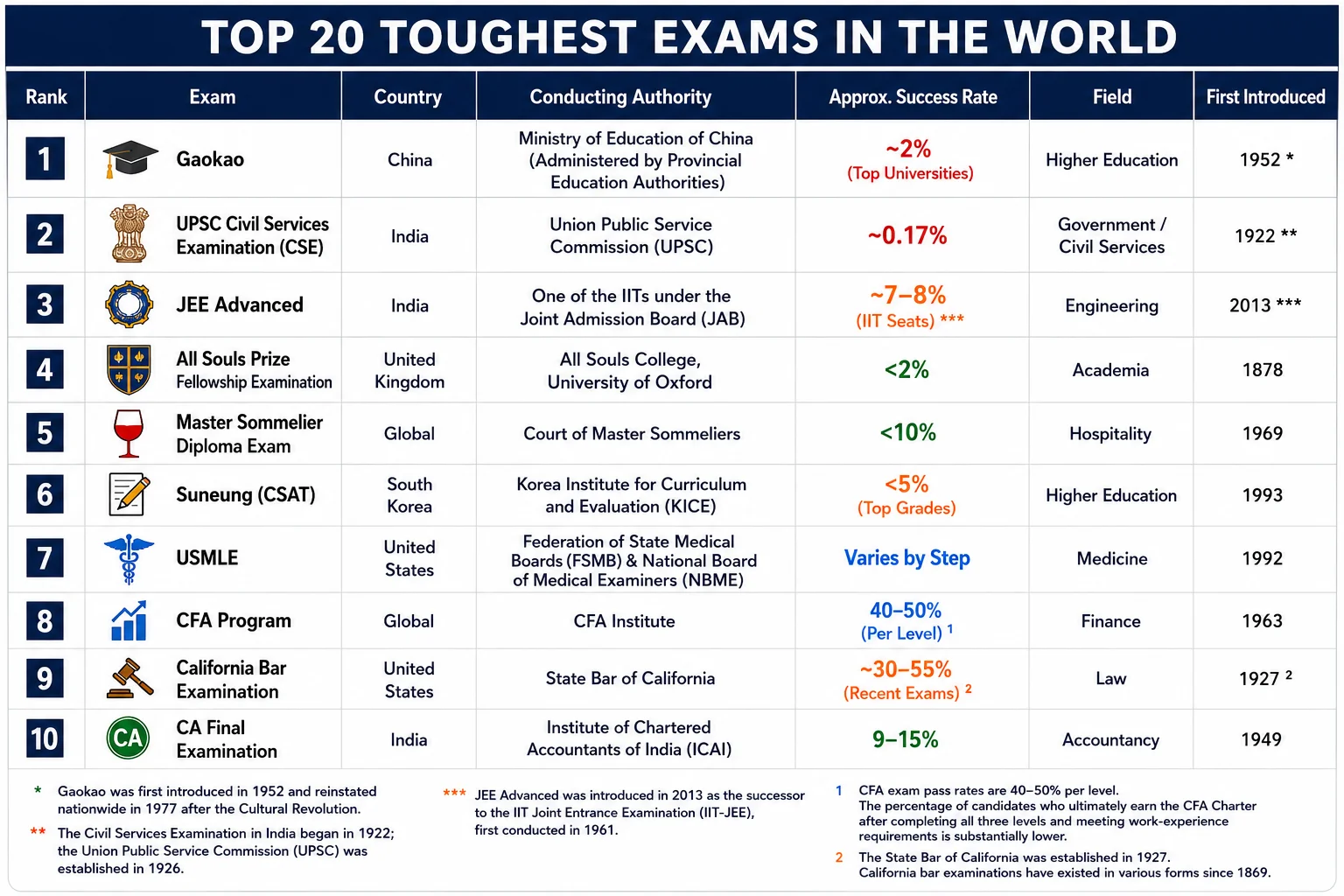
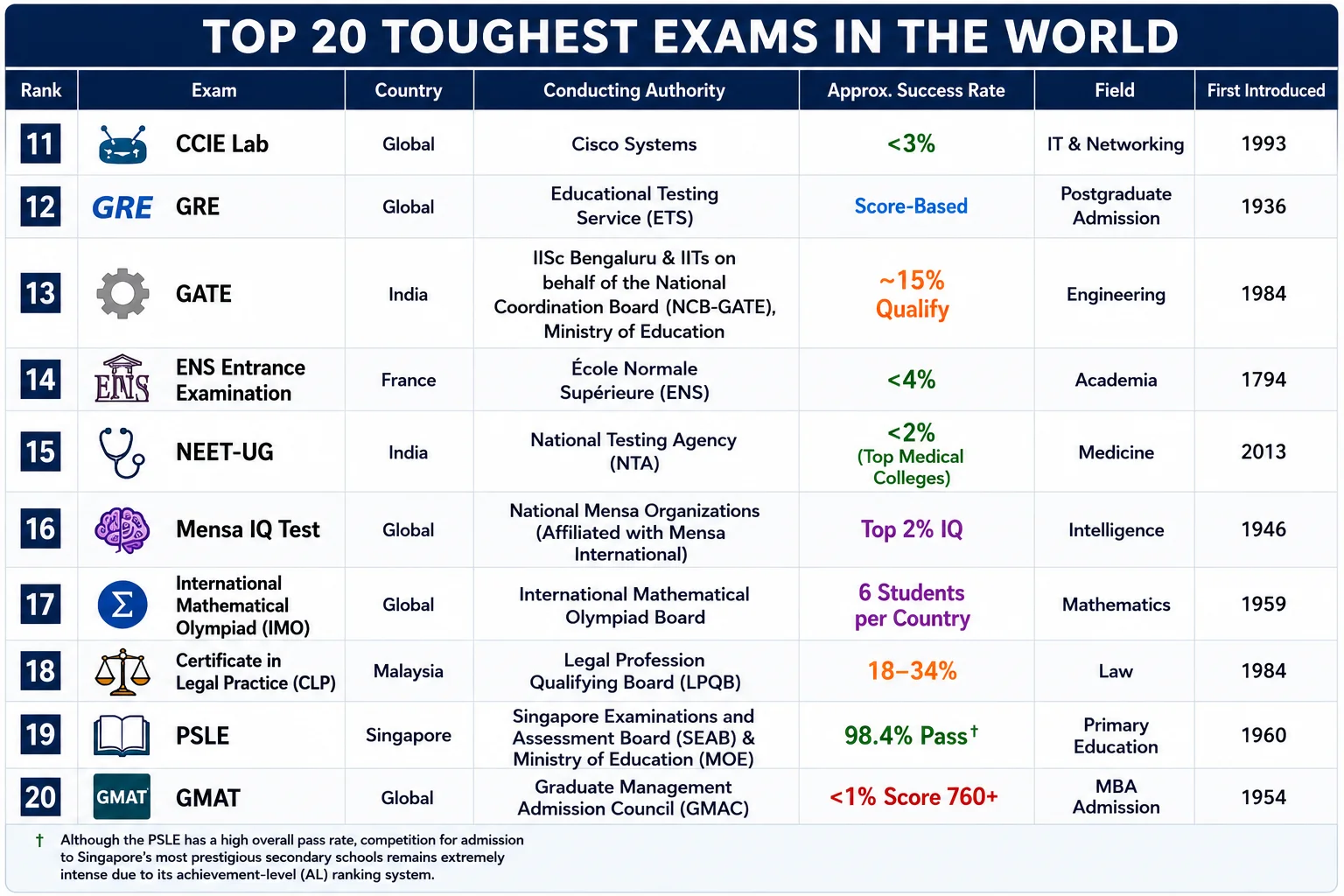
Top 20 Toughest Exams in the World (2026)
1. Gaokao — China
Pass Rate for Elite Universities: Less than 2%
The one test that determines the future of students in China is the Gaokao. Every year, more than 13 million students compete for a few slots at the best universities in China. The test spans two days and covers Chinese, Mathematics, Foreign Language, and specialization-based subjects. Marked out of 750, students need around 600 plus marks to get into some of the best universities. The competition is so stiff that very few manage to make it into universities such as Tsinghua and Peking University. Noise restrictions are applied throughout the country during this test period.
The Gaokao was first held on August 15–17, 1952. It has shaped the fate of Chinese society for over 70 years.
2. UPSC Civil Services Examination (CSE) — India
Pass Rate: 0.17% (approximately)
The UPSC Civil Services Examination (CSE) is the most renowned competitive examination in India, and possibly one of the toughest exams internationally. The UPSC conducts this examination to recruit candidates for the Indian Administrative Service (IAS), Indian Police Service (IPS), and Indian Foreign Service (IFS).
More than 10 lakh (1 million) students apply annually, but only 1,009 make it to the finish line, which is only 0.17% success rate. The examination is conducted in three rigorous stages:
Prelims: Objective type exam with negative marking
Mains: Nine descriptive exams on history, polity, economics, ethics, and much more
Interview: A personality test in front of a panel of senior officials
An aspiring UPSC candidate studies almost 10-12 hours a day for a period ranging from 12 to 18 months — roughly 1,500 to 2,500 hours of preparation in total. The syllabus is so enormous that it could be equated to an entire library. Still, every year there are lakhs of bright brains in India who undergo this exam, and this is all because of the immense reward attached to this exam. An IAS officer holds power, prestige, and the ability to change millions of lives.
3. JEE Advanced — India
Acceptance Rate to Top IITs: Under 7 to 8%
There is one engineering entrance examination that sets the benchmark for academic excellence in India and that is JEE Advanced. This examination presents an opportunity for the candidate to be eligible for admission into the esteemed IITs (Indian Institute of Technology). This is considered to be one of the hardest engineering entrance exams worldwide.
In 2026, the number of students who registered for the JEE Main examination stood at 15,38,468. Out of those, only 1,79,694 candidates qualified for the JEE Advanced examination. And out of those, only 56,880 were able to clear the examination while qualifying in IIT's computer science branch is extremely tough. This exam tests Physics, Chemistry, and Math well beyond the school syllabus, testing concepts, speed, and problem-solving, and not mugging up. The preparation for this exam usually starts at the 9th or 10th class level with about 4 to 6 hours of study per day.
4. All Souls Prize Fellowship Examination — Oxford University, UK
Pass Rate: Under 2% (only 2 selected from 150+ candidates)
This is perhaps the most unusual exam on this list, and arguably the most intellectually intense one in the world. Every year, the All Souls College at Oxford University selects its alumni for only two positions known as "Examination Fellowships" from among 150+ highly talented individuals.
Guess the reward? An exclusive paid fellowship of seven years that provides all the benefits such as free boarding, lodging, stipend, and everything else to help you conduct research work — in short, the academic equivalent of winning a jackpot.
The exam is conducted over two days. It includes four three-hour written papers. During earlier years, it famously featured one-word essay questions. In this, candidates were given a single word like — "Miracles," "Water," or "Innocence" — and they had to write a coherent, original, brilliant essay for three hours.
The questions test candidates not on their knowledge, but on how brilliantly they can think. Since 1438, only about 85 Examination Fellows have been elected. Former Fellows include Sir Isaiah Berlin (founder of the study of intellectual history) and a number of British cabinet ministers.
5. Master Sommelier Diploma Exam — USA/Global
Pass Rate: Under 10% (historically less than 300 Masters exist worldwide)
This exam surprises people. A Wine Exam — featuring in the list of top toughest exams in the world?
Yes. The Master Sommelier Diploma Exam is widely recognized as the hardest professional certification exam on the planet. It is conducted by the Court of Master Sommeliers. It has three components — a theory exam, a practical service exam, and a blind tasting section where candidates must correctly identify six wines within 25 minutes. This includes identifying grape variety, region, vintage year, and quality level.
Very few people have passed this exam — 269 in total. This is even less than those who have travelled to space. The passing rate is less than 10%, and some years nobody passes. Candidates face a fast, oral theory test and tricky questions from judges.
6. Suneung (College of Scholastic Ability Test) — South Korea
Pass Rate for Top Grades: Under 5%
Suneung, in South Korea, is a 9-hour long, single-day national exam. It is held every year in November that determines university admissions, career paths, and social standing. The stakes in this exam are so high that the South Korean government takes extreme precautions on exam day:
Air traffic is suspended briefly near testing centres to reduce noise
Military exercises are halted
Banks and stock markets open late to reduce traffic congestion
Ambulances are placed on standby outside every testing center
Police officers patrol the streets on motorcycles to rush students who are late to their testing centres
In the 2025 Suneung, only 11 students from the entire pool of candidates achieved the highest possible score. Only 3.11% achieved the top English grade, which is the lowest since 2018. For millions of Korean families, everything rides on this one day. The English section features passages so complex, covering topics like Immanuel Kant's philosophy — that even native English speakers struggle to solve them.
7. United States Medical Licensing Examination (USMLE) — USA
Preparation Time: 4–6 years across all steps
The USMLE is not one exam. It is a multi-step marathon that takes years to complete. Medical graduates who want to practice medicine in the United States must clear three separate steps:
Step 1: Basic medical sciences (requires 12-18 months of dedicated prep)
Step 2 CK: Clinical knowledge and patient management
Step 3: Applied clinical reasoning and independent practice
The pass rate for international medical graduates is significantly lower than for US graduates, and clearing all steps still doesn't guarantee a residency position in America. The USMLE is grueling not because of one hard day, but because it demands sustained excellence over years.
8. Chartered Financial Analyst (CFA) — Global
Overall Pass Rate (All Levels): Under 20%
The CFA is the gold standard for finance professionals globally. Managed by the CFA Institute, this exam comes in three levels, and candidates must pass all three to earn the coveted CFA charter.
Level I pass rate: approximately 37–45%
Level II pass rate: approximately 45%
Level III pass rate: approximately 56%
But those numbers are deceptive. The real challenge, however, is the cumulative pass rate across all three levels (factoring in dropouts and repeat attempts) which is below 20%. Most candidates take 4 to 6 years to finish the full program. The CFA Institute keeps its exact passing scores completely secret, using a "black box" grading method — providing candidates with performance charts relative to the minimum passing score rather than exact numerical scores.
CFA charterholders are considered the elite of investment banking and asset management. Officially, mid-career global charterholders make a median of $145,000 USD.
9. California Bar Examination — USA
Pass Rate: 40–50% (one of the lowest in the US)
Among all 50 US states, California has the toughest bar exam. It spans two days and includes — essay questions, performance tests, and MCQs covering all major disciplines of law. In recent times, the pass rate has hovered around 40–50%. It sounds reasonable until you realize the people sitting for it are all law school graduates. Notably, California rejects the Uniform Bar Exam (UBE), meaning the exam cannot be transferred to other states, and it offers a rare "Law Office Study Program" loophole allowed under specific training conditions. This test breaks the confidence of top law graduates, delays their careers, and has even caused lawsuits over its extreme grading. Passing it is a major badge of honour in the legal world.
10. ICAI CA Final Examination — India
Pass Rate: Approximately 9–15%
India's Chartered Accountancy (CA) Final Exam, conducted by the Institute of Chartered Accountants of India (ICAI), is another hardest professional examination in Asia. The exam tests advanced financial reporting, auditing, law, and taxation — and it has a pass rate that regularly remains in single digits.
The difficulty is amplified because candidates must pass all papers in a specific "group" simultaneously. Failing in one subject by a single mark wipes out the scores of all other cleared papers in that group, thus forcing a complete restart of the attempt.
Moreover, the ICAI has recently transitioned from bi-annual testing to a thrice-yearly cycle — it is held every January, May, and September — to handle huge backlog and reduce waiting times for repeating candidates. Becoming a CA in India remains a mark of extraordinary intellectual discipline and numerical precision.
11. Cisco Certified International Expert (CCIE) — Global
Lab Exam Pass Rate: Under 3%
In the world of IT networking, the CCIE is the highest and most respected certification issued by Cisco systems. The exam consists of two parts — a written test and an 8-hour practical lab exam where candidates must configure and troubleshoot actual network setups. Additionally, the pressure is intensified by Cisco's "Blind Grading" engine". This is an automated script that scans the final network configuration at the end of 8 hours. If the script detects even a single misplaced semicolon or a one-second delay in data routing, it instantly triggers a failing grade without any human review or partial credit. Only a few thousand professionals globally hold this certification, and it is considered by top tech firms as proof of elite-level networking expertise.
12. Graduate Record Examination (GRE) — Global
Accepted by 1,300+ universities; Highly competitive for top-tier programs
GRE is a global test for university master's and PhD programs. It evaluates your vocabulary, math skills, and analytical writing. The exam is adaptive: as you answer questions correctly, the computer automatically makes the next set of questions significantly harder to test your absolute limits.
A distinguishing factor about the GRE test is the "Score Select" feature, which enables the test taker to exclude his or her worst performance and submit only the best scores to universities. For the highly technical programs at schools like MIT and Stanford, a near-perfect math score is the baseline requirement. Despite being easy high-school-level mathematics and algebra questions, the test is deliberately set up using linguistic traps to trick smart students into making simple mistakes under tight time pressure.
13. Graduate Aptitude Test in Engineering (GATE) — India
Qualifying Rate: About 15% (but top ranks are incredibly competitive)
GATE is India's premier national test for engineering graduates. It acts as a dual gateway — it selects students for advanced master's degrees (M.Tech) at elite institutions such as the IITs, and functions as the direct hiring test for lucrative government jobs at Public Sector Undertakings (PSUs). Over 10 lakh candidates registered in the recent exam cycle to compete for a tiny pool of openings.
A unique aspect of GATE is its extreme "Rank Inflation Trap." Simply clearing the qualifying cutoff is virtually meaningless. Because top IITs and PSUs only accept the highest percentiles, losing just half a mark can destroy your chances of an interview, forcing thousands to retake the test.
14. ENS Entrance Examination — France
Pass Rate: Under 4%
France's École Nôrmale Supérieure (ENS) entrance exam is Europe's toughest academic test. Aspirants must complete two years of intensive preparatory classes before they can even sit for the exam. The preparation covers — advanced mathematics, science, literature, philosophy, or social sciences. Winners earn the prestigious title of Normalien élève — a status that marks them as part of France's intellectual elite.
Paid Students: Passing makes you a French civil servant. The state pays you a monthly salary of around €1,300 to €1,500 just to attend college.
The 10-Year Bond: You must sign a contract to work for the French government for 10 years. If you quit early, you must repay all your stipend money.
6-Hour Exams: The written section includes legendary endurance tests, like a 6-hour advanced mathematics paper consisting of highly complex proof questions.
15. NEET (National Eligibility cum Entrance Test) — India
Success Rate for Top Medical Colleges: Under 2%
India's NEET Exam determines admission to medical colleges across India. With over 2.4 million candidates appearing each year and only about 0.108 million MBBS seats available in total, the competition is overwhelming. For top government medical colleges like AIIMS or JIPMER, the effective acceptance rate drops below 1–2%. NEET is often compared to JEE Advanced in terms of preparation intensity, though its single-stage format means one bad day can end everything.
Tie-Breaker Lottery: Scoring a perfect 720/720 no longer assures the top rank. Dozens of students achieve perfect scores simultaneously, forcing NTA to use an automated random draw to break the tie.
5-Mark Drop: A single wrong guess or one mistake instantly drops your national rank by over 10,000 positions.
60-Second Circle: Candidates have less than 60 seconds per question to read, solve, and ink the OMR bubble sheet with zero room for error.
16. Mensa International IQ Test — Global
Eligibility: Top 2% of the world's population
Mensa IQ Test is not a career exam, but it is one of the world's hardest tests of pure intelligence. To join, candidates must score in the top 2% of the general population on a supervised exam. It has no syllabus and measures raw logic, pattern recognition, and fluid intelligence.
Culture-Free Rule: To remain completely fair across all countries and languages, the test uses zero words or numbers, depending completely on visual geometric puzzles.
Age Curve: It uses an age-adjusted grading system. Your raw score requirement changes based on your biological age to keep the playing field level.
Moving Target: The test is regularly recalibrated over time. As human intelligence averages shift, the questions are updated so that only the top 2% can ever pass.
17. International Mathematical Olympiad (IMO) — Global
Selection: Top 6 students per country from millions
IMO is the premier math competition for pre-university students. In this, teams of six represent over 110 countries, after surviving intense national eliminations. Over two days, contestants spend 4.5 hours daily solving six incredibly difficult problems in algebra, geometry, combinatorics, and number theory. Countries like India, China, South Korea, and the USA completely dominate the rankings.
Unsolved Problem: In 1988, "Question 6" was so complex that the elite mathematicians on the exam committee could not solve it. Yet, eleven genius teenagers scored perfect marks on it.
Zero Club: The test is so difficult that more than half of these national champions fail to solve even a single complete question, leaving them with a score of zero.
Genius Pipeline: IMO acts as a scout for world-class talent. Over half of all Fields Medal winners — the Nobel Prize equivalent for math — were youthful IMO medalists.
18. CLP (Certificate in Legal Practice) — Malaysia
Pass Rate: Declining sharply (approx. 18% to 34% depending on the cycle)
Malaysia's CLP exam, run by the Legal Profession Qualifying Board (LPQB), is a mandatory post-graduation test required to practice private law in the country. It covers dense subjects like civil procedure, criminal procedure, evidence, and ethics. Recent exam cycles have recorded historic lows, with the initial full pass rate plunging to a staggering 18.4% as the exam faces a total structural phase-out.
The Reset Rule: If you fail just two out of the five papers, it will immediately cancel your passing scores on the other three, forcing you to retake the entire exam from scratch.
Four-Strike Limit: Candidates get a strict maximum of four attempts. If you fail all four, it will permanently lock your law degree out of private local practice.
Upcoming Phase-Out: The Malaysian Government is formally scrapping the CLP exam. LPQB is replacing it with a new, practice-oriented vocational framework — the New Bar Course (NBC) — into the legal profession.
19. PSLE (Primary School Leaving Examination) — Singapore
Difficulty Level: Internationally recognized as uniquely intense for primary school
The exam, taken by 12-year-olds, determines secondary school placement and shapes long-term career paths. While Singapore's premier education system yields a 98.4% pass rate, the math portion deliberately includes highly complex logic problems, placing immense competitive pressure on young children.
Viral Questions: The math paper regularly features logic puzzles so exceptionally difficult they cause widespread parental outrage and trend on social media. Past questions about the weight of plastic coins or ribbon patterns have driven even the best students to tears.
Precise AL Scale: Singapore uses a strict Achievement Level (AL) scoring system from AL1 to AL8. Missing a top score by just one mark can completely bar a student from entering their preferred elite secondary school.
20. GMAT (Graduate Management Admission Test) — Global
Top Score Achievers: Under 1% score 760+
The GMAT is the preferred admission test for the world's top MBA programs — Harvard Business School, Wharton, INSEAD, and London Business School all rely heavily on GMAT scores. The exam tests integrated reasoning, quantitative ability, verbal reasoning, and analytical writing.
The scoring range is 200–800. A score above 760 places a candidate in the 99th percentile, and fewer than 1% of test-takers achieve this. For aspirants targeting M7 business schools in the US, average GMAT scores remain above 720 — meaning even above-average performers don’t qualify the exam.
Final Word: Every Hard Exam Was Once Impossible to Someone
The toughest exams in the world today — UPSC, JEE Advanced, and even the Master Sommelier Diploma — are not just academic tests. They can also be seen as psychological endurance experiments, which seek to break down your spirit before building it up. Every single topper started exactly where you are standing right now:: looking at what seems impossible, filled with self-doubt, and thinking if one can make it through.
These exams are not searching for perfection; they are searching for those few who would continue to fight regardless of the unfavorable conditions. The decision to take on the challenge does not only mean you are chasing a prestigious title or a high-paying career, but also means undergoing a process that would turn you into a stronger and unbeatable individual.
Latest Blogs
8 Top 20 Toughest Exams in the World 2026: Students Guide
 $100 Billion AI Automation Boom: Why Businesses Are Investing More in 2026
 CISSP vs. CISA: Which Cybersecurity Certification Controls Your Career?
 What is Continual Learning in AI and Machine Learning?
  What are the Major Benefits of Online DBA Programs?
 CMAT 2027: Exam Date, Syllabus, Exam Pattern, Preparation Tips & FAQs
 Why Is Nursing in Demand in 2026? Trends Driving the Need for More Nurses
 Why more Indian Students are Opting for Doctoral Degrees

Priyank Jha
Priyank is a Senior Content Developer and Strategist at SNVA Veranda. Earlier, he worked as a data scientist, where he gained extensive experience in developing data-driven solutions, advanced analytics, and strategic decision-making processes. His expertise includes data analysis, business intelligence, and implementing data-centric strategies that drive organizational growth and innovation. In addition to his data science experience, Priyank has over 10 years of experience in the banking and financial services sector. He has worked across various roles and operational levels, gaining in-depth knowledge of financial operations, customer service management, and business processes.