


Bachelor of Science in Computer Science
Duration
Learning Mode
Total ECTS
Career Scope
Selected Course
Bachelor of Science in Computer Science
Computer science is at the centre of the global digital revolution. The U.S. Bureau of Labor Statistics projects a 22% growth in software development roles and a 35% growth in AI and cybersecurity roles through 2032, far faster than average. Businesses and organisations increasingly rely on software, data analytics, AI, and secure systems, making tech professionals highly sought after.
The EIMT Bachelor of Science in Computer Science equips you to meet this demand with a modern, industry-aligned curriculum. Over 36 months, you learn:
Core Programming Skills – Master multiple languages, including Python, Java, and C++.
Data Structures & Algorithms – Build efficient solutions for complex problems.
Artificial Intelligence & Machine Learning – Develop predictive models and intelligent applications.
Cybersecurity Fundamentals – Secure systems and protect sensitive data.
Software & Systems Development – Design, test, and deploy real-world applications.
Data Analytics & Visualisation – Transform raw data into actionable insights.
The program emphasises hands-on experience through projects, case studies, and the Professional Pathway Scheme, where you gain practical skills while earning work experience. This ensures graduates leave with job-ready capabilities.
Technology is everywhere, and those who understand it shape the future. Studying computer science at EIMT prepares you for the jobs of tomorrow, roles, and industries that are just beginning to grow. You’ll learn to solve real problems, build solutions, and create opportunities for yourself.
BSc in Computer Science from EIMT
Develop Skills Today. Shape the Technology of Tomorrow.

Transform Your Interest into Expertise
Turn your curiosity about technology into a strong foundation for a career. The EIMT Bachelor of Science in Computer Science equips you with in-demand knowledge and practical experience to thrive in the evolving tech industry.

Acquire Skills that Drive Career Success
Gain hands-on experience in programming, artificial intelligence, machine learning, cybersecurity, and software development. Learn to apply concepts to real-world projects, preparing you to meet the expectations of employers today and tomorrow.
Flexible Learning to Fit Your Schedule
The fully online program allows you to study from anywhere while balancing work, internships, or other commitments. Structured modules and clear guidance ensure you progress steadily without disrupting your routine.

Access Diverse Career Opportunities
Graduates qualify for roles such as Software Developer, AI Engineer, Cybersecurity Analyst, Systems Architect, and more. The degree also provides a strong foundation for advanced certifications or further academic studies in technology.

The EIMT Bachelor of Science in Computer Science is a 36-month (3-year), 180 ECTS module-based program that follows a structured learning path from foundational concepts to advanced technologies. The curriculum covers programming, software development, database management, networking, cybersecurity, artificial intelligence, and machine learning, along with practical application of Python, Java, and web technologies.
As you progress, you engage in hands-on projects, system design exercises, and real-world problem-solving, gaining experience in software engineering, data analysis, and IT security. The program emphasizes applied learning through assignments, case studies, and the capstone project, helping you build technical expertise and professional skills that align with the demands of the modern technology industry.
Learn the basics of computing, including hardware, software, and essential IT concepts that form the foundation of all computer science knowledge.
Explore the principles of computer networks, communication protocols, and networking systems to understand how data flows and is managed across devices.
Understand how to design, implement, and manage relational databases using SQL, preparing you to handle large volumes of data efficiently.
Develop skills to create responsive web and mobile applications, combining front-end and back-end development techniques.
Build a solid foundation in programming logic, problem-solving, and algorithm design to write effective and efficient code.
Learn software development life cycles, project planning, and best practices to deliver high-quality software solutions.
Master Object-Oriented Programming using Java, focusing on classes, objects, inheritance, and encapsulation.
Examine how information systems support business operations and decision-making, linking technology with organizational strategy.
Dive into network architecture, protocols, and management strategies to ensure secure and efficient communication across systems.
Learn essential cybersecurity principles, including threat detection, prevention techniques, and system protection strategies.
Gain hands-on experience in Python programming, covering scripting, data manipulation, and building simple applications.
Study the mathematical foundations required for computing, including logic, discrete mathematics, probability, and statistics.
Explore big data technologies, storage systems, and analytical techniques to manage and interpret large datasets effectively.
Understand encryption, decryption, and secure communication methods to protect sensitive information in digital systems.
Learn how AI and data science intersect, using algorithms and models to extract insights and make predictions from data.
Study strategies and tools to secure data, comply with privacy regulations, and protect information assets.
Examine global security standards and compliance frameworks to ensure systems and processes meet industry requirements.
Learn how IoT devices communicate, integrate with networks, and provide smart solutions in everyday life and industry.
Build predictive and analytical models using supervised and unsupervised machine learning techniques for practical applications.
Develop efficient solutions for complex problems by mastering core data structures and algorithm design.
Understand methods to secure web applications, including common vulnerabilities and protective measures.
Apply mathematical methods to model computational and real-world problems, enhancing analytical and problem-solving skills.
Discover the principles of quantum computing and explore how it can revolutionize problem-solving in computing.
Learn how to analyze system requirements and design software solutions that are effective, scalable, and maintainable.
Understand blockchain technology, cryptographic security, and how decentralized ledgers are applied in real-world scenarios.
Acquire skills to plan, execute, and manage IT projects, balancing time, resources, and quality effectively.
Explore online business models, platforms, and secure digital transactions to understand the digital marketplace.
Learn to capture, organise, and utilise organisational knowledge to improve decision-making and operational efficiency.
Apply all the concepts learned throughout the program to a comprehensive project, simulating real-world challenges and solutions in computer science.

Our 5-step admission process ensures a smooth journey from application to enrollment. Complete each step at your own pace.
Internationally Recognised Accreditation and Quality Standards
The EIMT Bachelor of Science in Computer Science is fully accredited by QAHE, certified under ISO/IEC 40180:2017, and aligns with global quality benchmarks for higher education. These recognitions ensure your degree meets rigorous academic standards and carries international credibility.
Memberships in Leading Education Associations
EIMT holds memberships with EURASHE, the United States Distance Learning Association (USDLA), and the Association for Transnational Higher Education Accreditation (ATHEA), demonstrating its commitment to professional higher education, distance learning excellence, and global quality assurance.
European Recognition and Global Credit Transfer
EIMT programs, including the Bachelor of Science in Computer Science, are aligned with the European Higher Education Area (EHEA) and the Bologna Process, ensuring adherence to European quality standards. Degrees are recognised under the European Qualifications Framework (EQF) and accredited by the Malta Further & Higher Education Authority (MFHEA), providing globally respected credentials and smooth international credit transfer options.
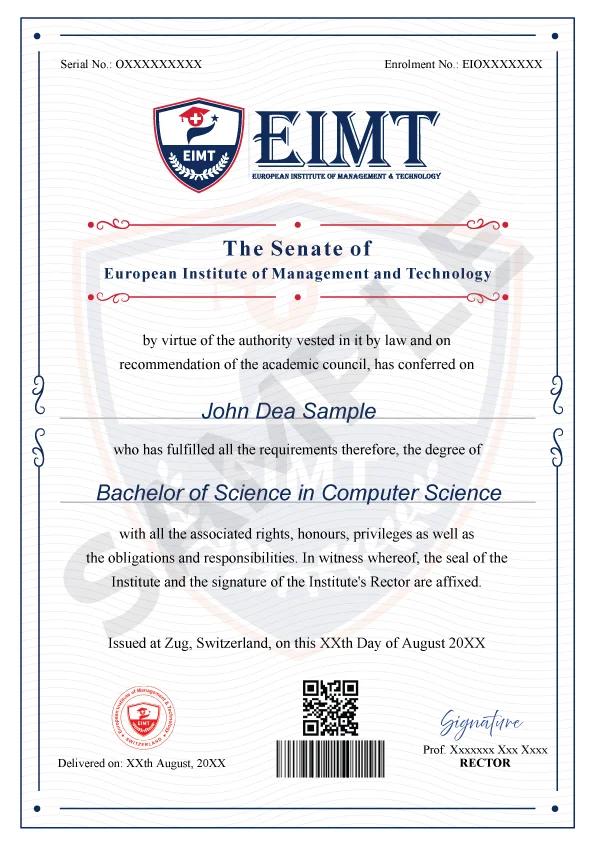
Ready to Earn Your Certificate?
Join thousands who have advanced their careers with our recognized certification.











- 20 June 2026
- TechnologyComputer ScienceArtificial Intelligence

- 13 June 2026
- TechnologyCyber Security
- 12 June 2026
- TechnologyData ScienceArtificial Intelligence