
Choosing the right cybersecurity or IT audit credential can feel like a monumental task. Two of the most respected heavyweights in the industry are: CISSP and CISA. Although they sound similar, yet they serve completely different roles in the career world.
Major Difference: CISSP focuses primarily on designing, implementing, and engineering an entire enterprise Cybersecurity Program. Whereas, CISA concentrates exclusively on evaluating, auditing, and reporting on the performance of existing security controls and their effectiveness.
Target Careers: CISSP is ideal for engineering, operational, and leadership positions such as Security Architect, Security Analyst, or CISO. On the other hand, CISA suits compliance, risk assessment, and evaluation positions such as IT Auditor or Compliance Manager.
Governing Bodies: ISC2 issues the CISSP certification, whereas ISACA issues the CISA certification.
Work Prerequisites: Both these credentials require 5 years of professional experience in relevant domains, though both offer specific education waivers to reduce this timeline.
Exam Format: CISSP uses an adaptive testing system (100–150 dynamic questions), while CISA uses a standard linear testing system (150 fixed questions).
Final Verdict: Get CISSP if you want to build and defend secure networks. Get CISA if you want to inspect systems, manage compliance frameworks, and interface with financial or regulatory auditors.
CISSP vs. CISA at a Glance
The fundamental difference between these two certifications comes down to organizational function and reporting structures.
CISSP: Security Builder
CISSP certification is administered by ISC2. And it is considered as the gold standard of cybersecurity management and engineering. The main reason for taking the CISSP exam is to validate that the individual has both knowledge and management capabilities to create, implement, manage, and maintain a world-class security infrastructure within the organization. The person holding CISSP generally reports to either the IT hierarchy or security hierarchy, like Director of Information Security/Chief Information Security Officer.
CISA: Independent Evaluator
A certification program administered by the Information Systems Audit and Control Association, CISA is the foremost international standard for IT audit, assurance, and security. A CISA professional would ask how a system can be independently verified to function securely, legally, and effectively. In order to maintain objectivity, CISA professionals usually report information outside of the IT line of business altogether. They provide information directly to the company’s internal auditing department or risk committee, or directly to the corporate board's audit committee.
In situations where a major cloud database needs to be secured, the CISSP selects the encryption algorithm, configures the identity and access management (IAM) roles, and monitors for active breaches. The CISA, meanwhile, will request the configuration log and compare that with the regulatory frameworks like HIPAA, GDPR, or SOC 2 and report back to executive stakeholders on any control deficiencies
Let’s have a look into the major differences between CISSP and CISA:
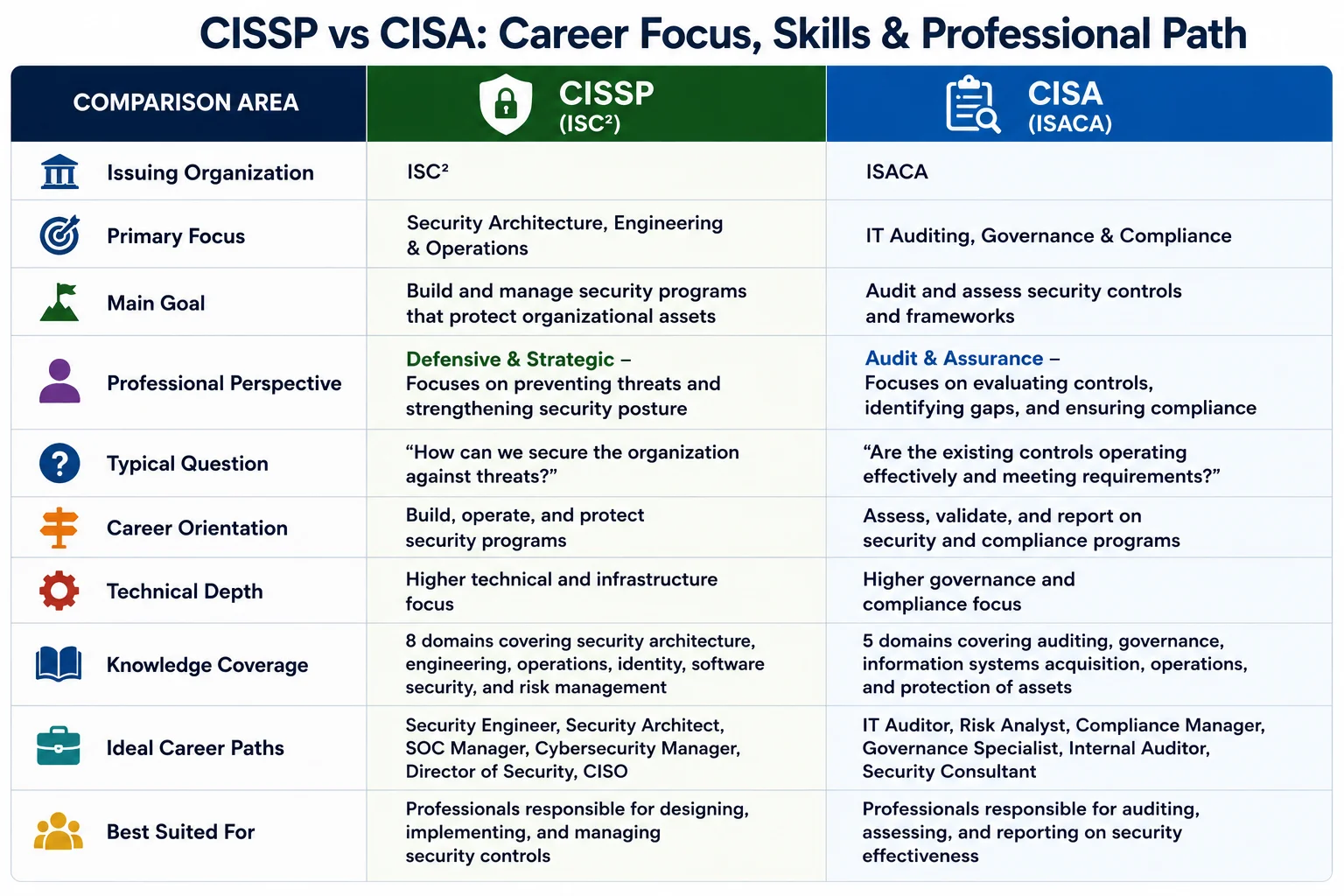
Important Metrics: Governing Bodies, Costs, and Prerequisites
You can check the comparison between CISSP and CISA on basis of exam structure, eligibility, and certification costs:
Comparison Area | CISSP (ISC²) | CISA (ISACA) |
Experience Requirement | 5 years of paid experience in at least 2 CISSP domains | 5 years of professional experience in auditing, control, assurance, or security |
Experience Waivers | Up to 1-year waiver through an approved certification or 4-year degree | Multiple waiver options available for education and relevant experience |
Exam Format | Computerized Adaptive Testing (CAT) | Traditional Computer-Based Testing (CBT) |
Exam Experience | Difficulty adjusts based on previous answers | Same exam structure for all candidates |
Question Navigation | No backtracking; answers are final once submitted | Full navigation available; questions can be flagged and reviewed |
Question Volume | 100–150 questions | 150 questions |
Exam Duration | 3 Hours | 4 Hours |
Passing Score | 700 / 1000 points | 450 / 800 points |
Knowledge Coverage | 8 domains | 5 domains |
Certification Cost | $749 USD | $575 USD (Members) / $760 USD (Non-members) |
Annual Maintenance Fee | $125 USD | $45 USD (Members) + local chapter fees |
1. Governing Bodies (Who issues them?)
CISSP is granted by ISC² or International Information System Security Certification Consortium. It is a global non-profit association that focuses entirely on cyber safety and security.
CISA is granted by ISACA or Information Systems Audit and Control Association. It is an international professional association focused on IT governance, risk management, and auditing.
2. Exam Delivery, Formats, and Costs
The mechanics of taking the exams differ significantly. CISSP is being perceived as a greater test of endurance because of its computer-adaptive nature.
CISSP Testing Experience
CISSP exam uses Computerized Adaptive Testing (CAT). This implies that the test engine assesses your performance dynamically as you answer each question. If your previous answer was correct, you will be presented with a more difficult task next; conversely, in case of an incorrect answer, the test system gives you an easier question, aiming to discover your true limit of knowledge.
In case you answered the previous question correctly, the test system is going to present you with a harder task next. But if your previous answer was wrong, you will be given an easier question, thus aiming to figure out your true limit of knowledge.
Length / Time: There are 100 to 150 questions over a maximum of 4 hours.
Mechanism: You cannot skip questions, return to previous items, or change answers once submitted. The exam can end abruptly at question 100 if the algorithm determines with 95% statistical certainty that you have either passed or failed.
Cost: $749 USD per attempt.
CISA Testing Experience
In the case of CISA exam, it uses a traditional linear testing format. Every candidate receives the same number of items, and the question order is fixed.
Length / Time: This exam involves 150 multiple-choice questions over a 4-hour window.
Mechanism: You can flag questions, skip hard sections, and freely review or modify your answers before submitting the final exam.
Cost: $575 USD for ISACA members; $760 USD for non-members.
3. Certification Prerequisites and Critical Changes
Neither credential allows you to bypass real-world experience requirements. However, recent rule changes have separated these paths further than before.
CISSP Prerequisites
If you wish to gain full CISSP status, you must prove at least five years of cumulative, paid, full-time work experience across two or more of the eight CISSP domains.
Waivers: One year of experience can be waived in case you possess a bachelor’s degree or any relevant certification such as CompTIA Security+, CISM, or CEH.
Important 2026 Update: As of April 1, 2026, ISC2 decided to remove the CISA from the list of credentials eligible for a waiver towards CISSP certification. Holding a CISA will no longer give you a one-year waiver towards CISSP.
Associate Status: Passing the exam with no experience will make you an “Associate of ISC2,” giving you six years to gain the required five years of work experience.
Endorsement Requirement: Once you clear the exam, an active CISSP holder will have to formally endorse your professional experience application.
CISA Prerequisites
To qualify for full CISA certification, five years of practical experience in information systems auditing, control, and/or security must be demonstrated.
Waivers: ISACA offers more generous substitution waivers than ISC2:
A 2-year or 4-year degree can substitute for 1 to 2 years of experience.
One year of full-time information systems experience OR one year of non-IT auditing experience can substitute for 1 year of the requirement.
Timeline: You may appear for the exam without experience, but you must fulfill the experience requirements and apply for certification within five years after clearing the exam.
Note: Both certifications let you substitute a 4-year college degree to waive 1 year of the experience requirement.
In-Depth Analysis: Domain Frameworks
The structural framework of each test clearly indicates the disparity in the scope of work involved.
CISSP Common Body of Knowledge (CBK)
There are eight different domains in the CISSP exam. It requires candidates to show comprehensive, end-to-end knowledge of technical, physical, and administrative security concepts.
Domain | Weight | Core Focus |
1. Security and Risk Management | 15% | Governance, compliance, legal regulations, and risk assessment models. |
2. Asset Security | 10% | Data classification, privacy, retention, and lifecycle protection. |
3. Security Architecture and Engineering | 13% | Cryptography, secure design principles, and physical site security. |
4. Communication and Network Security | 13% | Network infrastructure, secure channels, and IP protocols. |
5. Identity and Access Management (IAM) | 13% | Identification, authentication, authorization, and provisioning cycles. |
6. Security Assessment and Testing | 12% | Vulnerability assessments, penetration testing, and log analysis. |
7. Security Operations | 13% | Incident response, disaster recovery, patch management, and investigations. |
8. Software Development Security | 11% | Secure coding practices, SDLC integration, and software vulnerabilities. |
CISA Job Practice Domains
The blueprint for the CISA examination consists of five practice areas, giving priority to methodologies, asset management, and independent evaluation of evidence.
Domain | Weight | Core Focus |
1. Information System Auditing Process | 18% | Audit standards, risk-based planning, execution, and reporting. |
2. Governance and Management of IT | 18% | IT strategy, organizational structures, KPI monitoring, and HR security. |
3. IS Acquisition, Development, and Implementation | 12% | Project management frameworks, agile/waterfall governance, and post-implementation reviews. |
4. Information Systems Operations & Business Resilience | 26% | System maintenance, service level agreements (SLAs), database management, RTO/RPO, and DRP/BCP testing. |
5. Protection of Information Assets | 26% | Assessing technical controls, encryption standards, virtualization security, and data center physical controls. |
Target Job Roles, Market Demand, and Salary Outlook
Both certifications provide exceptional marketability. However, they point you toward distinct job opportunities and interview pipelines.
CISSP Roles and Compensation
CISSP acts as an unofficial prerequisite for top management and architectural roles. Moreover, it provides explicit job openings for advanced corporate cybersecurity positions.
Typical job titles include
Chief Information Security Officer (CISO)
Security Architect
Information Security Manager
Senior Security Engineer
Cybersecurity Consultant
Median CISSP Salaries
Region | Median CISSP Salary (U.S. $) |
Globally | $127,000 |
Asia-Pacific | $70,000 |
Europe | $106,200 |
North America | $150,000 |
Source: ISC2
CISA Roles and Compensation
For a career in IT auditing, CISA certificate becomes mandatory. If one wants to be employed by any of the Big Four firms (Deloitte, PwC, EY, KPMG), then this certification serves as the bare minimum requirement.
Typical job titles include
IT Auditor
GRC (Governance, Risk, and Compliance) Analyst
Information Systems Audit Manager
Internal Control Specialist
Technology Risk Consultant
CISA Salaries
CISA professionals usually enjoy high stability and good compensation. According to the official average pay reported by ISACA for a CISA professional, it is above $149,000 annually.
Decision Matrix: Which One Should You Choose?
If you are still uncertain about which certification to pursue then analyze your career objectives based on the following considerations:
Choose CISSP if:
Your end objective is to be an enterprise CISO, Security Architect, or Director of Security.
You enjoy working on configuring tools, creating network zones, dealing with firewalls, writing security policies, and coordinating incident responses.
You like to have an all-inclusive approach to operational security involving technology like cryptography and programming as well as administrative risk management.
You wish to stay in the realm of the operational IT and Security department.
Choose CISA If:
You are interested in a career in IT Auditing, Risk Management, Advisory Consulting, or Compliance.
You like looking at business records, analyzing system settings, interviewing administrative staff, and preparing formal audit report findings for management review.
You are comfortable with a technical and analysis-oriented job that entails verifying that the systems meet certain standards such as ISO 27001, COBIT, NIST, or SOX.
Your reporting structure involves organizational independence (e.g., Internal Audit or Risk Management).
Bottom Line
CISSP certification is widely regarded as the most suitable certification for professionals who design, manage, and oversee Cybersecurity Program initiatives. It’s security-oriented, strategic in nature, and broadly technical.
On the other hand, the CISA certification is the most prominent certification for professionals who have their focus on auditing, governance, compliance, risk management, and controls.
In other words, while the CISSP is designed to help you create and safeguard security programs, the CISA cert will help you assess them.
Latest Blogs
8 CISSP vs. CISA: Which Cybersecurity Certification Controls Your Career?
 What is Continual Learning in AI and Machine Learning?
  What are the Major Benefits of Online DBA Programs?
 CMAT 2027: Exam Date, Syllabus, Exam Pattern, Preparation Tips & FAQs
 Why Is Nursing in Demand in 2026? Trends Driving the Need for More Nurses
 Why more Indian Students are Opting for Doctoral Degrees
 ChatGPT Vs Claude (2026 Guide)
 What Is Midjourney AI? A Detailed Guide To The Photorealistic Image Generating Tool

Priyank Jha
Priyank is a Senior Content Developer and Strategist at SNVA Veranda. Earlier, he worked as a data scientist, where he gained extensive experience in developing data-driven solutions, advanced analytics, and strategic decision-making processes. His expertise includes data analysis, business intelligence, and implementing data-centric strategies that drive organizational growth and innovation. In addition to his data science experience, Priyank has over 10 years of experience in the banking and financial services sector. He has worked across various roles and operational levels, gaining in-depth knowledge of financial operations, customer service management, and business processes.