


According to the report by McKinsey, organizations around the world have increased using AI in at least one business function. It is further indicating that the role of AI in industrial application continues to be a long-haul drive, with 78% of global organizations increasing their AI spending and are reportedly planning to double their AI budgets from 0.8% to 1.7% of their total revenues.
No doubt, these events signal a massive corporate shift, revealing the fact that treating AI as an experimental technology is no longer a consideration but has now become a mainstream business strategy for global corporate houses based on how they operate, innovate, and generate revenues.
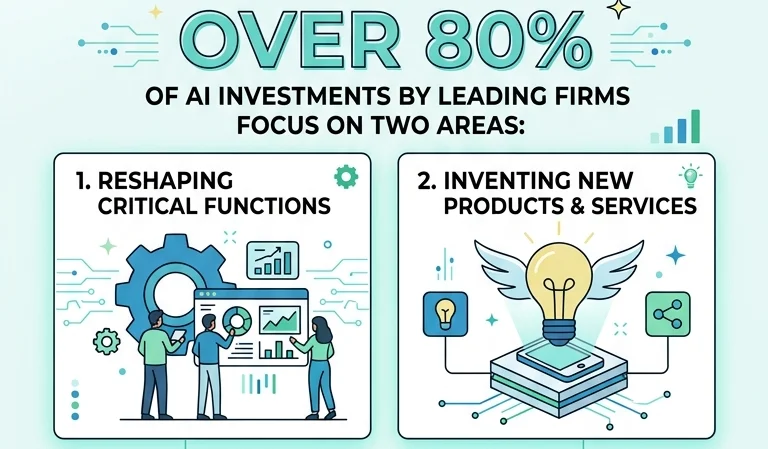
According to the purported Artificial Intelligence spending, it feels that AI is now becoming a single technological paradigm around which companies are consolidating their revenue gains. More like a centrifugal force driving global businesses to prioritize AI at any cost if they want competitive edge. In brief, the groundbreaking technology of artificial intelligence is redefining the mathematics of business efficiency for corporate sections around the world.
The interesting statistics of businesses prioritizing or increasing their AI spending:
According to the Boston Consulting Group (BCG) AI Radar, Companies that are earning more than $500 million in annual revenue are allocating 5% of their total gains on AI initiatives, a new shift from defunding their legacy systems to building AI-powered systems.
AI spending around the world is expected to reach $2.5 trillion in 2026 (source: Gartner).
75% of business leaders rank AI as a top-three strategic priority.
Enterprises are not just adding AI spend, they are actively defunding legacy infrastructure, older hardware and traditional systems management to free the capital.
Companies, which are earning over $500M in revenue, spend nearly 5% of their (not the IT budget) but TOTAL revenue on AI initiatives. It is indicative of how AI is displacing other strategic priorities, not just competing for discretionary technology spend. In simple words, AI is now the new budget priority, not just another IT priority for businesses.
Though businesses are putting more restraints on their budgets in traditional areas, they are aggressively experimenting with as many AI & Gen AI options as possible to gain a competitive edge. (Source: Boston Consulting Group).
55% of enterprises are already deploying AI agents due to economic reasons as they expect ROI of 13.7% from AI agents than 12.6% from non-agentic GenAI.
What is AI spending? An overview of the 2026 business investment landscape
Most people generalize that AI spending is mostly related to when companies invest billions in cutting-edge technology to automatically generate massive profits. This is not like that. AI spending refers to the total financial investments of organizations for the purpose of driving efficiency, reducing costs, and speeding up innovation. It is about building, integrating, scaling and maintaining AI capabilities. AI spending is not very much tied to purchasing technologies and models but it is a sophisticated strategy to upgrade an organization's technology, training the team, refining the work and managing risks.
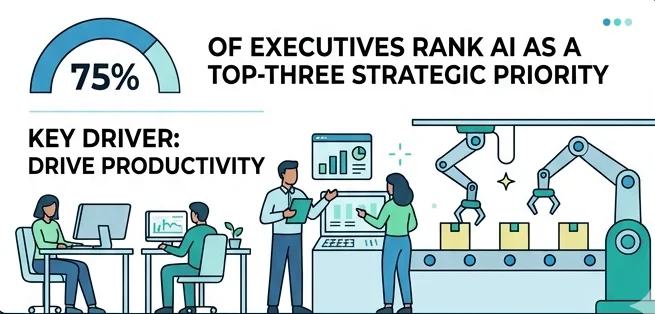
Key aspects of AI spending/investment that collectively drive business value
Operational efficiency and automation: AI investment serves the purpose of automating routine tasks like data entry, document processing, etc. to free up resources and engage them in more creative work.
Improve decision-making and analytics: AI tools are proving extremely handy in analyzing vast amounts of data in real-time, allowing organizations to make highly informed decisions.
Innovating product and service: A major portion of AI investment is meant for reshaping critical functions and innovating new products and services to build a competitive advantage.
Better customer experience (CX): AI spending on NLP (Natural Language Processing) and chatbots allow businesses to deliver high-quality, personalized services to customers, improving their experience.
Risk management, enhanced security: AI investment made by companies on their security systems and ethical oversight help them protect their brand position and ensure regulatory compliance.
Typically, AI spending in 2026 goes toward key categories, such as hardware/data centers, IT services, software, security, and data management. This is because organizations are experimenting with AI and are more focusing on driving business value in alignment of their targeted ROI.
The rise in AI adoption reshaping the global industry in 2026
According to multiple reports, including the one by Salesforce, AI adoption is expected to grow by 300% by 2027. In fact, Salesforce predicts a 282% rise in AI adoption. When it asked the CIOs (Chief Information Officer) about the next major development in enterprise AI, they answered that the future success of AI in the enterprise depends on the seamless integration of agentic AI into core business processes.

A major reason behind AI adoption is attributed to the rising importance of chatbots and agentic systems (e.g. AI or autonomous agents). The AI landscape is changing drastically in 2026 which happens to be quite a priority change for businesses. Because, a few years ago, they were not confident in adopting AI due to various concerns associated with it, such as:
Implementation costs
Technical complexity
Workforce disruption
Uncertain ROI
Today, those concerns are no longer worth considering. AI technologies drive proven results of better business value. Also, the ease of accessibility in sophisticated AI technologies has also given rise to AI adoption. For instance, Cloud computing and SaaS models have made it easy for small and mid-sized businesses to access advanced AI systems.
Businesses are no longer forced to use expensive research labs to maximize machine learning, predictive analytics, or AI-driven automation. Even implementing generative AI platforms, chatbots, and automated workflow systems is easier, allowing businesses to deploy agentic systems in weeks rather than years. Most importantly, the Return on Investment is no longer elusive now. Improvement in productivity, efficiency and profitability because of AI-driven automation is becoming the sound reason for companies to adopt AI to drive business value.
For instance, tasks that used to take weeks to be completed are now done in minutes, freeing up resources in an organization for more critical backlogs that directly impact operational efficiency. A creative stalemate that was once a naked reality is now over with the replacement AI technology. Frankly, AI adoption is not just a strategy for organizations but a baseline expectation serving as a growth engine toward the outcome of competitive gains down the line.
The $100 Billion AI Automation Boom: An Overview
Amazon founder Jeff Bezos is reportedly seeking a $100 billion investment to buy manufacturing companies and automate them with AI. This is just a single but gigantic case in the paradigm shift of the AI automation boom that is unfolding worldwide.
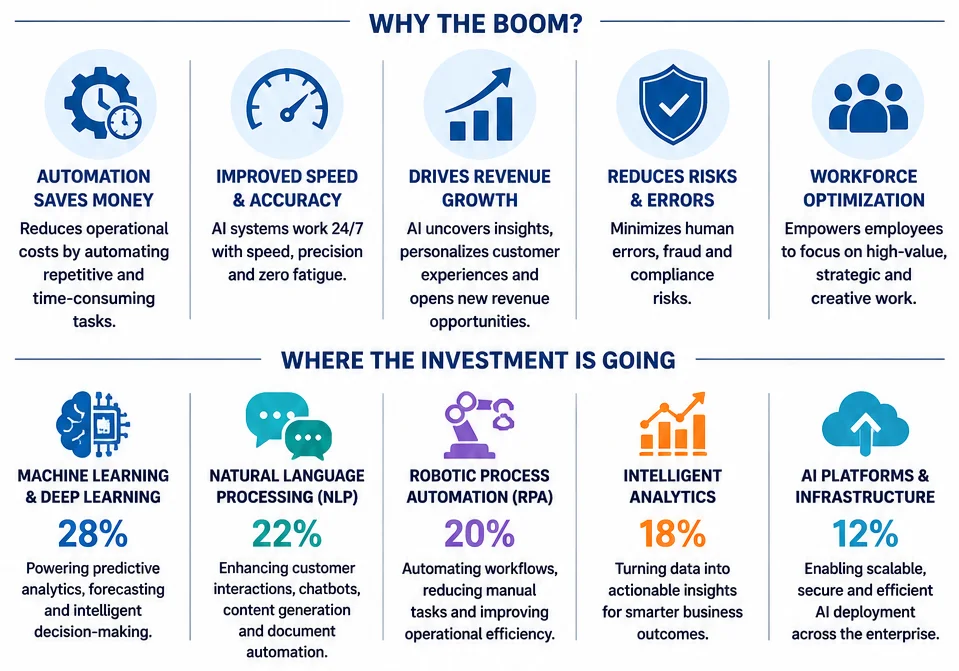
In fact, the purported $100 billion AI automation boom is actually the collective series of massive $100+ billion investments, indicating the beginning of an industry-scale adoption of artificial intelligence driven by the following initiatives:
Jeff Bezos is looking for investors to fund $100 billion to buy manufacturing and industrial companies and automate them using AI. The goal is simple: Apply AI design to legacy production facilities tremendously more efficiently.
India's Adani and related tech conglomerates have committed over $100 billion to build hyperscale data centers and infrastructure.
An estimated $100 billion market in the US alone for SaaS companies adopting agentic AI is also expected to grow, as per the research by Bain & Company.
The core idea behind this AI automation boom is that AI automation saves money. It saves businesses from wasting massive amounts of capital on repetitive operational tasks, administrative processes, customer support management, and data handling.
Al helps companies create new revenue opportunities by enabling them to understand customer behavior, personalize marketing campaigns and identify emerging market trends. This dual benefit of reducing cost and improving revenue is what popularizes AI as one of the most attractive investment areas for businesses in 2026.
Also, with AI, organizations can better manage their resource allocation, from assigning repetitive tasks to agentic systems and allocating critical functions to human resources. This sort of AI-supported strategy helps businesses achieve higher efficiency without having to expand workforce size. In brief, major developments including the context of Jeff Bezos indicate that AI automation is booming, though whether it is globally industry-wide is difficult to predict as of now.
How AI is impacting different industries: Real world examples
Most people misconstrue that the application of artificial intelligence is tied to tech companies or software development. Reality is, it is transforming nearly every sector. From boosting operational efficiency to driving innovation, the transformative value of AI industry-wise is tremendous.
AI impacting Healthcare industry
The healthcare industry is one of the biggest beneficiaries of artificial intelligence. Healthcare and medical institutions utilize AI to study patient data, improve diagnostics, automate administrative work and speed up drug discovery. In medical imaging, AI systems are used for breast cancer screening, reducing false positives and false negatives. In drug discovery, the use of AI serves to identify promising compounds faster than traditional methods. AI-powered scribes like Nuance are automating note-taking during patient consultation, reducing admin burden on doctors.
AI impacting the finance industry
AI is positively transforming the finance sector in fraud detection, customer service and investment strategy. For instance, Mastercard is using AI to study billions of transactions in real time to spot fraud patterns with near accuracy. Erica chatbot used by Bank of America is said to have handled one billion interactions with users. Modern hedge funds are making use of AI and Machine Learning to power their algo trading. For instance, JPMorgan uses AI to optimize execution strategies by adjusting to market dynamics in real-time.
AI impacting the Retail & e-Commerce industry
The use of AI in the Retail and c-Commerce industry is wide-scale in personalizing shopping experience and optimizing inventory management. This can be understood with the example of Amazon and Zalando, whose ML-powered recommendation engines account for up to 35% of total sales on some platforms, as per McKinsey report.

Similarly, Walmart uses massive AI and Machine Learning models to generate highly accurate predictions about the demand at the specific store and SKU (Stock Keeping Unit) level, thus reducing food waste and out of stock events.
In another example, websites like Sephora make use of AI chatbots to provide personalized product advice (like skin tone matching) and end up freeing up human resources to handle complex customer support tickets. Retailers use AI to study market conditions and then automatically change the prices of their products in real time.
AI impacting the Manufacturing industry
AI is transforming the manufacturing sector on a large scale, especially in the areas concerning automation and predictive maintenance. For example, Bosch uses this groundbreaking technology to monitor equipment health in real time, thus mitigating the chance for unplanned downtime by nearly 30%. The technology is being useful in quality control, as companies use AI-assisted visual inspection systems to catch defects on production lines with utmost accuracy than human analysts.
AI impacting logistics and supply chain
In the supply chain and logistics sectors, AI is being used to improve predictions about future product demand and scheduling regarding machinery maintenance, optimizing delivery routes and reducing transportation costs.
AI tools: Saving companies in millions in operational costs
Companies are saving millions in operational costs by deploying AI and machine learning models to automate repetitive tasks related to administrative workflows and reduce human error. In the context of logistics and supply chain, the use of AI serves the purpose of optimising supply chain and predicting equipment failure before the onset of downtime.
Based on these benefits, it is safe to say that massive investment made in AI stems from the purpose of attaining measurable cost reduction, among other reasons. Here's how AI is transpiring millions of savings in operational costs of companies.
Automating repetitive tasks
Repetitive tasks represent $5 trillion of lost productivity annually to companies. In an estimate, individuals spend 520 to 720 hours a year on redundant work. This means a total of more than $13, 000 in lost productivity per employee. From this standpoint, AI automation is a much-needed deployment long overdue, as businesses around the world prioritize cost-efficiency of any strategy that leads to competitive advantages. In this context, automating repetitive tasks using AI tools can eventually save companies in millions.
Deploying AI chatbots for customer support
Setting up a team of human-driven customer support ecosystems handling redundant tasks like answering generic customer queries is a hidden cost drain that companies suffer in the long run. Now picture this: Agentic AI systems automatically handling inbound customer queries! No human intervention. Just pure saving of time and resources! This is what deploying AI chatbots and virtual assistants look like, allowing companies to provide round the clock support while handling generic queries, reducing the number of full-time customer service representatives, which also means saving a great deal of money for companies.
AI tools have widespread industrial application wherein they help industry players cut immense overhead and save millions in lost productivity costs.
How businesses are winning big with AI automation
AI automation is no longer considered a fancy tech term. For businesses, it is now an indispensable mechanism for revenue generation and driving business value. The most immediate upside of AI automation for businesses is the automated efficiency it transpires in handling repetitive, mundane tasks. In addition, companies are driving operational efficiency by eliminating errors and managing resource allocation efficiently. When businesses use AI automation, they free up resources and use them for more strategic work driving value and competitive advantage to the business.
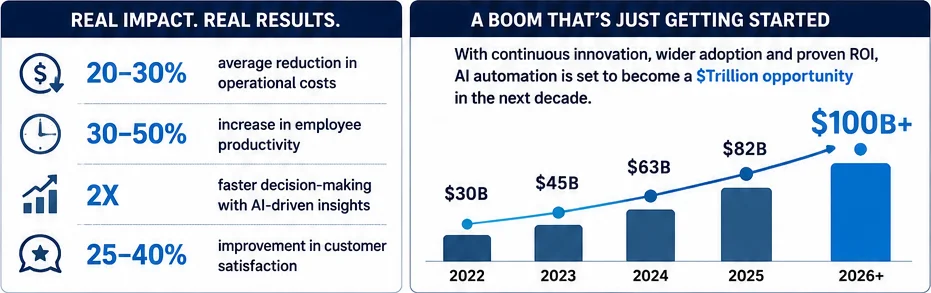
Businesses are winning big with AI automation based on how it helps them streamline customer support, optimize supply chain, enhance operational efficiency and productivity. When it comes to making a decision at the right time without losing competitive edge, AI-assisted solutions always come in handy for businesses. It, therefore, brings home the logic of why AI spending is now a rave trend worldwide, with industry players making a beeline for it to automate routine operations to slash costs, speed up innovation and lay the groundwork for new revenue streams.
When businesses are winning big with AI automation also means they are capturing new market opportunities. For example, AI is used to analyze vast datasets consisting of insights such as:
Customer behavioural patterns
Social sentiments
Economic indicators
AI systems like generative insights engines make use of these metrics to simulate future demand trends, allowing corporate strategy teams to design, test and validate new product concepts via a system called digital customer archetypes before spending a single dollar on a physical production.
The future of AI investment beyond 2026
The AI spending has now become a momentum less likely to slow down anytime soon. Experts predict that AI systems will be more autonomous in the future. They will have consciousness and can be deeply integrated into daily business operations. The future heralds several emerging trends signalling the next phase of AI innovation. They are:
Autonomous agents driven by AI for business operations.
Advanced predictive analytics for strategic planning.
Hyper-personalized customer experiences.
AI-enhanced cybersecurity systems.
Industry-specific Gen AI applications.
Integration between AI and IoT technologies.
While using AI technologies to the best of their business efficiency and productivity, companies will also be liable to balance innovation driven by AI with responsible and ethical use of the technology. In addition, the competition among top AI players will also be increased as to who will win the AI race. As a result, businesses will have access to more advanced AI tools. Therefore, in the future, businesses using AI to drive efficiency and productivity while ensuring its ethical and responsible use will thrive in the coming years.
Concluding statements
organizations around the world are prioritizing Artificial Intelligence spending not because they are adopting it to stay relevant with their rivals using AI but more because the reality associated with it. In fact, AI adoption is no longer considered an experimentation with groundbreaking AI technologies. It is to drive business values and improve operational efficiency. The trend is also an indication of a massive corporate shift where industry players including Amazon are making a beeline for AI automation as a business strategy to operate, innovate and generate revenues.
The reality that 78% of businesses are increasing AI spending in 2026 is more like a fundamental change than a technological shift in the global business landscape today.
The surge in AI adoption by 300% reveals how organizations have understood its value in driving measurable positive impacts to their businesses, apart from experiencing improved operational efficiency, reduced operational costs, faster decision-making, and seamless customer support.
AI-supported intelligent automation is helping companies save in millions and position themselves for long-term business growth in today’s competitive market landscape.
Automated efficiency that AI automation results in is what drives the tectonic shift concerning businesses prioritising AI spending on a massive scale. This is why the future of AI spending to bring forth sustainable growth and competitive advantages is promising, with companies expected to invest substantially to stay ahead of the curve.
Latest Blogs
8 Why Your PMO Is Dying, and How PRINCE2 7 Could Save It
 Is PRINCE2 Certification Still Worth It in 2026? An Honest ROI Breakdown
 Top 20 Toughest Exams in the World 2026: Students Guide
 $100 Billion AI Automation Boom: Why Businesses Are Investing More in 2026
 CISSP vs. CISA: Which Cybersecurity Certification Controls Your Career?
 What is Continual Learning in AI and Machine Learning?
  What are the Major Benefits of Online DBA Programs?
 CMAT 2027: Exam Date, Syllabus, Exam Pattern, Preparation Tips & FAQs

Careerera Editorial Team
The Careerera Editorial Team is a collaborative group of education writers, researchers, editors, content strategists, and subject matter experts dedicated to creating accurate, well-researched, and learner-focused content across technology, business, and professional education. Every article follows a structured editorial process that includes research, source verification, editorial review, and quality assurance before publication. The team references recognized academic institutions, certification bodies, industry research, and authoritative publications to deliver trusted content that helps learners and professionals make informed education and career decisions.