

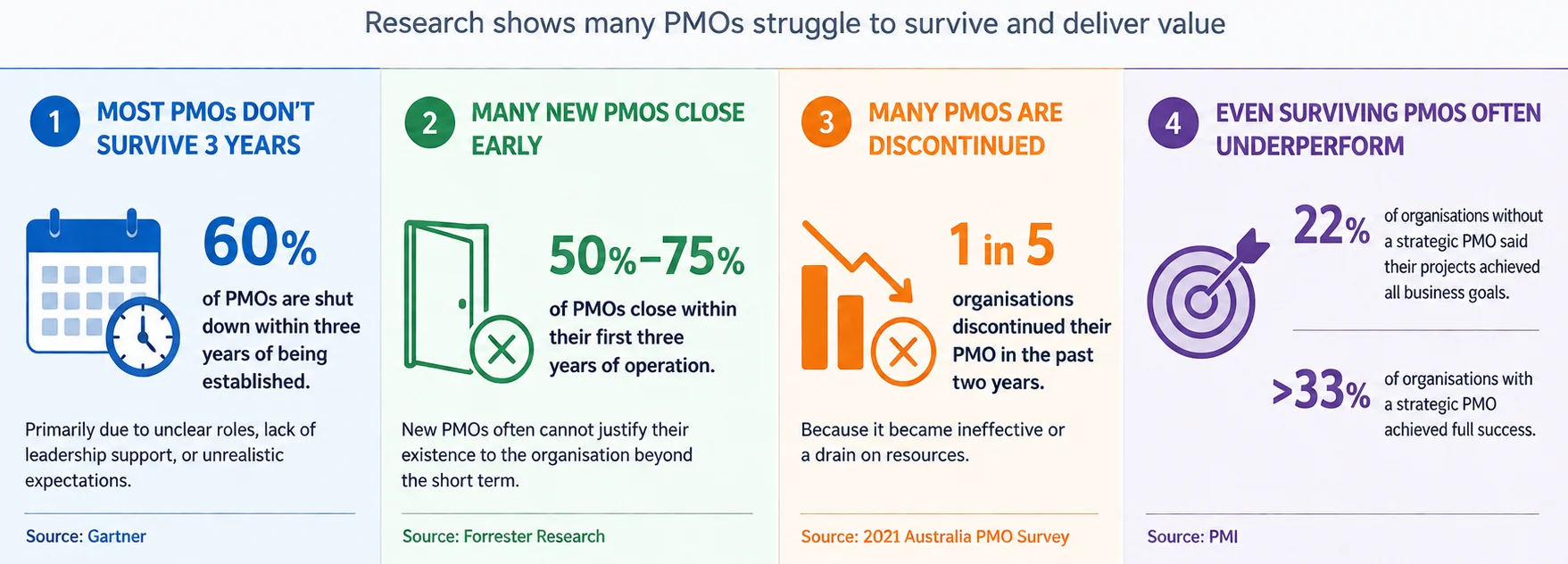
The traditional, bureaucratic Project Management Offices (PMOs) are not dying away but they somehow face an operational crisis in today's business environment where coping with shifting enterprise needs has become necessary. The report by Gartner gives a reality check of a PMO, a centralized department within an organisation once considered a backbone of successful project delivery.
Gartner reports that PMOs must evolve their functional capabilities, considering 60% of the traditional PMOs are completely shut down within 3 years of being established.
While the report may paint a bleak potential of a compliance-dedicated PMO, a reason indicating this development points out to the fact that organisations are mounting their expectations on a project management office. They expect it to get better than enforcing processes and demonstrate measurable business values. To say otherwise, it is not that PMOs are failing, it is because most traditional PMOs are struggling to keep pace with how organisations deliver projects today.
Are PMOs Really Dying? What Is Behind Their Credibility Problem?
As outlined before, PMOs are not dying, but their traditional models such as Supportive PMO, Controlling PMO, and Directive PMO are struggling to maintain their relevance. Companies around the world also expect that a project management office must perform its contributions in a way, helping them make decisions faster, support their Agile and hybrid delivery, leverage digital tools, and be fruitful in delivering valuable business outcomes.
Now, the problem with PMOs, in this context, is that they struggle to meet such expectations. Their internal working mechanisms rely heavily on prioritizing strict governance and documentation of how projects are managed and controlled throughout their lifecycle.
Several contributory factors account for this growing credibility problem associated with PMOs:
Slow project delivery due to rigid approval steps not compatible with today's modern, fast Agile workflows.
Too process-focused like how a project is done rather than what values it delivers.
These models have administrative focus that maintains time-consuming manual status reporting, which today's automation can do now instantly.
Most PMOs use the same project management rules for every project, even though every project is different in terms of size, risk, and delivery approach.
When To Know Your PMOs Are Showing Signs Of Failure
Long before facing a closure or restructuring, an ineffective PMO exhibits some warning signs that senior management and PMO leaders should recognize early on, so that corrective measures regarding improving a PMO’s performance capabilities and restoration of its value to an organization can be made possible. These signs are:
When PMO processes become too slow or unwanted by project teams to an extent that they regularly bypass such processes.
When the efficiency of a PMO is challenged by executives, questioning whether it delivers enough values to justify its operating costs.
When project status reports focus more on activities than demonstrating measurable business results.
When PMO-delivered information is outdated or inaccurate prompting stakeholders to question its veracity.
When governance processes delay project decisions instead of supporting them.
When the PMO struggles to support Agile, hybrid, or cross-functional teams.
When the goal of PMO focuses on governance and its metrics focus on process adherence.
The Problem with Traditional PMOs Struggling in Modern Business Environment
The traditional Project Management Offices struggle in today's modern business environment as their internal working mechanism prioritises strict process adherence and compliance rather than meaningful business outcomes. Rigidity of these legacy startups called PMOs is becoming one of the warning signs for their struggling in the modern business environment, as such rigidity doesn't allow team collaboration where responding to changing business needs faster must be a priority.
Another challenge faced by traditional PMOs is the way hybrid project management is being adopted, with many organisations starting to combine predictive planning with Agile delivery according to project requirements. This turns out problematic for legacy PMOs, especially if they focus more on traditional project management methods and so struggle to support flexible ways of working.
The traditional PMOs struggle in the modern business environment based on how companies allow their teams to work across different locations and time zones, using digital platforms to facilitate communication and making decisions. If the PMO is designed in a way that requires manual reporting cycles and lengthy approval chains, keeping information updated would be difficult for it. Overall, businesses can get along well with the PMO that facilitates delivery rather than controlling it.
How PRINCE2 7 Can Help Revive A Dying PMO
Unlike a legacy PMO that relies on maintaining strict project development compliance by being oblivious to how businesses are changing fast, PRINCE2 recognizes that the landscape for project management is evolving. It understands that maintaining rigidity in process compliance and discouraging team collaboration from responding to challenging business needs quickly is no longer a calling card for businesses to survive and thrive.
Performance Target | What It Measures |
Time | Whether the project is progressing according to the agreed schedule and key milestones. |
Cost | Whether spending remains within the approved budget while delivering the expected outcomes. |
Quality | Whether the project's deliverables meet the required standards and stakeholder expectations. |
Scope | Whether the agreed work and deliverables are completed without unnecessary additions or omissions. |
Risk | How effectively potential threats and opportunities are identified, assessed, and managed throughout the project. |
Benefits | Whether the project is creating the intended business value and measurable improvements for the organization. |
Sustainability | How the project's decisions and outcomes consider long-term environmental, social, and economic impacts. |
It doesn't mean to say that PRINCE2 7 framework rules out strong governance but it maintains that by also giving due consideration to adaptability, instead of prescribing rigid procedures for every situation.
PRINCE2 7 project management framework can help a failing PMO revive by using a host of tactics and strategies, some of them are being mentioned in the following ways;
A People-Focused Approach
Based on how we have analyzed the working mechanisms of legacy project management offices, it is clear that they, more often than not, place greater emphasis on process compliance with regard to project delivery than human collaboration and business outcomes. On the other hand, PRINCE2 7 methodology takes a balancing approach where it focuses on people, leadership and collaboration.
If we infer to the latest upgrades of PRINCE2 7 framework, one of them clearly gives people-centric collaboration a center stage in project development, accentuating better team collaboration drives meaningful business value.
Revival of a dying or struggling PMO needs a people-focused approach where collaboration and leadership are not compromised just to make room for an overtly strict project development compliance. After all, the success of a project not only depends on effective teamwork and communication, where each person works with a common, shared goal.
Actually, when people feel involved and informed throughout the project lifecycle, misunderstandings are less likely to occur, and stakeholders are more likely to support the project.
A Governance Approach That Fits Every Project
This is one of the reasons PRINCE2 7 can help save a dying PMO. Because the latest version of PRINCE2 7 is far from the advocacy of applying governance by bluntly disregarding the project context. Instead, it encourages organizations to adjust or tailor governance according to each project's specific requirements, regardless of its size or complexity.
Tailoring governance also allows better reduction of unwanted administrative burden without ignoring the accountability of each team member. If project management offices adopt this sort of flexibility, it will help them stay effective without creating unnecessary bureaucracy.
Maintains the Significance of a Business Case
One of the reasons most of the project management offices fail to maintain their credibility is their repeated behavior of treating the business case as a one-time approval document. That said, once the funding for a project is received and is in the process of development, nobody bothers to review the business case again. A negative fallout of this administrative approach is that the projects may continue even though the business priorities change or the expected benefits for such project development are no longer achievable.
This is where PRINCE2 7 takes a different approach, treating the business case as a living document, encouraging organisations to review it throughout the project lifecycle. It maintains that the project doesn't deviate from its intended goal of delivering value and remains in alignment with the business objectives.
These working mechanisms maintained by PRINCE2 7 can help PMOs assess a project's viability in the context of delivering value in alignment with target business goals. In this way, the Project Management Offices go beyond just monitoring project progress and play an instrumental role in ensuring that organisations allocate their resources in the right projects.
Supporting Digital Way of Working
Most legacy project management offices are still in the habit of spending too much time creating manual reports and updating spreadsheets. Not only do they take a lot of valuable time, they also delay project updates and decision making affecting project delivery adversely in the long run.
PRINCE2 7 encourages the use of digital tools, automated reporting and real time dashboards to simplify project monitoring. This cuts short on administrative work while giving PMOs faster access to accurate project information. It will allow project management offices to focus less on paperwork and more on helping projects achieve successful outcomes.
Encouraging Sustainability
It is worth noting that most project management offices have not historically treated sustainability as a core operational feature. They focus more on governance, resource allocation and project reporting. On the other hand, PRINCE2 7 includes sustainability as its seventh project performance target that should be considered throughout the project.
It means sustainability of PRINCE2 7 can save and modernize a struggling PMO through a standardized framework that mitigates environmental risk and drives long term value creation. For PMOs, this comes as an opportunity to align project governance with changing organizational priorities.
Final Words
What we have discussed in the write-up so far affords this understanding that PMOs or Project Management Offices are not dying away, but the working mechanisms of their legacy models surely struggle in keeping pace with the modern businesses where flexibility, better team collaboration, and goal-centric project lifecycles require a broader approach, not something strictly tied to compliance adherence.
The below table is a quick overview of certain warning signs indicating your PMO is dying or struggling compared to how PRINCE2 7 responds to such signs.
PMO Warning Sign | How PRINCE2 7 Responds |
Bypassed processes | Tailored governance keeps processes practical and relevant, making teams more likely to follow them. |
Outdated reporting | Encourages the use of digital tools and real-time reporting for faster, data-driven decisions. |
Slow approvals and decision-making | Tailored governance reduces unnecessary bureaucracy while maintaining appropriate oversight. |
Rigid one-size-fits-all rules | Applies the principle of tailoring, allowing project controls to match the project's size, complexity, and risk. |
Business case forgotten after project approval | Treats the business case as a living document that is reviewed and updated throughout the project lifecycle. |
Teams working in silos | Places greater emphasis on people, collaboration, clearly defined roles, and stakeholder engagement. |
Focus on process over outcomes | Shifts attention from compliance to delivering business value, benefits, and measurable outcomes. |
Poor visibility into project health | Supports continuous monitoring through timely reporting and digital project management practices. |
Sustainability rarely considered | Integrates sustainability as a core performance target alongside cost, time, quality, scope, benefits, and risk. |
Low stakeholder engagement | Encourages active stakeholder communication and collaboration throughout the project, not just at key milestones. |
Clearly PRINCE2 7 framework attempts to make a distinction, not as a replacement or solution to struggling or dying PMOs but assisting them revive and become a fitting solution to modern project requirements in an organisation.
Latest Blogs
8 Why Your PMO Is Dying, and How PRINCE2 7 Could Save It
 Is PRINCE2 Certification Still Worth It in 2026? An Honest ROI Breakdown
 Top 20 Toughest Exams in the World 2026: Students Guide
 $100 Billion AI Automation Boom: Why Businesses Are Investing More in 2026
 CISSP vs. CISA: Which Cybersecurity Certification Controls Your Career?
 What is Continual Learning in AI and Machine Learning?
  What are the Major Benefits of Online DBA Programs?
 CMAT 2027: Exam Date, Syllabus, Exam Pattern, Preparation Tips & FAQs

Careerera Editorial Team
The Careerera Editorial Team is a collaborative group of education writers, researchers, editors, content strategists, and subject matter experts dedicated to creating accurate, well-researched, and learner-focused content across technology, business, and professional education. Every article follows a structured editorial process that includes research, source verification, editorial review, and quality assurance before publication. The team references recognized academic institutions, certification bodies, industry research, and authoritative publications to deliver trusted content that helps learners and professionals make informed education and career decisions.