

Most AI systems work like a printed manual — once created, they stay the same regardless of the circumstances around them. Adaptive AI is different and works more like an experienced professional. It develops its response system through continuous observation of its environment which enables it to detect patterns from all incoming interactions and learn from both successful and faulty methods., and naturally improves its responses over time without needing constant instructions.

Imagine you hired a customer service representative whose capabilities, after every conversation, would go on improving after every interaction with the customer -- no training required, no supervisors involved. It keeps on improving itself in a nutshell. This is the basic idea behind Adaptive AI.
The majority of AI systems you've interacted with were built once, trained on a large dataset, and then deployed — frozen in time. Your 2019 spam filter lacks knowledge about 2024 phishing techniques until someone performs manual updates to the system. Adaptive AI breaks that pattern entirely. The system operates through continuous learning which enables it to modify its actions immediately while adapting to changes in its environment.
This isn't a sci–fi concept. It's powering Netflix recommendations, hospital diagnostics, traffic lights in smart cities, and fraud detection systems right now. Let's break it all down in a simple manner.
Read Also: The History of Artificial Intelligence 1950s To 2025s
What Is Adaptive AI?
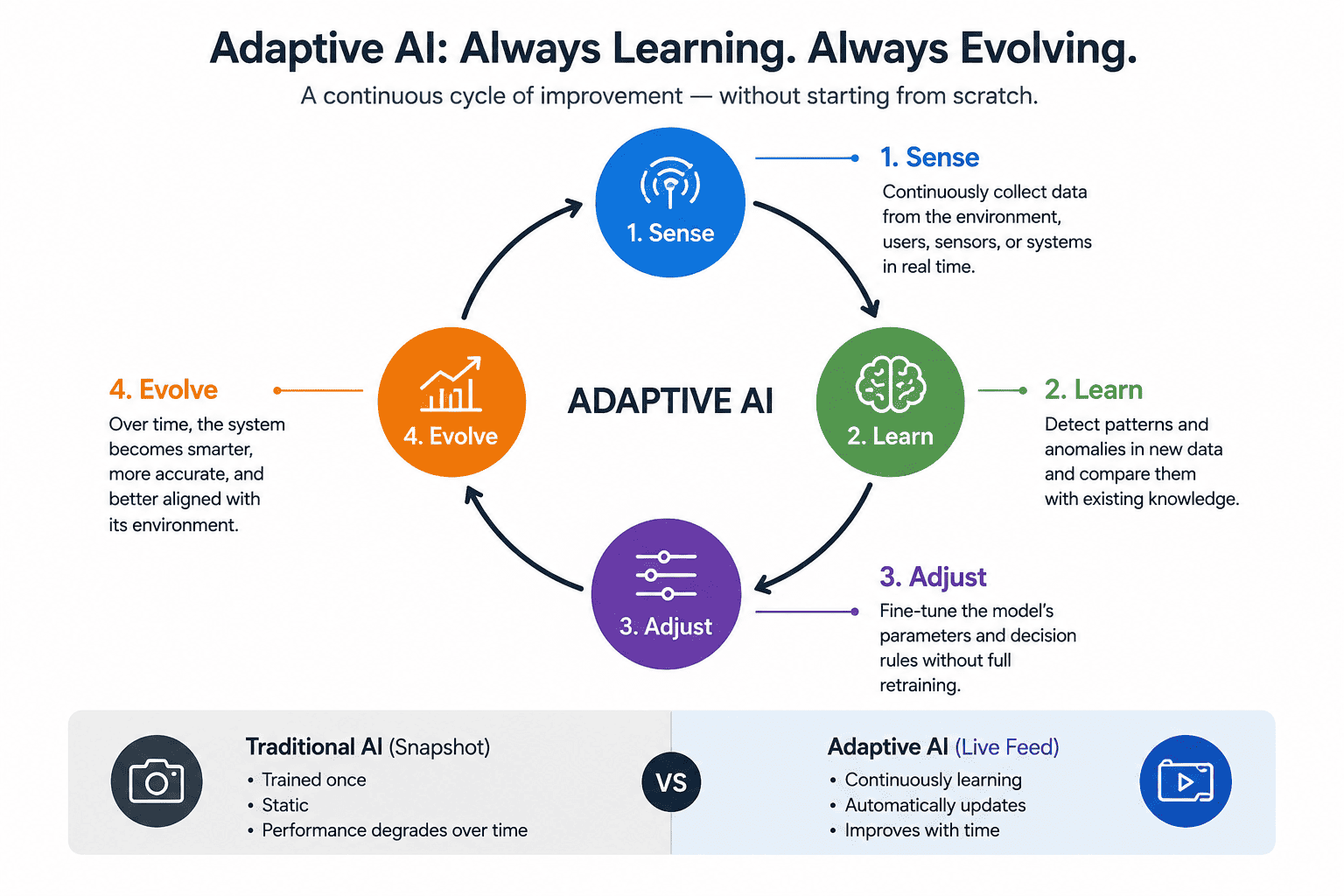
Adaptive AI refers to any artificial intelligence system designed to continuously learn and update itself based on new information — without needing a human to step and retrain it from scratch.
Think of it like the difference between a photograph and a live video feed. The traditional AI system functions as a sharp, accurate snapshot which provides a precise depiction of what was true at the time it was taken. The live feed system operates as adaptive AI because it continuously updates and reacts to changing conditions.
"Adaptive AI doesn't just predict the future based on the past. It updates its understanding of the present — constantly."
Fundamentally, every adaptive AI system runs on a simple four–part loop:
1. Sense
The system gathers new data — from user behavior, sensors, market movements, or interaction — in real time.
2. Learn
It identifies patterns in that new data and compares them against what it already knows.
3. Adjust
The model fine–tunes its own parameters — changing its internal rules without full retraining.
4. Evolve
Over time, the system becomes measurably smarter, more accurate, and better suited to its environment.
Did You Know?
Traditional AI models are like a student who studies hard before an exam — but then never opens a book again. Adaptive AI is the student who reads the news every morning and updates their understanding of the world daily.
Read Also: Free Artificial Intelligence Courses for Beginners
Adaptive AI vs Traditional AI — The Real Difference
See below table to understand what actually separates the Adaptive AI from Traditional AI:
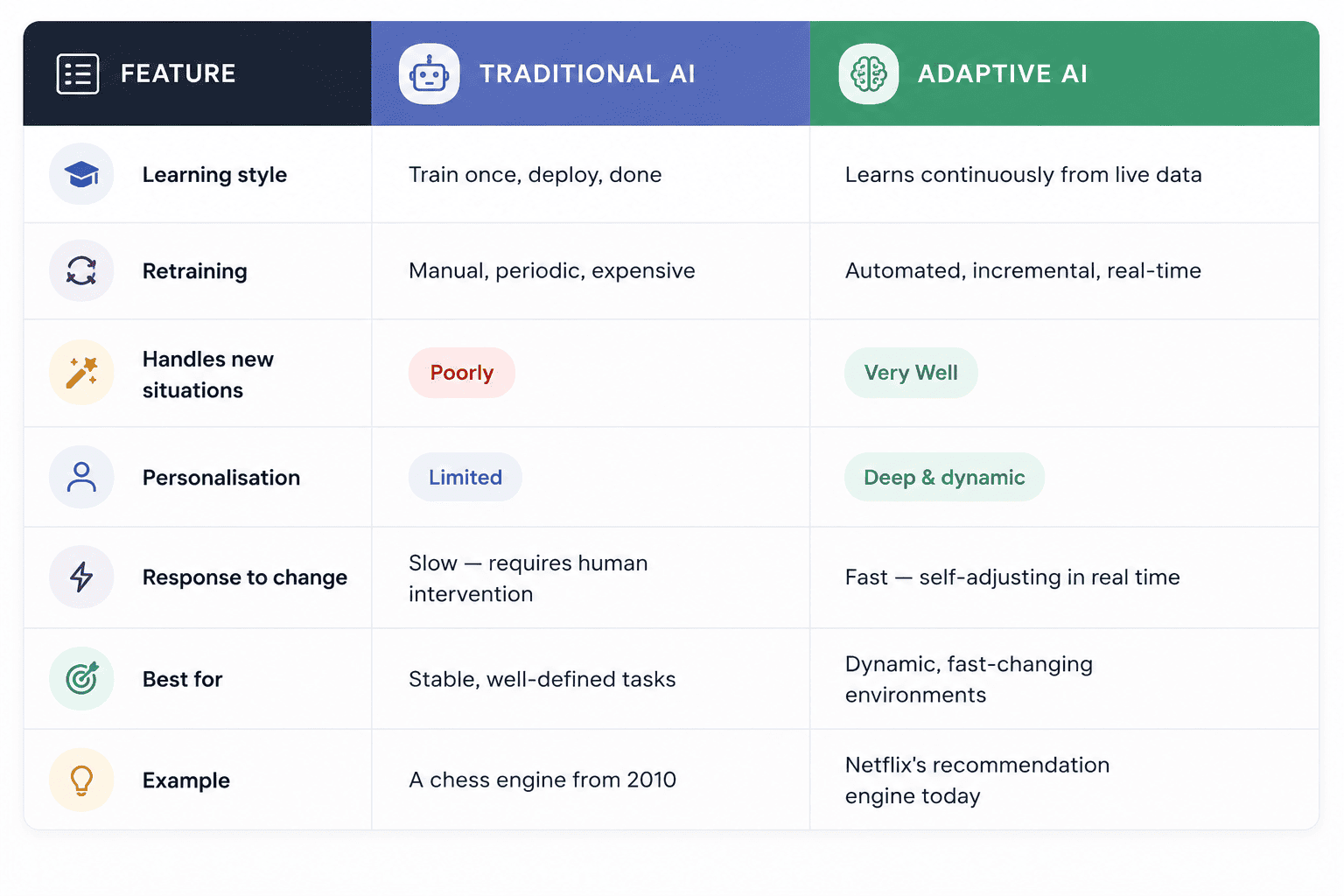
Neither is always "better." A traditional AI model that predicts bridge load tolerances is fine being static — physics doesn't change month to month. But a fraud detection model? It must adapt, because scammers invent new tactics daily.
How Does Adaptive AI Actually Work Behind the Scenes?
Adaptive AI typically combines three technical ingredients that work together:
Continuous Data Ingestion
The system is always plugged into fresh data streams — customer clicks, purchase behavior, sensor readings, or social signals. Unlike a model trained on a frozen dataset, adaptive AI has a live pipeline feeding it new information around the clock.
Incremental (Online) Learning
Adaptive learning enhances the current system by implementing specific updates to the needed components instead of creating and training a new model which requires rebuilding the entire system for each new data set. The process works much like editing a document — rather than creating something entirely new, it focuses on refining and updating what already exists.
Feedback loops
Every output the AI produces generates a signal: did the user click it? Was the recommendation accepted? Was the flagged transaction actually fraud? These reactions teach the system what to do differently next time — automatically.
Real–World Analogy
Think of Spotify's "Discover Weekly" playlist. It doesn't just play songs you already love — it watches which new songs you skip, which you replay, and which you add to your library. Every Monday, it adjusts. After six months, the system understands your musical preferences better than most of your friends do.
That's adaptive AI working silently in the background.
Adaptive AI Architecture
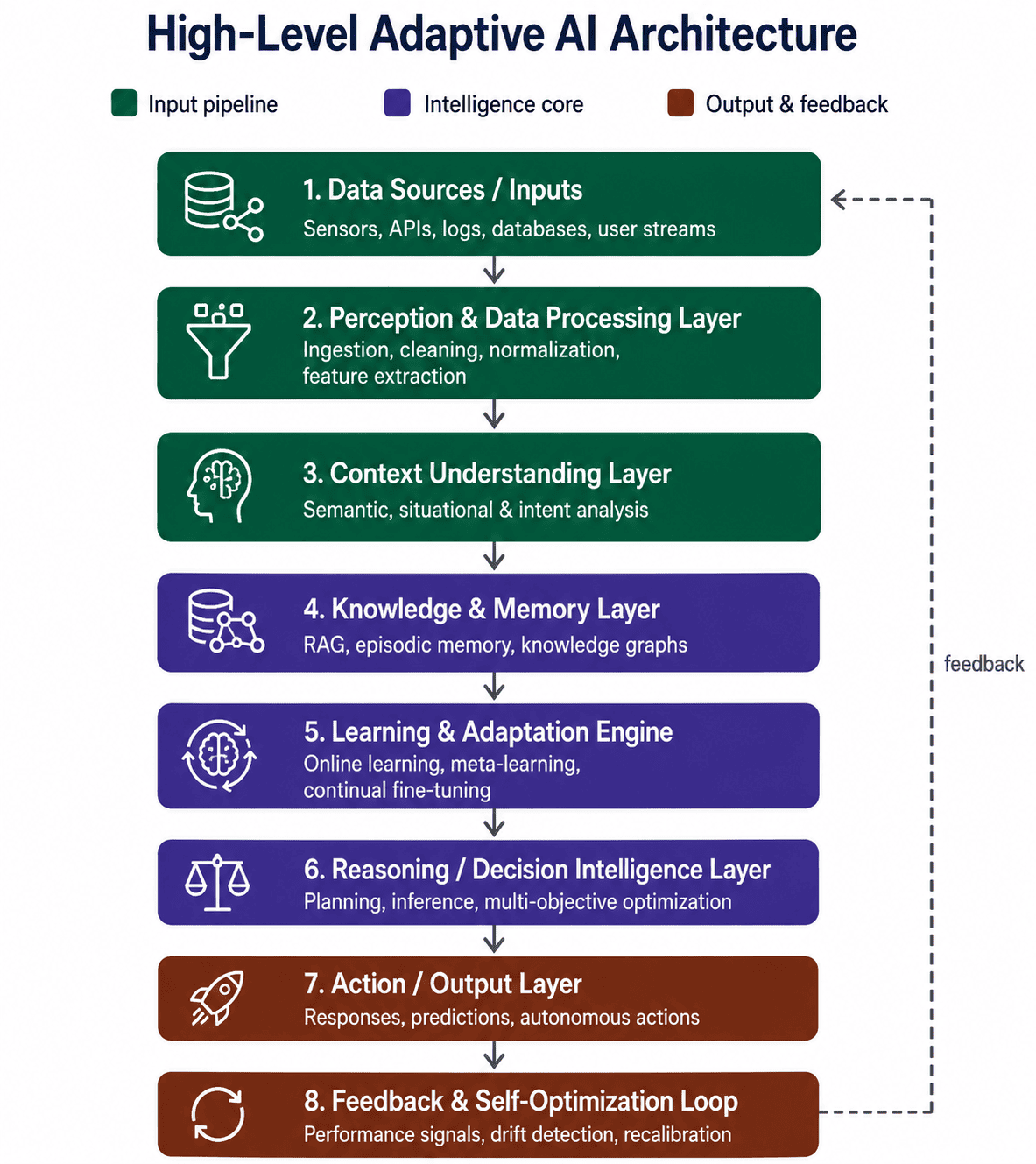
1. Input Layer
This is the entry point of the system where data is collected from different sources such as text, voice, images, sensors, user activity, databases, or APIs.
Purpose: Gather raw information from the environment.
2. Perception & Processing Layer
In this step, the raw input is cleaned, structured, analyzed and processed in terms of natural language processing, computer vision, or some other kind of signal processing.
Purpose: Convert unstructured data into meaningful machine-readable information.
3. Context Understanding Layer
This layer analyzes the situation around the data—who the user is, what the intent is, previous interactions, time, location, or business conditions.
Purpose: Understand the meaning behind the data in its real context.
4. Knowledge & Memory Layer
The system stores past interactions, learned patterns, rules, and domain knowledge for future reference.
Purpose: Retain experience and historical intelligence.
5. Learning & Adaptation Engine
This is where the system improves itself by learning from new data, feedback, and changing patterns.
Purpose: Continuously update models and behaviors over time.
6. Reasoning & Decision Layer
Based on what it has learned and understood, the system evaluates possible actions and selects the best response or decision.
Purpose: Enable intelligent decision-making.
7. Action / Execution Layer
The system delivers its output—such as recommendations, alerts, predictions, automation triggers, or responses.
Purpose: Turn intelligence into real-world action.
8. Feedback & Optimization Loop
After action is taken, the system monitors outcomes, user reactions, and performance metrics.
Purpose: Learn from results and continuously improve future decisions.
This feedback loop is what makes adaptive systems dynamic, unlike traditional static systems.
Read Also: 10 Trending AI Models & Systems You Need to Know Right Now
Where Is Adaptive AI Being Used Right Now?
This is where it gets exciting. Adaptive AI isn't a future promise — it's running right now in industries you interact with daily.
Healthcare: Smarter Diagnoses Over Time
Adaptive AI systems in hospitals cross–reference a patient's history, recent lab results, and even medical imaging — and they get more accurate as they process more cases. A system trained in a Mumbai hospital will gradually become better calibrated for the specific health patterns of that region's population.
Case Example — Finance
Fraud Detection That Evolves With Scammers
Banks using adaptive AI don't just block known fraud patterns. Their systems notice that a new wave of scams is emerging — let's say a spike in synthetic identity fraud — and update their detection logic within hours, not months. The scammers change tactics. The AI changes with them.
Traditional fraud models, by contrast, require a data science team to manually identify the new pattern, label the data, retrain the model, and push an update. That cycle can take weeks. Adaptive AI collapses it to near–zero.
Result: Faster responses, fewer false positives, less manual oversight needed.
Education: Learning That Learns From You
EdTech platforms now build dynamic learning paths. If you're acing the algebra but struggling with geometry, the system notices — and reshuffles your lesson queue, quiz difficulty, and practice exercises accordingly. No teacher is required to make that call.
Retail & E–Commerce: Hyper–Personalization
A conventional recommendation engine suggests products based on your past purchases. An adaptive one goes further — it factors in what you've been browsing this week, trending products in your city, and even time of day. It's always recalibrating, always fresh.
Urban Traffic Management
Smart cities are deploying adaptive AI to manage traffic flow. The system reads real–time congestion data, weather patterns, and event schedules — then adjusts traffic light timings dynamically. In 2025, several major cities reported measurable reductions in average commute times through this approach.
Adaptive AI vs Generative AI — Are They the Same Thing?
A lot of people confuse these two. They're related but not the same.
Generative AI creates new content — text, images, code, audio. ChatGPT writes essays. DALL·E paints pictures. That's all generative AI.
Adaptive AI is about how a system updates itself over time. It's a learning strategy, not a content type. A generative AI model can also be adaptive if it continuously refines its responses based on user feedback — which modern LLMs increasingly do.
Think of it this way: Generative AI is the output. Adaptive AI is the learning mechanism.
Read Also: Free Generative AI Courses for Beginners: Start your AI Journey with Zero Investment
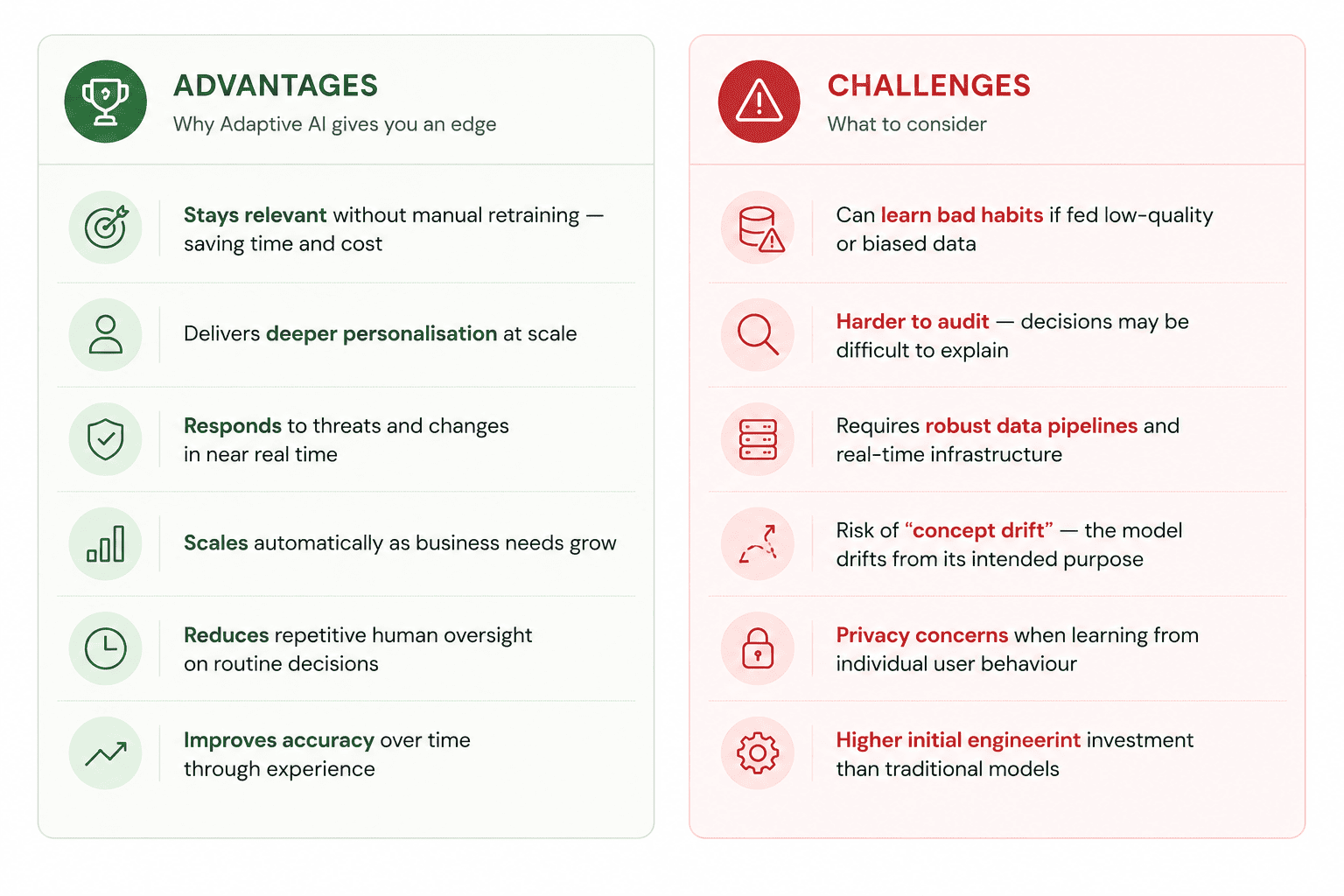
Pros and Cons of Adaptive AI
No technology is perfect. Let's have a fair–minded look at both sides:
Common Mistakes People Make When Thinking About Adaptive AI
Thinking it means the AI has opinions or feelings. Adaptive AI learns patterns in data. It doesn't "want" anything. It just adjusts probabilities based on what outcomes have been rewarded.
Assuming it's always better than traditional AI. If your task is stable and well–defined — like calculating shipping distances — a fixed model works perfectly fine. Adaptive AI adds complexity where it isn't needed.
Ignoring data quality. If you feed garbage data into an adaptive system, it will learn garbage patterns and apply them confidently at scale. The phrase "garbage in, garbage out" is ten times more dangerous when the system is learning continuously.
Treating it as "set and forget." Adaptive AI requires ongoing monitoring because people treat it as a system that requires no further attention after deployment. The humans don't disappear — they just transition from training activities to monitoring responsibilities.
Expert Tips: Getting the Most From Adaptive AI
Start with a clear feedback signal. The most successful adaptive AI systems are built around one explicit signal — a click, a purchase, a rating, a flag. Fuzzy feedback produces fuzzy learning.
Build monitoring before deployment. Know what "good behavior" looks like for your system before it goes live. If accuracy drops 5% over three months and nobody is watching, that's a silent disaster.
Think in environments, not datasets. Adaptive AI thrives in dynamic environments — customer behavior, financial markets, healthcare. Match the technology to settings that actually change over time.
Invest in explainability alongside adaptability. As your AI evolves, you need tools to understand why it made a decision — especially in regulated industries like finance and healthcare. Don't let the black box get blacker over time.
What's Coming Next: The Future of Adaptive AI
We are still in the early development phase of this story. Here are the developments most worth watching over the next few years:
On–Device Adaptive AI (Edge AI)
Instead of sending data to the cloud to update a model, future systems will learn directly on your device — your phone, car, smartwatch. This is faster, more private, and capable of working offline.
Explainable Adaptive AI (XAI)
One of the biggest criticisms of adaptive systems is that they become hard to explain over time. Explainable AI research aims to make decision–making transparent — so a doctor, judge, or loan officer can actually understand how the AI reached its decision.
Self–Healing Systems
The next frontier is AI that doesn't just adapt to new data but can detect when it's failing, diagnose the problem, and fix itself — without a human engineer to step in overnight.
Agentic + Adaptive AI
The most powerful near–term combination: autonomous AI agents that not only take independent action but also learn from the outcomes of those actions. By 2025, 83% of organizations surveyed said they had planned to deploy agentic AI systems — and as those agents become adaptive, their usefulness will compound dramatically.
Industry Insight
The Adaptive Artificial Intelligence market worldwide is anticipated to surpass $1.6 billion in revenues by 2030, fueled by continuous enterprise adoption. In the BFSI industry, which currently leads implementation, adaptive AI technologies are employed for improved fraud detection, quick decision-making, and personalized financial services.
Your Next-Step Decision Framework
If you are not sure whether adaptive AI is right for your situation — use this simple filter before making any decision.
Step 1 — Ask
Does your environment change regularly? (User behavior, markets, threats, demand?)
Step 2 — Check
Do you have a clear feedback signal? (A click, a conversion, a flag, a rating?)
Step 3 — Audit
Can you monitor and explain the system's decisions over time? (Especially in regulated fields?)
Step 4 — Decide
If you answered Yes to all three → Adaptive AI is a strong fit. If mixed → start with a hybrid approach. If you answered No to all three → traditional AI may serve you better.
The goal isn't to use the newest technology. It's to use the right technology — one that solves the actual problem you're facing, not the one that sounds impressive in a boardroom.
Latest Blogs
8 Why Your PMO Is Dying, and How PRINCE2 7 Could Save It
 Is PRINCE2 Certification Still Worth It in 2026? An Honest ROI Breakdown
 Top 20 Toughest Exams in the World 2026: Students Guide
 $100 Billion AI Automation Boom: Why Businesses Are Investing More in 2026
 CISSP vs. CISA: Which Cybersecurity Certification Controls Your Career?
 What is Continual Learning in AI and Machine Learning?
  What are the Major Benefits of Online DBA Programs?
 CMAT 2027: Exam Date, Syllabus, Exam Pattern, Preparation Tips & FAQs

Priyank Jha
Priyank is a Senior Content Developer and Strategist at SNVA Veranda. Earlier, he worked as a data scientist, where he gained extensive experience in developing data-driven solutions, advanced analytics, and strategic decision-making processes. His expertise includes data analysis, business intelligence, and implementing data-centric strategies that drive organizational growth and innovation. In addition to his data science experience, Priyank has over 10 years of experience in the banking and financial services sector. He has worked across various roles and operational levels, gaining in-depth knowledge of financial operations, customer service management, and business processes.