

There has been a dramatic change in the way software is built, delivered, and integrated into daily life.
For instance, 46% of code written by GitHub Copilot is now entirely AI-generated. In a survey by Stack Overflow, 84% of developers now actively use or plan to use AI tools in their development pipeline. According to Gartner, task-specific agentic AI systems will be integrated with 40% of enterprise applications. Understandably, they are a gradual yet massive shift in the business landscape that was once dependent on different SaaS tools to complete daily operations.
Back in the old days, the software architecture supporting daily workflows was structurally siloed. There was one platform for emails, another one for customer support, another for analytics, and another one for project management. Now that model is bottoming out.
In 2026, AI agents are taking center stage as a new growth engine for business operations. Completing a task using ten different applications is now replaced by AI agents executing those tasks independently through voice commands. Now is the day for intelligent systems that can think, make a thorough analysis, automate, and even make operational decisions in real time.
Read Also: $100 Billion AI Automation Boom: Why Businesses Are Investing More in 2026
The technological shift of AI agents is seen as one of the biggest transitions after cloud computing had become a mainstream business priority worldwide. AI agents are shifting from being experimental tools for tech startups to being a replacement engine for traditional SaaS workflows across sales, HR, finance, cybersecurity, customer service and operations.
Statistics Pointing Out To The Rise Of Agentic Systems
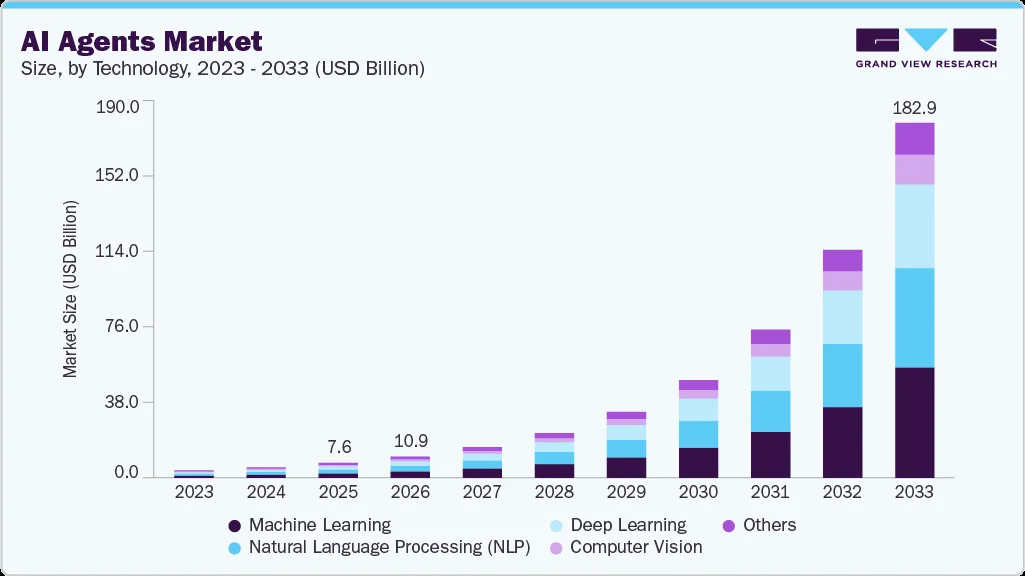
The market size of global AI agents is expected to reach $182.97 billion by 2033 from its estimated valuation of $7.63 billion in 2025. (Grand View Research).
The scale of advancement Gen AI has reached is now believed to have gained significant maturity.
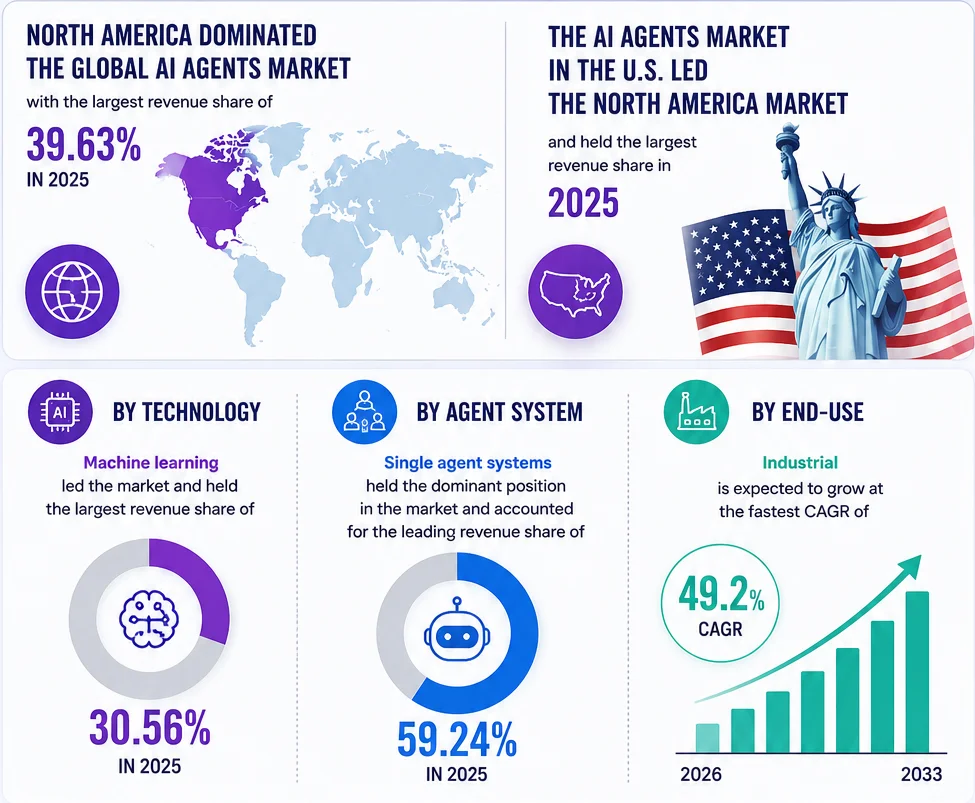
North America is leading the AI agents market, contributing to the share of 41%.
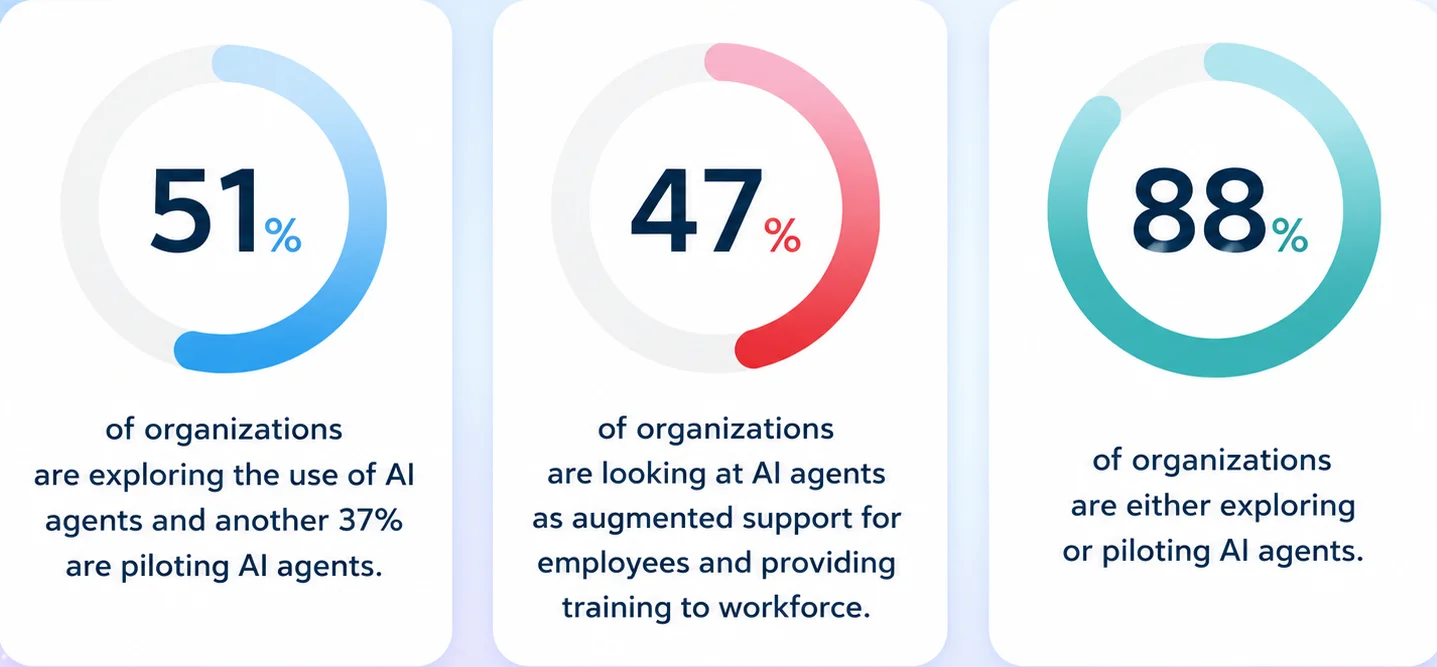
51% of organisations are exploring the use of ai agents and another 37% are piloting ai agents. (Source: KPMG)
47% of organisations are looking at ai agents as augmented support for employees and training to workforce (Source: KPMG)
Industries that implement AI agents most are: healthcare, finance&banking, retail & e-commerce, Transportation & logistics, and telecommunication etc.
How AI Agents Are Changing The Game When Traditional SaaS Model Is Still Holding Business Value?
The SaaS market remained uncontested for many years. The subscription-based model ruled the roost in the business landscape, encouraging companies to adopt SaaS for competitive gains. Now, with AI agents taking a center stage in business application, things are changing fast. Actually, AI agents are transitioning the SaaS model from human-operated software to autonomous, result-driven platforms. It signals an exit for per-user pricing and clicking through dashboards.
It is true that when SaaS incorporated a subscription model, it allowed businesses to access powerful software without having to host them on a local server and suffer expensive maintenance of on-premises systems. Cloud-based applications rolled out in the market on a large scale followed by the subscription model. It was phenomenally good for companies until they started to operate with massive software stacks.
The current status-quo is such that a mid-sized business may likely use more than 100 SaaS applications across departments. Departmental functionality is also in a state of lost productivity where the teams have to jump between platforms to complete routine tasks. Fragmented information across systems slows down team collaboration and affects decision-making processes. The time of employees gets wasted in managing software than actually working.
The issues with SaaS tools faced by teams and organisations are there, even though they are technically not bad. The real problem lies in the fact that they depend on human intervention to facilitate coordinating everything manually. This is where AI agents are taking the driving seat.
An Overview Of AI Agents And How They Eliminate Dashboard Fatigue
What Are AI Agents?
AI agents are basically autonomous agents that perform tasks on their own, with nominal human intervention. The unique thing about these agentic AI systems is that they understand objectives. They take actions based on the pre-instructed goals, analyze information and perform independently. For example, Bank of America is using an AI agent called Erica for retail clients, BMW Group is using an AI agent called SORDI AI to optimize supply chain processes.
The point is, AI agents are uncountable in numbers and based on an estimated guess, there are tens of thousands of verifiable autonomous agents. In the enterprise sector, there are roughly 28.6 million active AI agents. Mark Zuckerberg once said the Earth will soon have more AI agents than people.
How Do AI Agents Function?
They are like smart digital coworkers that work independently.
They reason through the instructed goals and use tools to complete the tasks on their own.
They just don't respond to prompts, they break down complex workflows and execute actions without much human intervention.
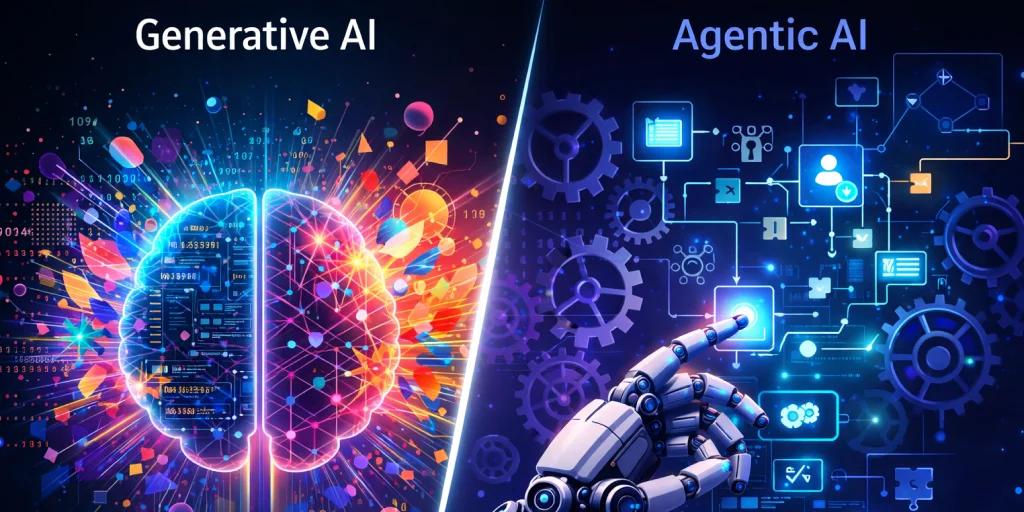
Autonomy, reasoning, and memory retention are some of features making ai agents different from traditional chatbots
In business applications, the AI agents help organisations automate operations, like customer support, workflow management, analytics, etc.
They are considered a major force based on their ability to operate across platforms and process information in real time, facilitating enterprise productivity.
Role of AI Agents In Eliminating Dashboard Fatigue
In the context of AI agents, dashboard fatigue refers to the mental tiredness and lost productivity when you wade through too many fragmented reports. Lack of unified context in such reports affords dashboard fatigue, something in which the role of AI agents is distinctively impactful. In fact, these autonomous systems play an instrumental role in connecting all the dashboards for CRM, analytics, project management, HR, finance, and communication.
Employees get assisted real-time as they just need to ask the AI agent for insights, updates, or task execution. The result is amazing, as the agent performs collecting information automatically, summarizing critical findings, highlighting trends, and recommending actions. The point is, instead of wasting time in navigating endless dashboards and reports, AI agents just do them in seconds, improving efficiency, reducing mental overload, and enabling smarter decision-making.
AI Agents Automating Entire Workflows
AI agents are programmatically designed to automate workflows serving as an efficient solution for operational inefficiency for businesses. In addition, these autonomous systems also handle repetitive business processes that once took human intervention to complete manually.
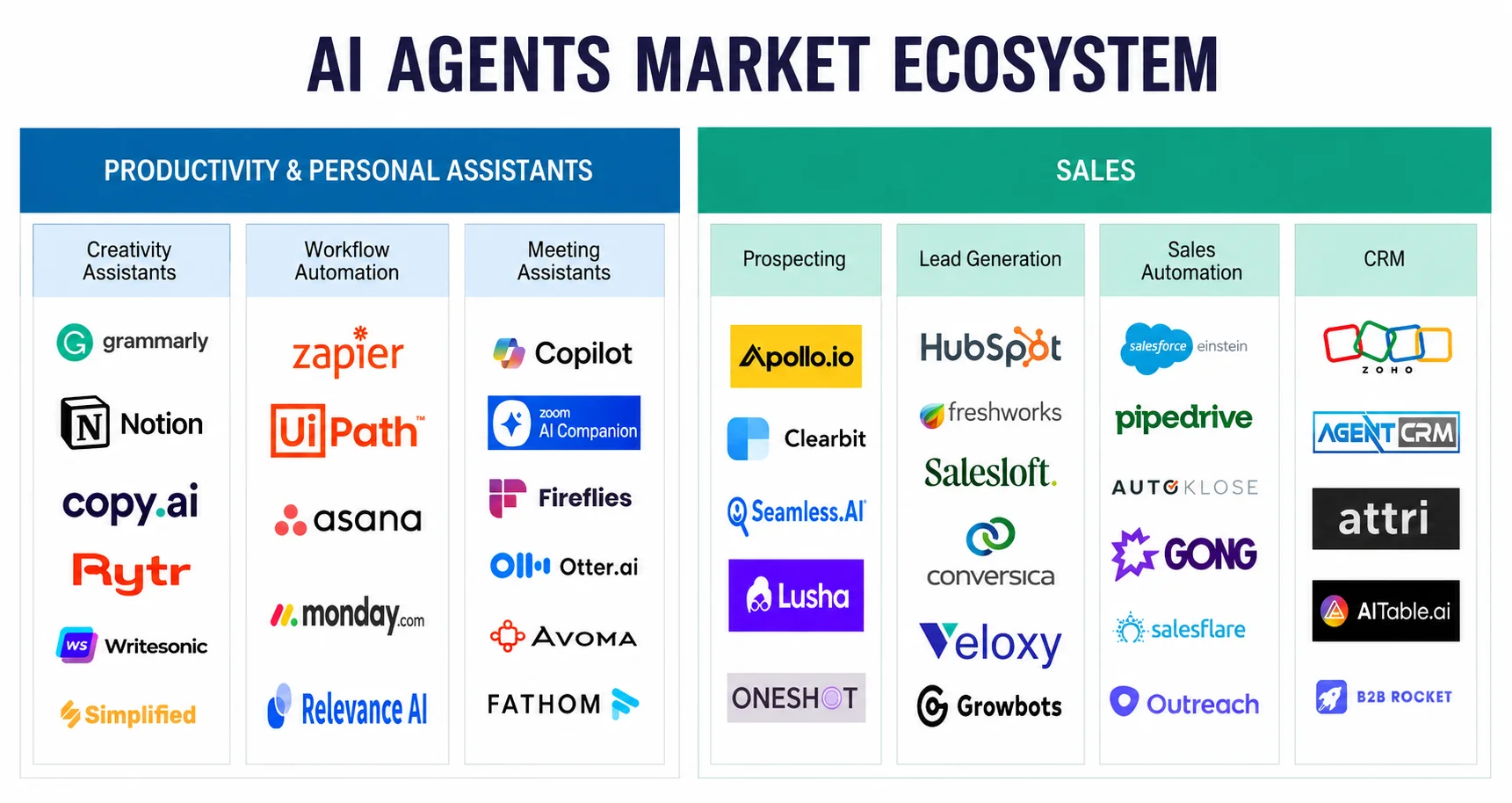
Solution of these agents in handling tasks like scheduling meetings, generating reports, updating CRM records, managing invoices, monitoring customer support tickets and analyzing marketing performance is immensely valuable in business context. In fact, businesses today are realizing that they don't have to depend on multiple SaaS tools as these agents can manage cross-platform workflows autonomously, resulting in faster operation while reducing administrative burdens on employees.
A Shift Toward Actual Business Outcomes
There has been a technological shift in the business landscape where companies gravitate toward outcome-based software rather than relying on traditional SaaS platforms selling features and interfaces. The relevancy of software featuring advanced dashboards or complex reporting features is no longer interesting to companies, as they want cost-efficient execution of their operational burdens to bring forth higher productivity. This is where AI agents step into the picture, helping companies do away with traditional SaaS platforms and experience automated efficiency in workflows.
Cost Reduction In SaaS Expenses
When a business can employ a single intelligent agentic system to handle multiple operational tasks, it undoubtedly leads to reduction in their SaaS expenses. Instead of relying on different SaaS products for executing different types of tasks and then ending up incurring huge subscription costs in the process, use of agentic systems is comparatively better and more cost-effective.
AI Agents Replacing Traditional SaaS In Transforming Customer Support
Customer support is one of the areas where the role of agentic ai systems has been tremendously transformative, replacing traditional saas workflows. In the past, support systems relied too much on ticketing platforms, live chat platforms, CRM dashboards and even human intervention in managing customer interactions. Modern ai agents now handle customer interactions autonomously. They understand customer intent, analyze previous interactions, troubleshoot issues and even predict whether a customer is not happy before it becomes critical.
If we talk in the context of what happened in the past, the support team often had to manually switch between platforms to track issues, respond to customers, escalate complaints, and analyze service performance. What AI agents are doing is consolidating these functions into a single intelligent system where they independently understand customer queries, access account histories, troubleshoot issues, generate personalized responses, etc.
Final Words
Though the SaaS landscape remains one of the most sought-after models for businesses around the world and it is still so, the role of agentic ai systems has been quite instrumental in reshaping traditional SaaS tools.
In 2026, the technological shift of businesses moving away from relying on subscription-based models to handle their workflow and operational performances to advanced and outcome-based AI agents. As outlined, traditional SaaS tools are not going away anytime soon. It is their role that is taking a new definition of reshaping due to agentic ai systems. That is because modern businesses want their resources more efficient and productive rather than busy in disconnected dashboards and software interfaces.
Where real-time intelligent decision-making matters, depending on traditional SaaS tools hampering work productivity is not an option. Therefore, the role of agentic AI systems gets spotlight as they understand objectives and require least human intervention to execute tasks efficiently.
Conclusively, AI agents are giving new definitions of productivity and performance enhancement to businesses over traditional SaaS tools.

Careerera Editorial Team
The Careerera Editorial Team is a collaborative group of education writers, researchers, editors, content strategists, and subject matter experts dedicated to creating accurate, well-researched, and learner-focused content across technology, business, and professional education. Every article follows a structured editorial process that includes research, source verification, editorial review, and quality assurance before publication. The team references recognized academic institutions, certification bodies, industry research, and authoritative publications to deliver trusted content that helps learners and professionals make informed education and career decisions.
Learn how we research, review, and update our content. Editorial Standards & Review Process.

Latest Blogs
8 Why Your PMO Is Dying, and How PRINCE2 7 Could Save It
 Is PRINCE2 Certification Still Worth It in 2026? An Honest ROI Breakdown
 Top 20 Toughest Exams in the World 2026: Students Guide
 $100 Billion AI Automation Boom: Why Businesses Are Investing More in 2026
 CISSP vs. CISA: Which Cybersecurity Certification Controls Your Career?
 What is Continual Learning in AI and Machine Learning?
  What are the Major Benefits of Online DBA Programs?
 CMAT 2027: Exam Date, Syllabus, Exam Pattern, Preparation Tips & FAQs
Featured Courses

There has been a dramatic change in the way software is built, delivered, and integrated into daily life.
For instance, 46% of code written by GitHub Copilot is now entirely AI-generated. In a survey by Stack Overflow, 84% of developers now actively use or plan to use AI tools in their development pipeline. According to Gartner, task-specific agentic AI systems will be integrated with 40% of enterprise applications. Understandably, they are a gradual yet massive shift in the business landscape that was once dependent on different SaaS tools to complete daily operations.
Back in the old days, the software architecture supporting daily workflows was structurally siloed. There was one platform for emails, another one for customer support, another for analytics, and another one for project management. Now that model is bottoming out.
In 2026, AI agents are taking center stage as a new growth engine for business operations. Completing a task using ten different applications is now replaced by AI agents executing those tasks independently through voice commands. Now is the day for intelligent systems that can think, make a thorough analysis, automate, and even make operational decisions in real time.
Read Also: $100 Billion AI Automation Boom: Why Businesses Are Investing More in 2026
The technological shift of AI agents is seen as one of the biggest transitions after cloud computing had become a mainstream business priority worldwide. AI agents are shifting from being experimental tools for tech startups to being a replacement engine for traditional SaaS workflows across sales, HR, finance, cybersecurity, customer service and operations.
Statistics Pointing Out To The Rise Of Agentic Systems
The market size of global AI agents is expected to reach $182.97 billion by 2033 from its estimated valuation of $7.63 billion in 2025. (Grand View Research).
The scale of advancement Gen AI has reached is now believed to have gained significant maturity.
North America is leading the AI agents market, contributing to the share of 41%.
51% of organisations are exploring the use of ai agents and another 37% are piloting ai agents. (Source: KPMG)
47% of organisations are looking at ai agents as augmented support for employees and training to workforce (Source: KPMG)
Industries that implement AI agents most are: healthcare, finance&banking, retail & e-commerce, Transportation & logistics, and telecommunication etc.
How AI Agents Are Changing The Game When Traditional SaaS Model Is Still Holding Business Value?
The SaaS market remained uncontested for many years. The subscription-based model ruled the roost in the business landscape, encouraging companies to adopt SaaS for competitive gains. Now, with AI agents taking a center stage in business application, things are changing fast. Actually, AI agents are transitioning the SaaS model from human-operated software to autonomous, result-driven platforms. It signals an exit for per-user pricing and clicking through dashboards.
It is true that when SaaS incorporated a subscription model, it allowed businesses to access powerful software without having to host them on a local server and suffer expensive maintenance of on-premises systems. Cloud-based applications rolled out in the market on a large scale followed by the subscription model. It was phenomenally good for companies until they started to operate with massive software stacks.
The current status-quo is such that a mid-sized business may likely use more than 100 SaaS applications across departments. Departmental functionality is also in a state of lost productivity where the teams have to jump between platforms to complete routine tasks. Fragmented information across systems slows down team collaboration and affects decision-making processes. The time of employees gets wasted in managing software than actually working.
The issues with SaaS tools faced by teams and organisations are there, even though they are technically not bad. The real problem lies in the fact that they depend on human intervention to facilitate coordinating everything manually. This is where AI agents are taking the driving seat.
An Overview Of AI Agents And How They Eliminate Dashboard Fatigue
What Are AI Agents?
AI agents are basically autonomous agents that perform tasks on their own, with nominal human intervention. The unique thing about these agentic AI systems is that they understand objectives. They take actions based on the pre-instructed goals, analyze information and perform independently. For example, Bank of America is using an AI agent called Erica for retail clients, BMW Group is using an AI agent called SORDI AI to optimize supply chain processes.
The point is, AI agents are uncountable in numbers and based on an estimated guess, there are tens of thousands of verifiable autonomous agents. In the enterprise sector, there are roughly 28.6 million active AI agents. Mark Zuckerberg once said the Earth will soon have more AI agents than people.
How Do AI Agents Function?
They are like smart digital coworkers that work independently.
They reason through the instructed goals and use tools to complete the tasks on their own.
They just don't respond to prompts, they break down complex workflows and execute actions without much human intervention.
Autonomy, reasoning, and memory retention are some of features making ai agents different from traditional chatbots
In business applications, the AI agents help organisations automate operations, like customer support, workflow management, analytics, etc.
They are considered a major force based on their ability to operate across platforms and process information in real time, facilitating enterprise productivity.
Role of AI Agents In Eliminating Dashboard Fatigue
In the context of AI agents, dashboard fatigue refers to the mental tiredness and lost productivity when you wade through too many fragmented reports. Lack of unified context in such reports affords dashboard fatigue, something in which the role of AI agents is distinctively impactful. In fact, these autonomous systems play an instrumental role in connecting all the dashboards for CRM, analytics, project management, HR, finance, and communication.
Employees get assisted real-time as they just need to ask the AI agent for insights, updates, or task execution. The result is amazing, as the agent performs collecting information automatically, summarizing critical findings, highlighting trends, and recommending actions. The point is, instead of wasting time in navigating endless dashboards and reports, AI agents just do them in seconds, improving efficiency, reducing mental overload, and enabling smarter decision-making.
AI Agents Automating Entire Workflows
AI agents are programmatically designed to automate workflows serving as an efficient solution for operational inefficiency for businesses. In addition, these autonomous systems also handle repetitive business processes that once took human intervention to complete manually.
Solution of these agents in handling tasks like scheduling meetings, generating reports, updating CRM records, managing invoices, monitoring customer support tickets and analyzing marketing performance is immensely valuable in business context. In fact, businesses today are realizing that they don't have to depend on multiple SaaS tools as these agents can manage cross-platform workflows autonomously, resulting in faster operation while reducing administrative burdens on employees.
A Shift Toward Actual Business Outcomes
There has been a technological shift in the business landscape where companies gravitate toward outcome-based software rather than relying on traditional SaaS platforms selling features and interfaces. The relevancy of software featuring advanced dashboards or complex reporting features is no longer interesting to companies, as they want cost-efficient execution of their operational burdens to bring forth higher productivity. This is where AI agents step into the picture, helping companies do away with traditional SaaS platforms and experience automated efficiency in workflows.
Cost Reduction In SaaS Expenses
When a business can employ a single intelligent agentic system to handle multiple operational tasks, it undoubtedly leads to reduction in their SaaS expenses. Instead of relying on different SaaS products for executing different types of tasks and then ending up incurring huge subscription costs in the process, use of agentic systems is comparatively better and more cost-effective.
AI Agents Replacing Traditional SaaS In Transforming Customer Support
Customer support is one of the areas where the role of agentic ai systems has been tremendously transformative, replacing traditional saas workflows. In the past, support systems relied too much on ticketing platforms, live chat platforms, CRM dashboards and even human intervention in managing customer interactions. Modern ai agents now handle customer interactions autonomously. They understand customer intent, analyze previous interactions, troubleshoot issues and even predict whether a customer is not happy before it becomes critical.
If we talk in the context of what happened in the past, the support team often had to manually switch between platforms to track issues, respond to customers, escalate complaints, and analyze service performance. What AI agents are doing is consolidating these functions into a single intelligent system where they independently understand customer queries, access account histories, troubleshoot issues, generate personalized responses, etc.
Final Words
Though the SaaS landscape remains one of the most sought-after models for businesses around the world and it is still so, the role of agentic ai systems has been quite instrumental in reshaping traditional SaaS tools.
In 2026, the technological shift of businesses moving away from relying on subscription-based models to handle their workflow and operational performances to advanced and outcome-based AI agents. As outlined, traditional SaaS tools are not going away anytime soon. It is their role that is taking a new definition of reshaping due to agentic ai systems. That is because modern businesses want their resources more efficient and productive rather than busy in disconnected dashboards and software interfaces.
Where real-time intelligent decision-making matters, depending on traditional SaaS tools hampering work productivity is not an option. Therefore, the role of agentic AI systems gets spotlight as they understand objectives and require least human intervention to execute tasks efficiently.
Conclusively, AI agents are giving new definitions of productivity and performance enhancement to businesses over traditional SaaS tools.
Latest Blogs
8- Why Your PMO Is Dying, and How PRINCE2 7 Could Save It
- Is PRINCE2 Certification Still Worth It in 2026? An Honest ROI Breakdown
- Top 20 Toughest Exams in the World 2026: Students Guide
- $100 Billion AI Automation Boom: Why Businesses Are Investing More in 2026
- CISSP vs. CISA: Which Cybersecurity Certification Controls Your Career?
- What is Continual Learning in AI and Machine Learning?
- What are the Major Benefits of Online DBA Programs?
- CMAT 2027: Exam Date, Syllabus, Exam Pattern, Preparation Tips & FAQs
Careerera Editorial Team
The Careerera Editorial Team is a collaborative group of education writers, researchers, editors, content strategists, and subject matter experts dedicated to creating accurate, well-researched, and learner-focused content across technology, business, and professional education. Every article follows a structured editorial process that includes research, source verification, editorial review, and quality assurance before publication. The team references recognized academic institutions, certification bodies, industry research, and authoritative publications to deliver trusted content that helps learners and professionals make informed education and career decisions.
Learn how we research, review, and update our content. Editorial Standards & Review Process.