


The Common Admission Test (CAT) is widely considered an academically challenging entrance exam for students pursuing MBA or PGDM in India. The positive outcome of this largest management entrance test finally determines the fate of hundreds of thousands of participating aspirants as a gateway to all 21 Indian Institutes of Management (IIMs) and top management schools across the country.
An Overview Of CAT Exam 2026
Most students may feel that the CAT is just an aptitude test. It is beyond that. It tests analytical ability, reading comprehension, and logical thinking of examinees. It is also an academic evaluation of your data interpretation skills and how you process decision-making under pressure.
As an aspirant for CAT 2026 exam, this test will evaluate your ability to solve complex problems within a permissible timeframe. CAT is a highly predictive and competitive exam. It involves a strategic and disciplined preparation approach. CAT 2026 exam is expected to follow the same traditional examination cycle. However, an official announcement is likely to be made in July 2026, though the tentative schedule of the exam is set for the last Sunday of November 2026.
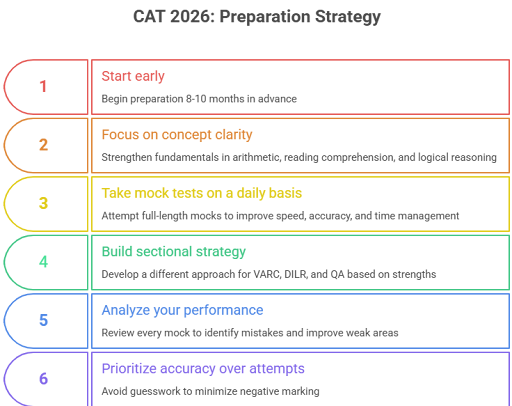
Aspirants are advised to prepare for the exam as early as possible to ensure building enough understanding, conceptual clarity and strategies to pass the exam with flying colors.
In this guide, you will be provided materials related to CAT, such as exam date, registration, eligibility, syllabus, patterns, and preparations.
A Snapshot To CAT Exam 2026
Parameter | Details | Why It Matters |
Exam Name | CAT Exam 2026 | Primary MBA entrance exam in India |
Full Form | Common Admission Test | Standardized aptitude test for management admissions |
Conducting Body | Indian Institutes of Management (IIMs) | Ensures credibility and nationwide recognition |
Exam Level | National | Accepted by top B-schools across India |
Exam Mode | Computer-Based Test (CBT) | Requires familiarity with digital interface |
Frequency | Once a year | Limited opportunity increases competition |
Expected Exam Date | November 29, 2026 (Tentative) | Helps candidates plan preparation timeline |
Registration Period | August–September 2026 | Important application window |
Application Mode | Online | Entire process conducted digitally |
Eligibility | Graduation with 50% marks (45% for reserved categories) | Basic qualification for MBA admission |
Final-Year Students Eligible | Yes | Allows students to apply before graduation completion |
Age Limit | No age limit | Open to both freshers and working professionals |
Attempt Limit | Unlimited | Candidates can improve scores through multiple attempts |
Duration | 120 Minutes | Tests speed and time management skills |
Sectional Timing | 40 Minutes per section | Prevents switching between sections |
Total Sections | 3 | Evaluates multiple aptitude areas |
Sections Included | VARC, DILR, QA | Covers verbal, logical, and quantitative skills |
VARC Full Form | Verbal Ability & Reading Comprehension | Tests reading and language ability |
DILR Full Form | Data Interpretation & Logical Reasoning | Measures analytical and reasoning skills |
QA Full Form | Quantitative Aptitude | Assesses mathematical aptitude |
Total Questions | Around 66 | Determines overall exam strategy |
Question Types | MCQ + TITA | Mix of objective and non-MCQ questions |
TITA Meaning | Type In The Answer | No options provided; answer typed manually |
Negative Marking | -1 for wrong MCQs | Accuracy becomes extremely important |
Negative Marking for TITA | No | Encourages attempting non-MCQ questions |
Medium | English only | Important for preparation strategy |
Difficulty Level | Moderate to High | Requires serious preparation |
Number of Slots | Usually 3 slots | Scores normalized across sessions |
Score Validity | 1 Year | Used for current admission cycle |
Expected Applicants | 3.5–4 lakh candidates | Indicates intense competition |
CAT 2026 EXAM - Important Details (Expected)
Event | Expected Date |
Official Notification release | Last week of July 2026 |
Registration starts | First week of August 2026 |
Registration ends | Mid-September 2026 |
Application correction window | September 2026 |
Admit card release | October/November 2026 |
CAT 2026 Exam Date | November 29, 2026 |
Answer Key Release | December 2026 |
Result declaration | December 2026/January 2026 |
IIM Interview Process | February-April 2027 |
Key Objectives of CAT Exam
Key objectives | Description | Why it matters |
Evaluate aptitude skills | CAT tests verbal, logical and analytical abilities. | Helps institutes to identify academically capable students. |
Assess problem-solving skills | CAT questions are designed to evaluate decision-making and analytical thinking of students. | Essential for managerial roles. |
Measure time management | Candidates must solve questions within strict sectional limits | Shows the ability of students whether they can perform under pressure. |
Test logical reasoning | The DILR section checks reasoning and interpretation skills. | Great for strategic business decisions. |
Evaluate communication skills | VARC assesses reading comprehension and language proficiency. | Strong communication is essential in management careers. |
Assess numerical ability | QA section measures mathematical understanding and accuracy | Important for finance, analytics, and operation roles. |
Shortlist MBA aspirants | CAT serves as a screening test for MBA admissions | Helps top B-schools shortlist deserving candidates. |
Ensure fair evaluation | Standardized national-level exam creates uniform assessment criteria | Maintains transparency and selection based on merit. |
Identify leadership potential | Exam structure evaluates critical thinking and mental ability of students | Important for future managerial responsibilities |
Test analytical thinking | Complex questions assess data interpretation and structured thinking | Essential in environments where problem-solving skills are required. |
Remember, CAT is not just about scoring marks in the exam. It is about preparing for future talent in management based on the academic assessment.
CAT Exam 2026: Notification
The official notification associated with CAT exam 2026 will be made public on the official CAT portal. When students are notified about CAT Exam 2026, the information generally includes following particulars;
Details regarding conducting body
Exam schedule
Eligibility criteria
Registration process
Reservation policy
Exam pattern
Test city list
Important instructions
Note: As per exam rotation trend, the Indian Institute of Management Indore is likely to be the conducting body for CAT Exam 2026.
Core Skills Tested In CAT Exam:
Verbal Ability and Reading Comprehension (VARC):
Verbal ability: Students are evaluated based on their proficiency in vocabulary, grammar and in arranging disorganized sentences into logical order (e.g. paragraph jumbles).
Reading Comprehension: In this test, students/aspirants are tested based on how quickly they understand, analyze, and interpret complex passages.
Topics: Tense errors (phrasal verbs, Parts of Speech, Sentence completion), Antonyms (Syllogisms, sentence completion/correction), Idioms (phrases modifiers, etc.)
Analytical and Logical Reasoning (DILR):
This test assumes comprehensive analysis of how aspirants analyze complex data sets, identify patterns, and draw logical conclusions from graphs, tables, and puzzles.
Quantitative Aptitude:
Evaluation of aspirants' numerical ability, accuracy and speed in solving mathematical problems related to algebra, arithmetic, geometry and modern math.
Time Management & Decision-making:
This evaluation tests how aspirants manage time and decide which questions to solve and which to skip under a permissible timeframe per section to enhance accuracy.
Mental Calmness and Pressure Handling:
This evaluation means how aspirants solved hard questions under limited time while maintaining calm and confidence.
CAT Exam 2026: Eligibility Criteria:
Eligibility Criteria | Details |
Educational qualification | Bachelor's degree from recognised university or institution. |
Min Marks | 50% of General/OBC/EWS/, 45% for SC/ST/PwD. |
Final-year students | Eligible to apply |
Age limit | No age limit |
Attempt limit | Unlimited |
Accepted degree | Regular and distance-learning degree, though recognised |
Acceptable professional courses | CA, CS, CMA/ICWA equivalent qualifications |
Academic stream | All streams eligible |
Work experience | Not mandatory |
Nationality | Indian and foreign candidates |
Reservation benefits | Based on Government norms |
Required documents | Graduation marksheets, ID proof, category certificate |
Degree recognition | Must be from UGC/AIU-recognised institution |
Eligibility verification | Done during admission process |
Eligible candidates for CAT Exam 2026
Candidate type | Why CAT is relevant for them |
Final year students | An exposure to management career right after graduation |
Graduates | Career pathway for business and management roles |
Working professionals | Career growth, role switch, or professional upgrade |
Engineers | Move into managerial and leadership roles |
Commerce students | Build career in finance, marketing, business domains |
Arts/Humanities students | An entry into corporate and management sectors |
Science students | Career exposure into analytics and business |
CA/CS/CMA professionals | An upgrade in managerial and strategic skills |
Freshers | A gateway to top MBA institutes early in career |
Entrepreneurs | Develop business and management skills |
IT professionals | Transition from technical to managerial roles |
Aspirant business leaders | Develop leadership and decision-making abilities |
CAT Exam 2026: Syllabus Overview
The CAT 2026 Syllabus is divided into three sections: VARC, DILR, and QA. The exam is expected to be scheduled on November 29, 2026. In addition, the syllabus is designed to evaluate the aptitude of students based on these three sections, focusing on conceptual clarity, and problem-solving approach. This is why understanding the syllabus is very important for students to be able to build a preparation strategy effectively and include in priority the high-yield topics.
Read Also: NEET 2026 Exam Date 21 June 2026 - Latest Updates
CAT Exam 2026: Exam Patterns, Marking Scheme (Expected)
Understanding the CAT Exam 2026 pattern is a crucial step to preparing for the exam, considering it is an evaluation-based examination where candidates are supposed to gather early understanding about the structure of the paper, sectional timing, question types, and marking scheme before they start to prepare for the exam.
The CAT Exam 2026 pattern aims to evaluate both accuracy and time management of candidates under a permissible timeframe. They are also expected to perform consistently across all mandatory three sections: VARC, DILR, and Quantitative Aptitude. Each section of the exam will have a fixed time limit, meaning candidates can't switch between sections during the exam.
The CAT marking scheme is also worth considering in this regard, as it evaluates whether candidates deserve admission to prestigious institutions by assessing their performance relative to one another. You can also say it rewards accuracy and smart attempts made by candidates during exams. There is provision for negative marking in multiple choice questions for incorrect answers. However, non-MCQ or TITA (Type in The Answer) questions do not carry negative marking, thus being safe to attempt if not totally sure or at least better than negative marking.
Detailed Pattern Overview of CAT Exam 2026
SECTION | TOTAL QUESTIONS | MCQs | NON-MCQS | TIME LIMIT | DIFFICULTY LEVEL | IDEAL ATTEMPT STRATEGY |
VARC | 24 | 19 | 5 | 40 mins | Moderate | Focus on RCs, attempt 16-18 accurately. |
DILR | 20 | 15 | 5 | 40 mins | High | Select 2-3 tests, no guesswork. |
QA | 22 | 14 | 8 | 40 mins | Moderate-high | Focus on arithmetic & Algebra |
Total | 66 | - | - | 120 mins | Balanced attempts with high accuracy. |
Source: asiapacific.edu
Please be mindful that the expected CAT Exam 2026 pattern is based on recent CAT trends. Therefore, actual question distribution may vary, depending on conducting IIM.
CAT Exam Fees 2026 (for General/OBC/SC-ST)
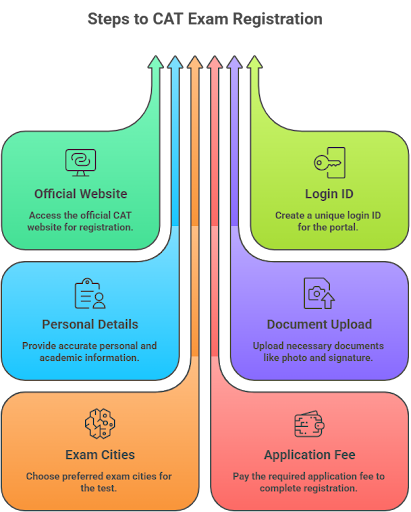
For the upcoming CAT 2026 Exam, the registration fees for General/OBC candidates is Rs 2400-Rs 2600 (approx), and Rs1300 for candidates in the category of SC/ST/PwD. Payment can be done using Debit card, credit card, Net Banking, or UPI. Remember, fees are non-refundable under most circumstances. Therefore, review all the details furnished in your form before submitting. Scheduled registration is likely on August 1, 2026, on the official website of CAT.
Final Thoughts
CAT Exam 2026 appears a significant academic milestone for students as an entry point to all 21 Indian Institute of Management and other prestigious management schools across India. The exam heralds a great opportunity for students and professionals who want to build a successful career in management, consulting, finance, and analytics, as well as in other fields like marketing, corporations and businesses. Despite being one of the toughest exams, it is equally helpful for aspirants who prepare for it with dedication and consistency.
To crack CAT Exam 2026, more than relying on intelligence or academic background, aspirants should also focus on maintaining disciplined preparation, strategic practice, time management, and calmness. Also, early preparation of the exam lays the solid groundwork for better understanding and concept clarity of the exam and is considered a great strategy rather than relying on last-minute efforts.
Latest Blogs
8 Why Your PMO Is Dying, and How PRINCE2 7 Could Save It
 Is PRINCE2 Certification Still Worth It in 2026? An Honest ROI Breakdown
 Top 20 Toughest Exams in the World 2026: Students Guide
 $100 Billion AI Automation Boom: Why Businesses Are Investing More in 2026
 CISSP vs. CISA: Which Cybersecurity Certification Controls Your Career?
 What is Continual Learning in AI and Machine Learning?
  What are the Major Benefits of Online DBA Programs?
 CMAT 2027: Exam Date, Syllabus, Exam Pattern, Preparation Tips & FAQs

Careerera Editorial Team
The Careerera Editorial Team is a collaborative group of education writers, researchers, editors, content strategists, and subject matter experts dedicated to creating accurate, well-researched, and learner-focused content across technology, business, and professional education. Every article follows a structured editorial process that includes research, source verification, editorial review, and quality assurance before publication. The team references recognized academic institutions, certification bodies, industry research, and authoritative publications to deliver trusted content that helps learners and professionals make informed education and career decisions.