

Boost Your Tech Career in 2026
For Indian professionals everywhere — in Bengaluru, London, Toronto, or Dubai — navigating AI disruption, real layoff numbers, and what to do next.
Across the global tech industry, a clear pattern is emerging: companies are cutting roles at the bottom while simultaneously investing heavily in AI at the top. If you are a working professional — in India or abroad — the question is not whether this affects your field. It already does. The only question left is what you do about it.
The AI Disruption — What The Numbers Actually Say
Start with the layoff data, because it is the most concrete signal. According to Layoffs.fyi — one of the most consistently maintained public trackers of tech industry layoffs — over 260,000 tech employees were laid off globally in 2023, followed by approximately 150,000 more in 2024. These are not pandemic-era adjustments. These are companies that over-hired during the growth years and are now restructuring around automation. Many of the same firms cutting headcounts have publicly announced significant AI tool investments in the same earnings calls.
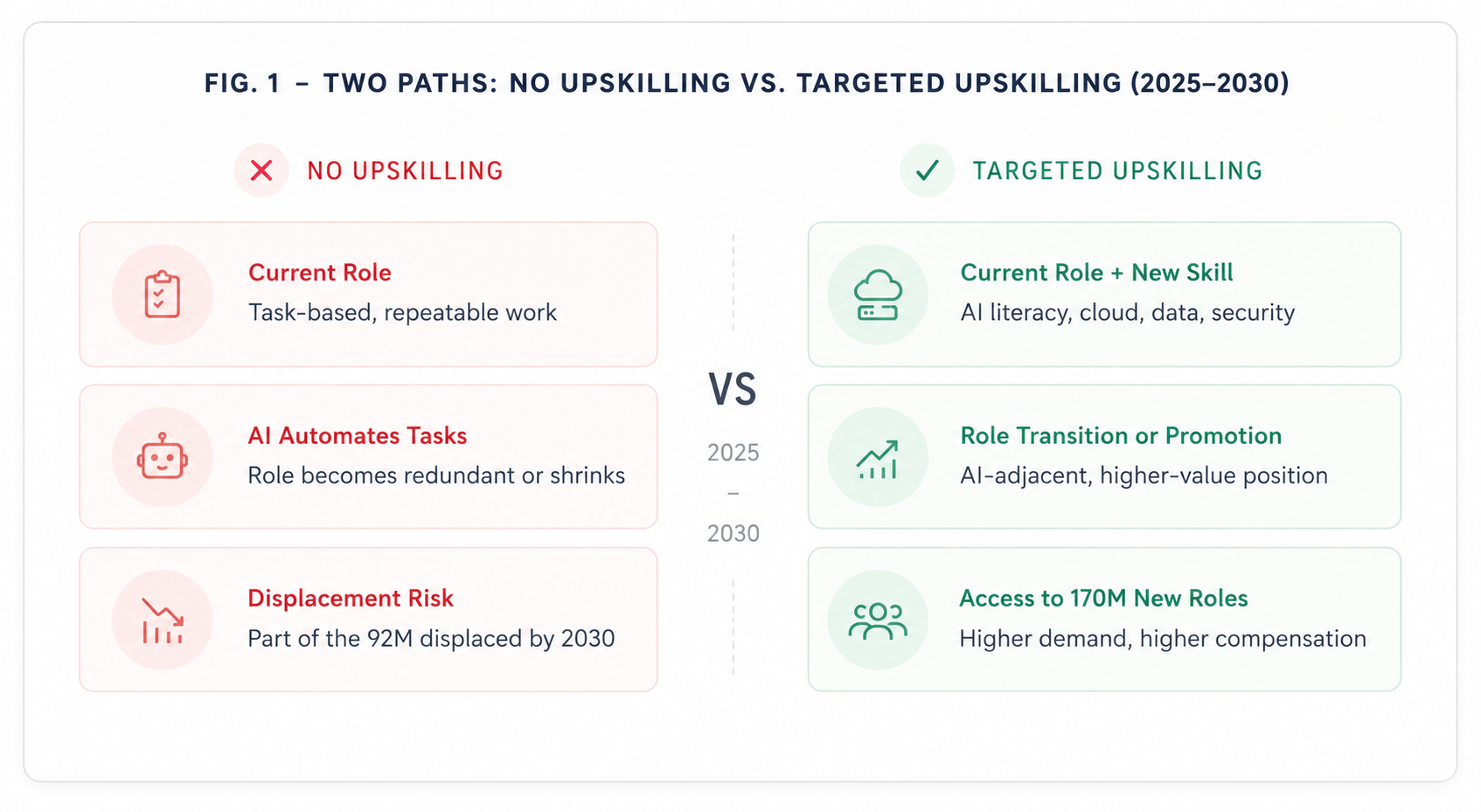
At the macro level, the World Economic Forum's Future of Jobs Report 2025 — which surveyed over 1,000 employers across 55 economies — is the most credible forward-looking document available. It projects that by 2030, roughly 92 million jobs will be displaced by automation and AI, while 170 million new roles will be created. Net positive: 78 million jobs. An important caveat is that the new roles require skills the existing workforce mostly does not have today.
260K+ | 65% | 170M | 5.4M |
Tech layoffs in 2023 (Layoffs.fyi) | Orgs using Gen AI regularly in 2024 (McKinsey) | New jobs created by 2030 (WEF 2025) | IT-BPM professionals in India (NASSCOM 2024) |
McKinsey's 2024 State of AI survey puts the adoption curve in sharp focus: 65% of organizations now regularly use generative AI — up from just 33% in early 2023. That is near–doubling in under 12 months. Goldman Sachs Research (2023) estimated that AI could automate tasks equivalents globally — not sudden job cuts but extensive job restructuring, which has already begun in customer services, quality assurance, fundamental programming, data entry, and content generation.
"As highlighted by Saadia Zahidi in the context of the Future of Jobs Report 2025, the future of jobs is less about replacement and more about transformation, where human judgment and AI collaboration become increasingly valuable."
— Saahida Zahidi, MD, World Economic Forum
The disruption is not uniform, Entry-level roles built on repetitive tasks — QA testing, basic data entry, templated code reviews, first-line customer support — are the most immediately at risk. Mid-level analytical roles face restructuring next. While the senior roles requiring strategic judgment, client trust, and cross-functional leadership remain the most insulated. For now.
5 Shifts Defining the Workforce of 2030
Your skills have a shelf life and it's getting shorter: Nearly 40% of core workplace skills are expected to change by 2030. AI, data literacy, and digital security are becoming essential. What made you employable yesterday may not be enough tomorrow.
The real advantage will not be technical knowledge alone: It will belong to people who can combine technology with judgment, creativity, and critical thinking. Machines can generate output. Humans create meaning from them.
Companies are investing in people, not just automation: Instead of replacing talent outright, many organizations are prioritizing upskilling because building internal capability is often faster and more strategic.
The future of work is collaboration between AI and humans: The WEF report is clear on this: AI is being built to handle repetitive tasks so humans can focus on higher-order work. The goal is augmentation, not replacement. Your role is to direct, interpret, and improve what the machine does — not race against it.
Fastest growing careers sit at the intersection of tech and sustainability: AI/ML specialists, data analysts, and renewable energy engineers are at the top of the list. These aren't niche roles anymore. They are the mainstream career paths of the next decade.
Read Also: Free Generative AI Courses for Beginners: Start your AI Journey with Zero
Why Indian Professionals Are at a Global Crossroads
India's IT-BPM sector employs approximately 5.4 million professionals, according to NASSCOM's 2023–24 Strategic Review. In addition, about 1-1.5 million Indian-born tech specialists work in countries like America, the UK, Canada, Singapore, UAE, and Australia. The integration of Indian professionals into the global tech value chain implies that their exposure to the risks of AI is higher compared to most other nationalities.
The WEF 2025 report identifies 2025–2030 as the critical transition window. This is the period in which reskilling decisions determine who benefits from AI–driven economic growth and who is left behind. This is not a distant planning exercise. Professionals who begin upgrading their skills in 2025–26 will be positioned for the new–role wave by 2027–2028. Those who wait until displacement hits will find the competition far steeper.
Five Most In-Demand Tech Skills for 2026
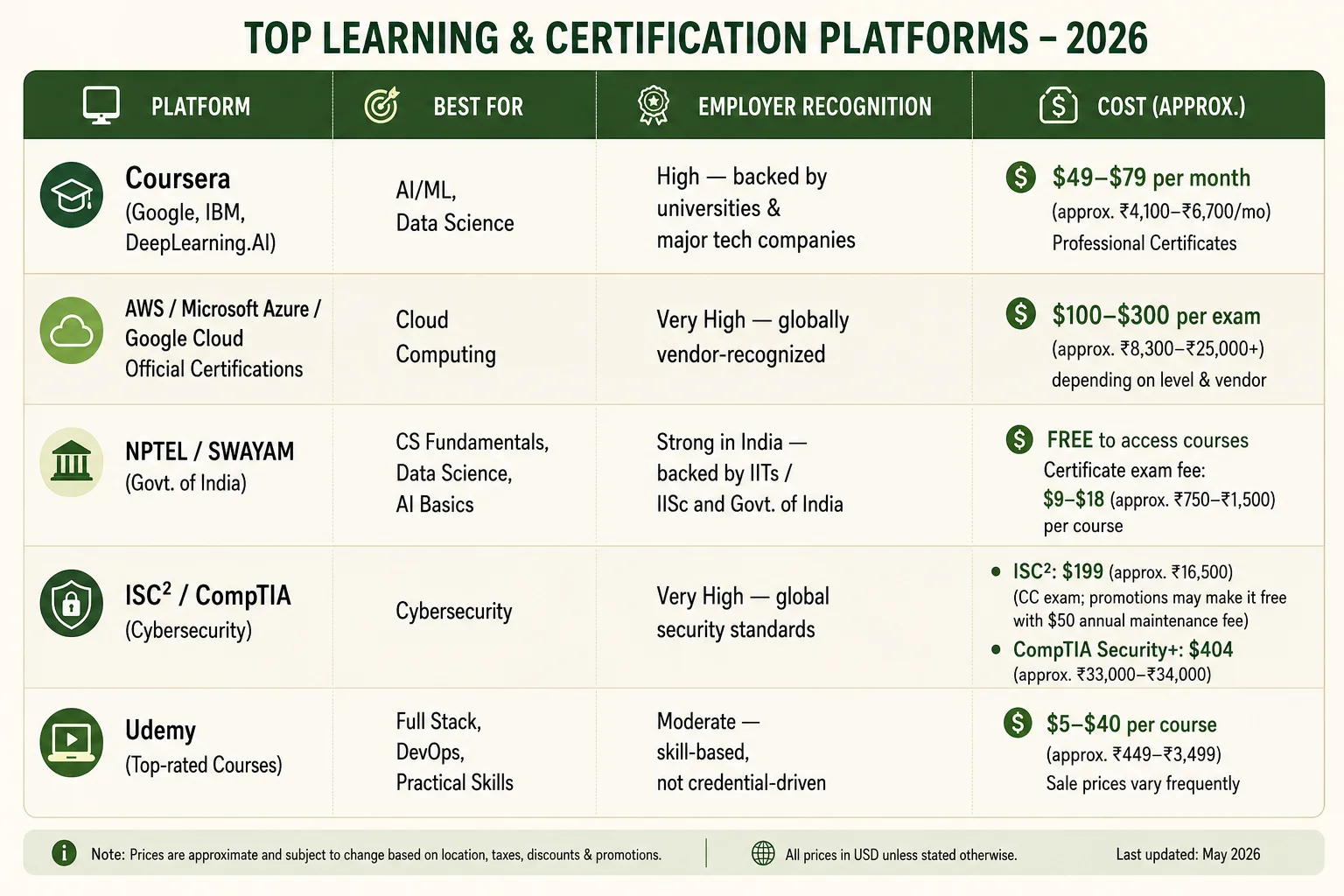
LinkedIn's 2024 Workplace Learning Report identified AI literacy, cloud skills, and data analysis as the three fastest–growing hiring requirements across all industries globally. They correlate into very precise, learnable certifications that companies seek when reviewing resumes or LinkedIn profiles. Following is a list of the top-five skill categories and the platforms that deliver recognized credentials for these skills.
1. AI & Machine Learning
Prompt engineering, model usage, LLM integration, and AI product workflows. The foundational literacy every role requires.
2. Cloud Computing
AWS, Azure, GCP certifications. Vendor-verified, globally portable, and among the highest–paying credentials in any market.
3. Data Science & Analytics
Python, SQL, PowerBI, Tableau. Every organization makes decisions through data. Data–literate professionals are universally hireable.
4. Cybersecurity
As AI tools expand attack surfaces, security expertise is in critical short supply globally — a deliberate structural shortage.
5. Full Stack Development
React, Node.js, REST APIs. Demand has shifted from volume coders to developers who can architect and integrate AI–powered systems.
Decision Table — Which Course Fits Your Profile
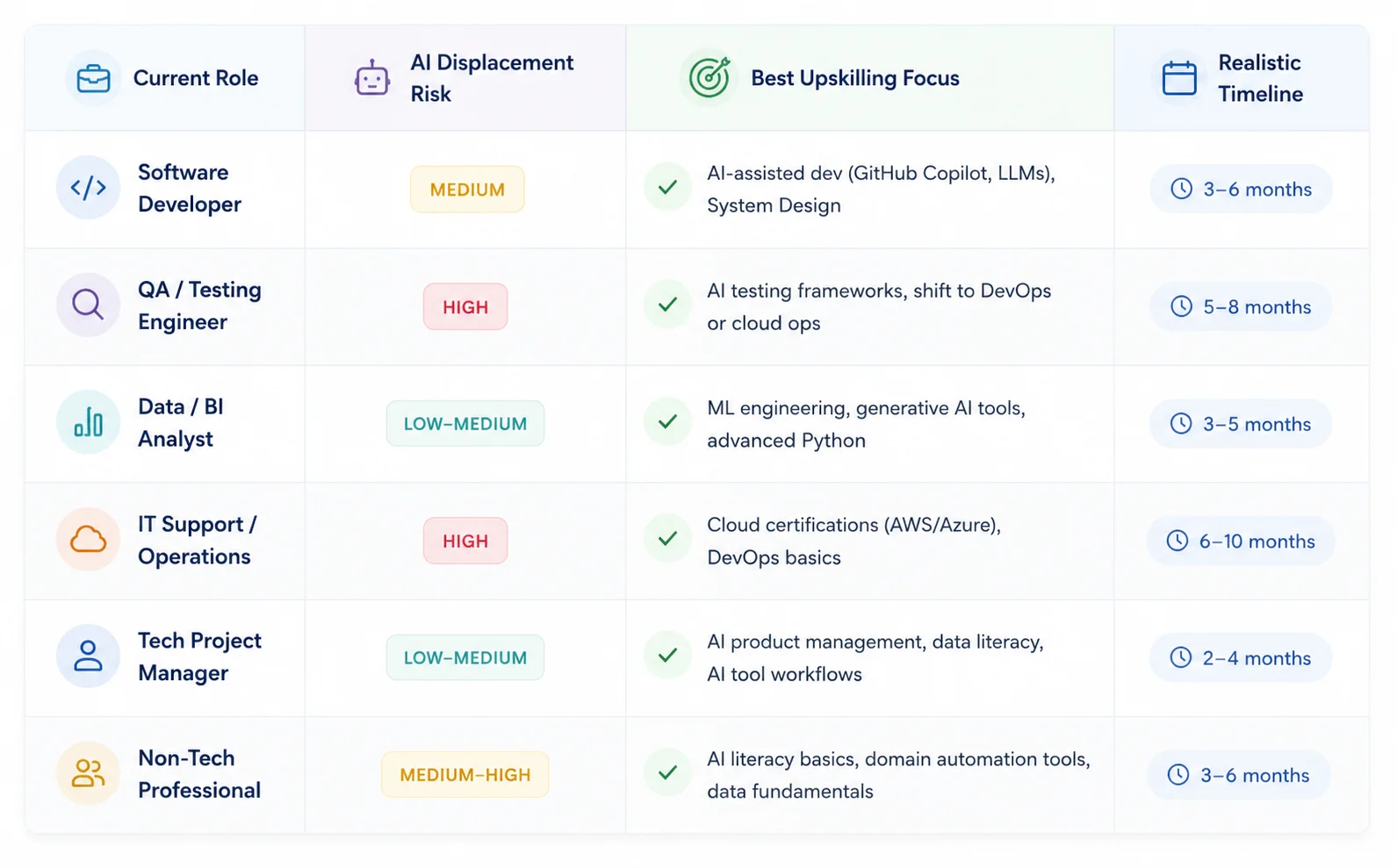
The right upskilling path depends on where you are now, not just where you want to go. Proximity to your current role reduces the learning curve and speeds up time-to-value. Use this table as a starting framework:
Advantage of Upskilling — Real Data, Real Hope
Here is what the same reports that flag displacement also show: the demand side of this equation is enormous. The WEF 2025 Future of Jobs Report lists the five fastest–growing global job categories through 2030 — AI and ML Specialists, Data Analysts and Scientists, Cybersecurity Professionals, FinTech Engineers, and Renewable Energy Engineers. Four of these five are directly reachable through online certifications for mid-career professionals. No degree required. No campus.
What Employers Are Actually Searching Right Now
AI Skills are no longer a niche advantage. From the WEF to PwC and Coursera, global workforce data shows that employers are increasingly prioritizing professionals who can work with AI, interpret its output, and apply human judgment where automation stops. (Source: WEF, PwC & Coursera)
For Indian professionals working outside India, this matters equally. Cloud certifications from AWS, Azure, or Google Cloud carry identical weight in San Francisco, Sydeny, or Riyadh. A complete Google Data Analytics Professional Certificate on Coursera is recognized by hundreds of global employers. The credential value does not diminish by geography. The learning playing field is flat in a way that it has never before.
NASSCOM has also projected a significant and growing skills gap within India itself — particularly in AI/ML engineering, cloud architecture, and cybersecurity analysts — through 2027. Domestic Indian companies, MNC India operations, and GCCs (Global Capability Centers) are all expanding AI–ready teams. The hiring pipeline cannot fill fast enough. The gap is a direct opportunity for professionals who upskill now.
"AI is the new electricity. Just as electricity transformed almost everything 100 years ago, today I actually have a hard time thinking of an industry that I don't think AI will transform in the next several years."
— Andrew Ng, speaking at Stanford Graduate School of Business (2017), a theme he has reiterated in later talks and Coursera communications.
Read Also: FREE ChatGPT Courses For Beginners: Learn AI Skills
Where to Start — A Practical Path for Working Professionals
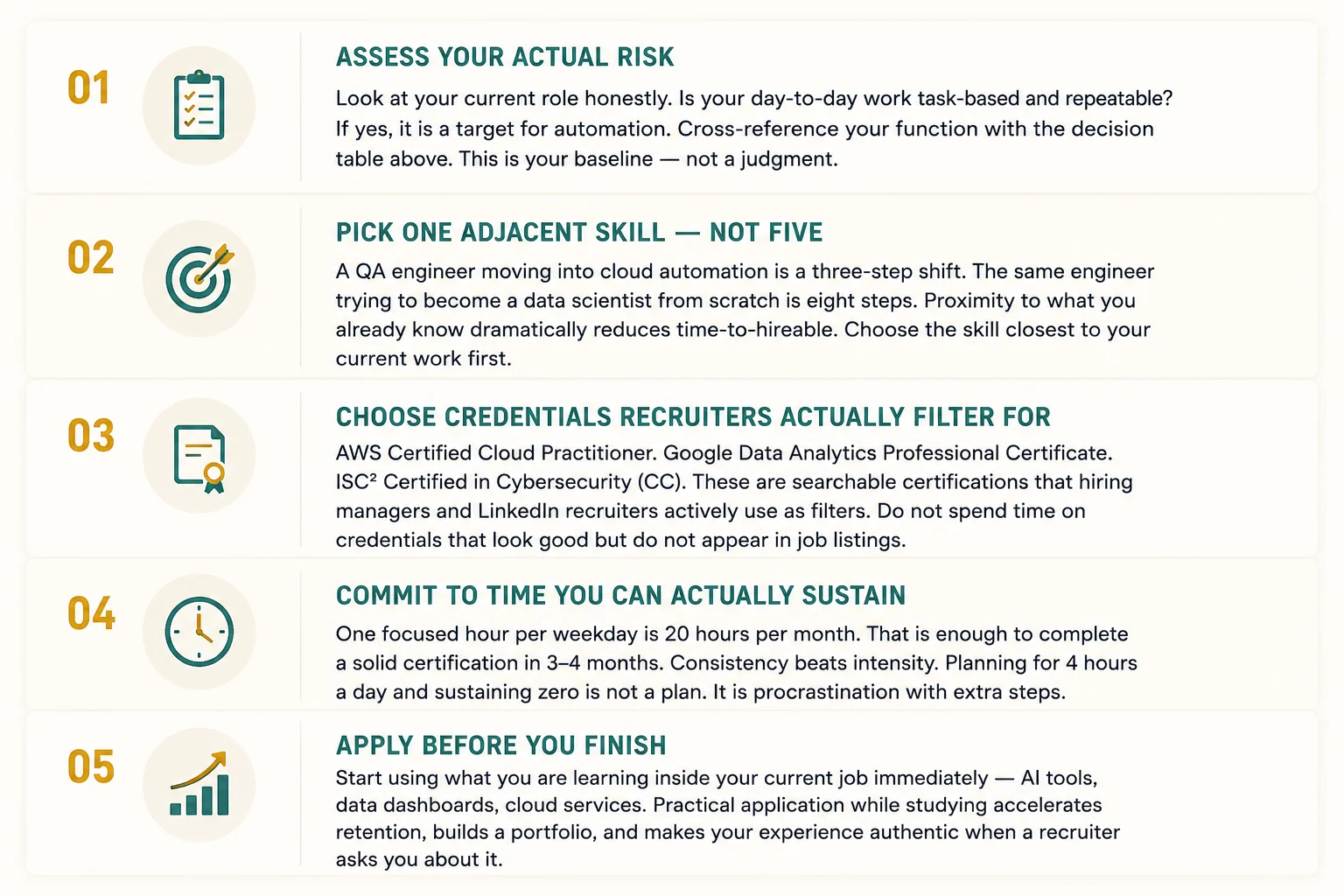
The most common mistake is trying to learn five things simultaneously while holding a full-time job. That approach produces burnout, not credentials. A focused, sequential approach produces results in months, not years.
For Indian Professionals Working Outside India
If you are based in the US, UK, Canada, Singapore, UAE, or Australia — give priority to vendor–certified credentials (AWS, Azure, GCP) and globally portable cybersecurity certifications (CompTIA Security+, ISC2 CISSP, or CC). These hold strong credibility with local employers and are independent of region–specific recognition systems. NPTEL/SWAYAM credentials are excellent for strengthening fundamentals but are less recognized by non–Indian employers in isolation.
Read Also: Free Ethical Hacking Courses: Pathway to Upskill In Cybersecurity
Conclusion
By the numbers, the message is impossible to ignore — in 2023, more than 260,000 tech professionals lost their jobs amidst layoffs, followed by another 150,000+ in 2024. 65% of companies have adopted generative AI in their daily operations. Meanwhile, it is estimated that up to 92 million jobs may be displaced by 2030, but a total of 170 million new jobs will emerge. Countries like India which has more than 5.4 million IT workers, can feel the impact even more. Clearly, there is an opportunity, especially in areas such as AI/ML, cybersecurity, cloud computing, data analytics, and full stack development, but it requires that the individuals prepare themselves with certifications in advance with necessary skills before the market fully changes.
Latest Blogs
8 $100 Billion AI Automation Boom: Why Businesses Are Investing More in 2026
 CISSP vs. CISA: Which Cybersecurity Certification Controls Your Career?
 What is Continual Learning in AI and Machine Learning?
  What are the Major Benefits of Online DBA Programs?
 CMAT 2027: Exam Date, Syllabus, Exam Pattern, Preparation Tips & FAQs
 Why Is Nursing in Demand in 2026? Trends Driving the Need for More Nurses
 Why more Indian Students are Opting for Doctoral Degrees
 ChatGPT Vs Claude (2026 Guide)

Priyank Jha
Priyank is a Senior Content Developer and Strategist at SNVA Veranda. Earlier, he worked as a data scientist, where he gained extensive experience in developing data-driven solutions, advanced analytics, and strategic decision-making processes. His expertise includes data analysis, business intelligence, and implementing data-centric strategies that drive organizational growth and innovation. In addition to his data science experience, Priyank has over 10 years of experience in the banking and financial services sector. He has worked across various roles and operational levels, gaining in-depth knowledge of financial operations, customer service management, and business processes.