

You may have probably read 50 of these ChatGPT vs Claude articles. They all say the same thing. But I bet this one won't. I went down a rabbit hole with ChatGPT and Claude.
If you ask them to write a blog post, both can do it.
If you ask them to summarize a PDF, both can do that, too. But the actual differences come from when you ask them to:
Analyze a 150-page report,
Build a marketing strategy from scratch,
Find the holes in your thinking,
Write or debug code,
Challenge your assumptions and act like a senior consultant who actually reads the whole brief.
Over the last two years, I've used both tools across content strategy, prompt engineering, research workflows, long-form writing, document analysis, and business planning. I've intentionally pushed them beyond simple chatbot tasks to see how they behave when I pressurize them.
Test this yourself:
Open ChatGPT and Claude in a different tab.
Ask both: "Who are you, what do you stand for, and what principles guide your responses?"
Don't compare the words. Compare the identity behind the words. The answers reveal more about these models than any feature table or 3000 words ever could.
What you're going to get in this guide:
Side-by-side tests with actual outputs, not theoretical comparisons
ChatGPT vs Claude: 10 Day Performance Test
Ideas of prompts that most people have never thought to try
The uncomfortable truths neither company likes to talk about
A clear, specific verdict for YOUR situation, and not a generic one
By the end of this, you'll get to know which tool fits your workflow, which is worth paying for, and honestly? Why you might need both.
Let's get started.
The Founding Story Behind ChatGPT and Claude
If you want to understand their behavioral differences, don't start with features, pricing, or outputs. Start by comparing their soul and motive first.
ChatGPT
On November 30, 2022, OpenAI released a chatbot not as a product company but as a nonprofit research lab, and they called it ChatGPT. ChatGPT stands for Chat Generative Pre-trained Transformer. Within five days, it had a million users. Within two months, 100 million. That's a milestone that took Instagram two and a half years and TikTok nine months to reach. ChatGPT did it in sixty days.
ChatGPT comes from OpenAI, an organization founded in 2015 by figures including Sam Altman, Elon Musk, Greg Brockman, Ilya Sutskever, and several leading AI researchers. Together, they announced more than $1 billion in pledged funding and a mission to develop artificial intelligence with an aim of benefiting humanity in an open, transparent, and safe way.
Interestingly, the original fundraising target was around $1000 million, but Musk reportedly pushed for a much larger figure, arguing that anything small would look less ambitious and offering to cover any funding shortfall himself. Over time, Musk left OpenAI's board in 2018 because of the potential conflict with Tesla's AI efforts, though reports later suggested disagreements over the company's direction.
OpenAI faced another major turning point in November 2023 when its board unexpectedly removed Sam Altman as CEO, claiming he had not been sufficiently candid in communications. The decision triggered an internal revolt, with most employees threatening to quit and Microsoft moving quickly to hire Altman. Within five days, Altman returned as CEO, the board was reshaped, and the episode became one of the most dramatic leadership reversals in modern tech history.
Despite all this, today, OpenAI is valued at roughly $840 billion and generated around $13 billion in annual revenue. ChatGPT has 900 million weekly active users, which is more people than the combined populations of the US, EU, and Canada using it every single week.
Claude
Anthropic is the AI research and development company founded in 2021 by Dario Amodei and his sister Daniela Amodei, along with several former OpenAI researchers. While Claude is the name of an AI assistant and the family of language models they produce.
Claude was built around a framework called Constitutional AI, where the model is trained using a written set of principles that guide how it should behave and reason. If we talk about its practical level, it is designed around four main priorities:
Safety: Avoid harmful actions and remain under human oversight.
Ethics: Be honest, responsible, and avoid dangerous behavior.
Guidelines: Follow clear behavioral rules consistently.
Hepfulness: Still solves problems and assists users in the easiest way possible.
Anthopic publicly publishes large parts of this philosophy through documents like Claude's Constitution, which is called MODEL SPEC, explaining how the model should handle difficult situations, disagreements, uncertainty, and ethical trade-offs. For this reason, it has become the dominant choice for professional developers and enterprise users.
However, no equivalent document exists publicly for ChatGPT. This is not something that we can ignore because Claude was designed with internationality about who it is, not just what it can do. But neither is wrong. This way, their foundational idea or design is revealed to you.
One is built to be a maximally capable tool. The other is designed to be a genuinely thoughtful interlocutor.
Latest ChatGPT and Claude Models (2026)
Tool | Model | Release Date | Description |
ChatGPT | GPT-5.5 Thinking | May 2026 | Most powerful reasoning model; best for research, coding, and complex tasks |
ChatGPT | GPT-5.3 Instant | March 2026 | Default everyday model for most users |
ChatGPT | GPT-5.5 Pro | May 2026 | Advanced model for enterprise workflows and large projects |
Claude | Claude Sonnet 4.6 | April 2026 | Best overall model for most users; balances speed and intelligence |
Claude | Claude Haiku 4.5 | October 2025 | Fastest and most cost-effective Claude model |
Claude | Claude Opus 4.8 | May 2026 | Most powerful Claude model for deep reasoning, coding, and complex analysis |
Read Also: FREE ChatGPT Courses For Beginners: Learn AI Skills
ChatGPT vs Claude: Default Behavior
People who are comparing ChatGPT and Claude by features, they are missing the actual gap. The actual gap is hidden in how each model approaches the same problem from the first response.
ChatGPT moves toward action. Meanwhile, Claude slows down to understand structure, risks, and intent before answering.
ChatGPT
When you give ChatGPT a task, it acts like a fast execution partner who tries to reduce the friction between your request and a usable output.
It majorly prioritizes direct answers and not diplomatic ones, ready-to-use formats, along with the immediate execution plan.
Provides faster action plans because when you ask something like: Build a marketing plan for a fitness app. It responds with a step-by-step plan, campaign structure, content ideas, and timeline suggestions.
It adds extras you didn't explicitly ask for, like alternative options, templates, examples, and improvements.
It has an inbuilt tendency to move quickly toward solutions, so it provides a solution early, refining suggestions, options, and adjusting through follow-up prompts.
Claude
It does not rush from the start and run into output. Instead, it builds a mental map of the problem.
Claude is an expert in analytical thinking, as it breaks your request into assumptions, missing information, constraints, and edge cases.
It doesn't prefer speed like ChatGPT and prefers more cautious responses. It focuses more on clarifying intent, highlighting uncertainty, and provides multiple interpretations of the request.
It explores options first, compares approaches, and then suggests a final direction. It behaves more like a consultant who wants alignment before execution.
Example Prompt: I'm thinking of starting a freelance content agency. What should I do first?
ChatGPT Response | Claude Response |
|
|
ChatGPT vs Claude: 10 Day Performance Test
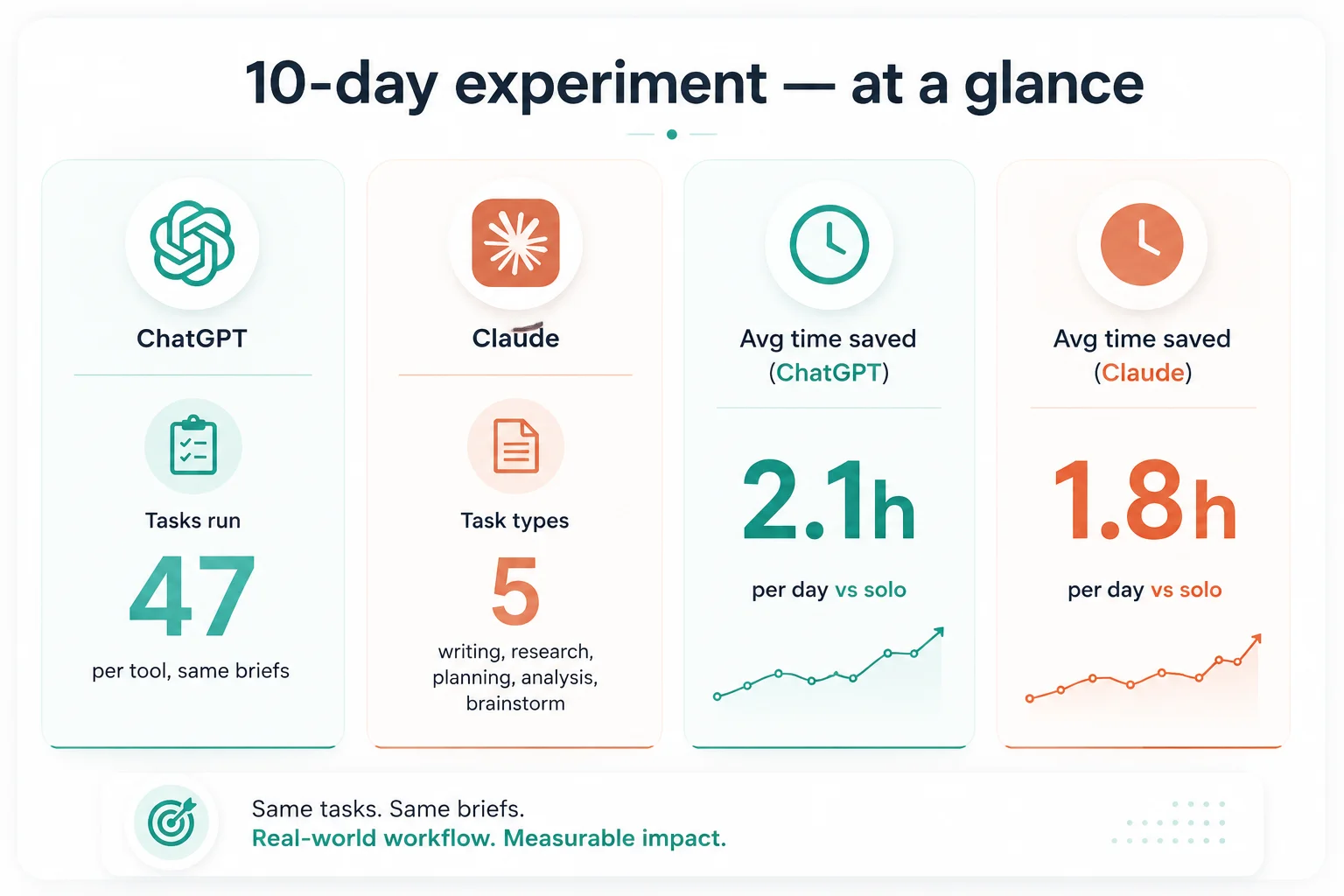
I used ChatGPT and Claude the way most professionals actually use them for their daily work. Every prompt was run on both tools within the same 24-hour window, so conditions stayed consistent. Tasks came from client briefs, content calendars, research requests, and strategy documents.
Day 1-3 Writing Task
First three days, I focused on blog intros, social captions, email drafts, and one long-form article outline. Tasks include
Blog writing
Content strategy
Market research
Business planning
Client communication
Editing
Prompt engineering
Long-form analysis
Example Prompt 1: Write the opening paragraph for a blog post: "Why Most Productivity Systems Fail Within 30 Days". My audience is working professionals, and I keep it engaging and not generic.
ChatGPT Response | Claude Response |
"You've probably tried at least one productivity system- GTD, time blocking, the Pomodoro technique- with the best of intentions. A week in, you're hooked. By week four, it's gathering digital dust. You're not alone, and you're not lazy. Most productivity systems are designed to impress, not to last." My note on this: It is punchy, structured, and immediately usable. Classic hook formula executed well. Reads like a competent writer, but one you've read before. Took me 11 seconds to get this back. | "The problem with most productivity systems isn't that people don't try hard enough. It's that the system is built around who you want to be, not who you actually are at 7 pm on a Tuesday when the motivation has worn off, and dinner still needs cooking. They're aspirational by design. That's also why they collapse." My note on this: The "7 pm on a Tuesday" detail stopped me. That's the kind of specific, grounded observation that earns reader trust instantly. Took about 18 seconds. Worth the extra 7 seconds. |
Day 4-6: Research + Analysis Tasks
Within these days, I focused on judging them on heavy analysis, summarising a 60-page industry report, and pulling insights from three client briefs.
Example Prompt 2: "I'm going to paste a 60-page market research report. Read it fully, then tell me: what is the single most underreported finding that most people will miss, and why does it matter?"
ChatGPT response summary | Claude's response summary |
"The most underreported finding is the divergence in adoption rates between SMEs and enterprise companies in the 50–200 employee band. Most coverage focuses on the enterprise tier, but the report's data suggests the SME segment is growing 3x faster..."
| "The finding most people will miss is in section 4.3, the footnote on regulatory lag in Southeast Asian markets. The headline data shows adoption growing, but this note reveals that 34% of that growth is pre-purchases ahead of a compliance deadline, not organic demand. That distinction changes the 3-year outlook significantly..."
|
Day 7-8: Planning + Brainstorming
Example Prompt 3: "Create a 60-day content launch plan for a B2B SaaS product targeting HR managers. Include channel breakdown, content types, posting cadence, and a pre-launch vs post-launch structure."
ChatGPT Response | Claude Response |
"Pre-launch (Days 1–30): LinkedIn thought leadership (3x/week), teaser email sequence (4 emails), 2 long-form SEO articles targeting HR pain points, 1 webinar announcement... Post-launch (Days 31–60): case study release, customer testimonials, product demo video, retargeting ads..." My note: Complete, structured, and 80% of the way there in one shot. Would have taken me 45 minutes to draft this solo. Needed personalisation, but the bones were solid. | "Before mapping the 60 days, a few things would sharpen this significantly: is the product replacing an existing tool HR managers already use, or creating a new workflow? That affects whether the content angle is 'switch from X' or 'add this capability.' Also, what's the sales cycle length? If it's 3+ months, a 60-day plan needs to focus on top-of-funnel trust, not conversion. Assuming a 45–90 day sales cycle and a switching product, here's the structure..." My note: It asked two questions I hadn't thought to include in the brief — and both were exactly right. The plan it then produced was sharper because of it. The switching vs. new workflow distinction changed three content angles entirely. |
Complex Prompt Example 4 : 30+ instructions, formatting + tone + audience requirements
Instructions included: Write for a non-technical audience, use second person, no bullet points, max 3 paragraphs, include one analogy, end with a question, avoid corporate jargon, use active voice throughout
ChatGPT | Claude |
Followed:
Ignored:
| Followed
Ignored
|
Extreme Prompt Example 5: Multi-constraint, role + writing requirements
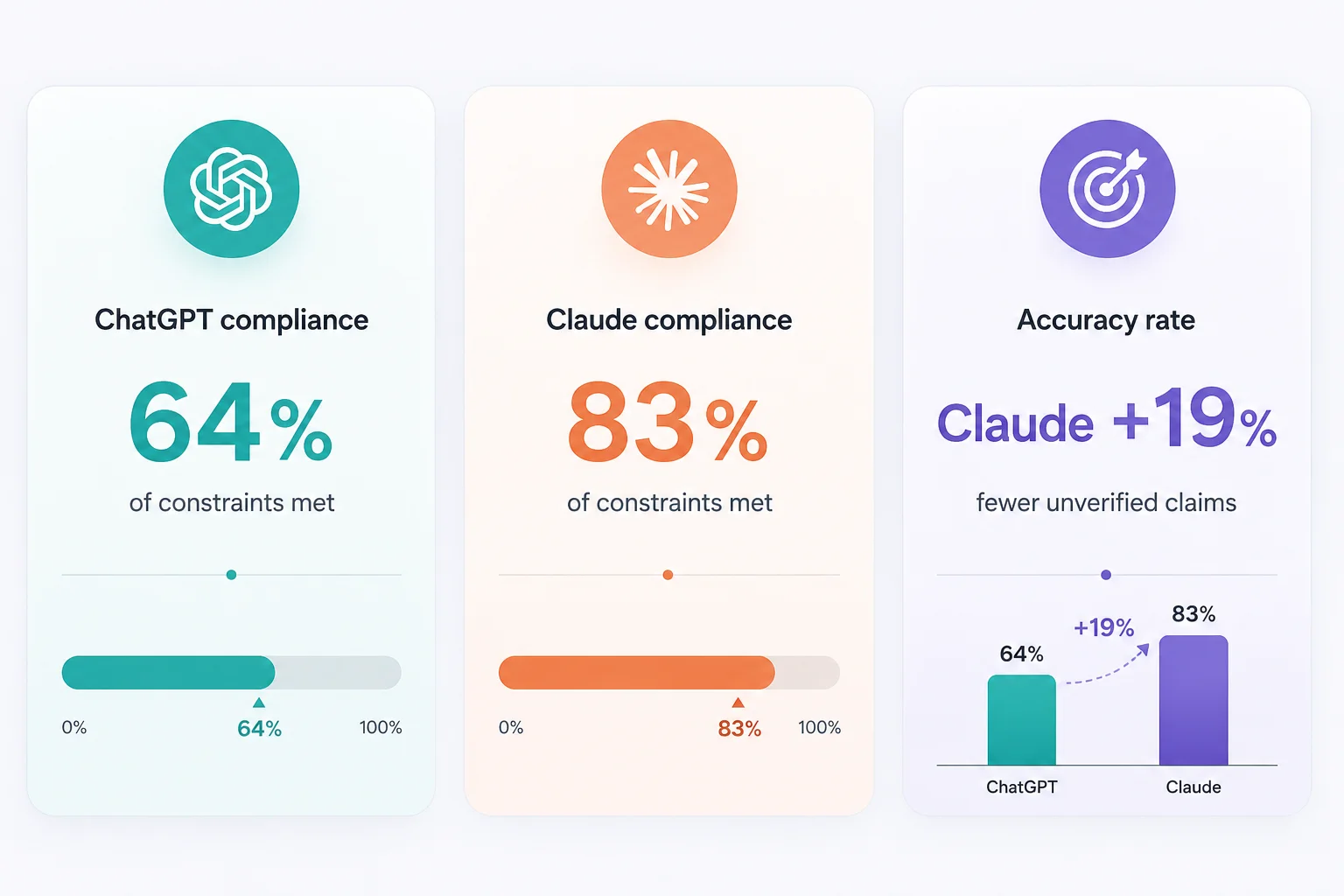
Prompt included: Act as a brand strategist with 15 years of experience, write for a CMO audience, formal but not stiff, data-backed claims only, no filler phrases, each section max 80 words, use the brand name "Vela" naturally 3 times, close with a risk section.
ChatGPT | Claude |
|
|
The ChatGPT pattern I didn’t expect
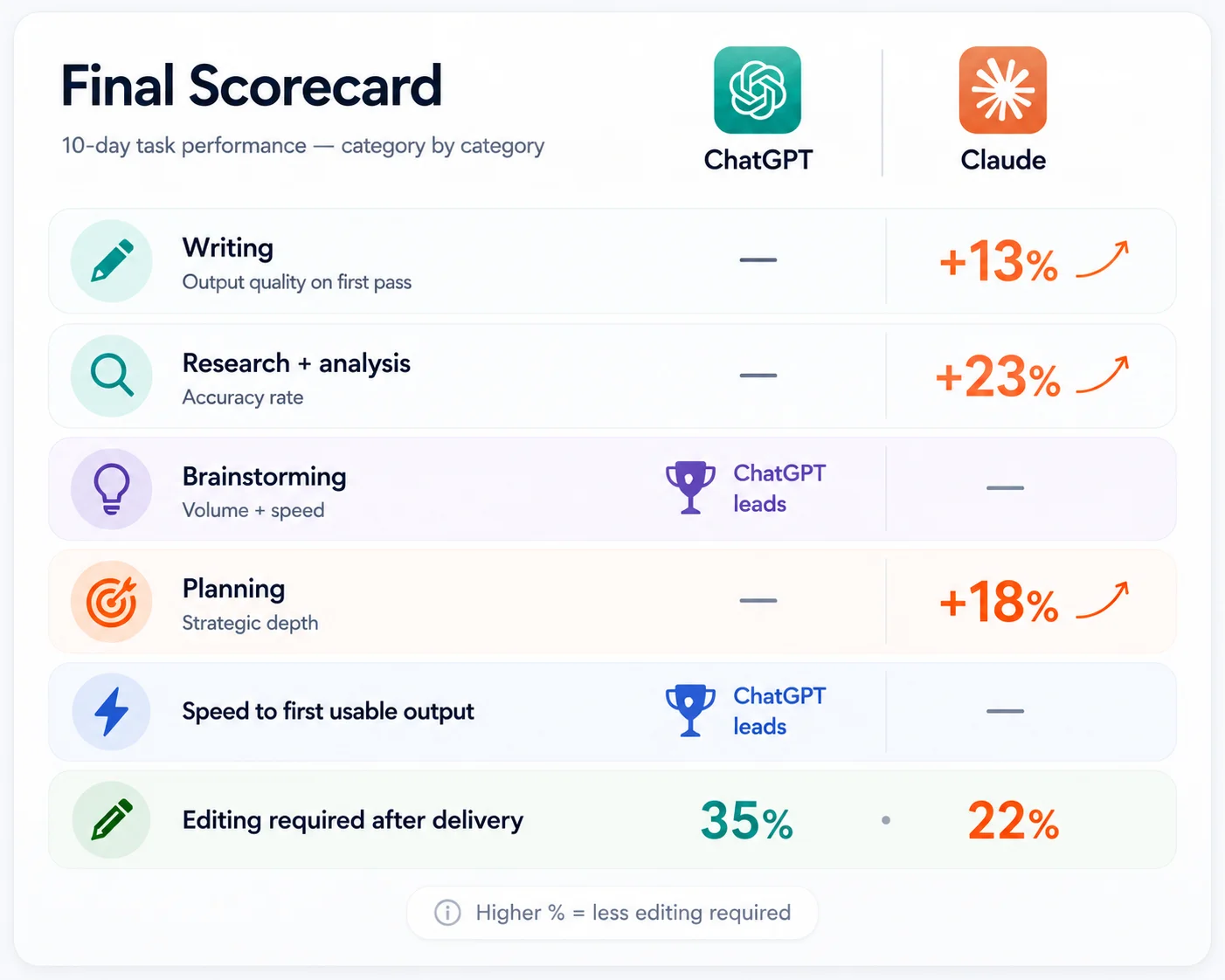
By Day 9, I noticed I was getting faster results but making more re-edits.
Its speed is a subtle trap: I was accepting outputs more quickly than I should have rejected because they looked right at first glance.
Three of my major pieces of content needed a hefty amount of rework on client review that I should have caught myself.
The Claude pattern I didn’t expect
By Day 10, I was having conversations with Claude, not just issuing commands.
The back-and-forth of “here’s my concern”- “ here’s why that matters or doesn’t” felt like working with a junior strategist who had genuinely read the brief.
Two of my best ideas from the 10 days came out of Clade, pushing back on my initial direction. That was not something I expected from an AI tool, and it is something that needs to be appreciated.
The finding that changed how I use both tools: ChatGPT optimises for your confidence. Claude optimises for your outcome. These are not the same thing. In the short term, confidence feels better. Over 10 days, outcome wins. I now use ChatGPT to start things and Claude to pressure-test them. |
ChatGPT vs Claude: The Advanced Testing Round
If all you do is ask AI to write emails, summarize articles, or answer basic questions, ChatGPT and Claude can feel surprisingly similar. That's why many comparison articles conclude they're nearly interchangeable.
My experience was different.
The biggest differences didn't appear during simple tasks. They appeared when I started relying on these tools for work that required judgment rather than just output.
Things like reviewing long reports, spotting flaws in business plans, analyzing multiple documents at once, challenging assumptions, debugging complex problems, and staying consistent across lengthy conversations. At that point, the comparison stopped being about features and started becoming about thinking style.
That's where the gap became impossible to ignore.
Performance Across Advanced Workloads
Test Area | ChatGPT | Claude | Winner |
Long Conversations | Strong memory and continuity | Better context retention over extended discussions | Claude |
Research Papers | Good summaries and findings | Better at extracting implications, limitations, and methodology issues | Claude |
Business Reports | Strong executive summaries | Better risk and opportunity analysis | Claude |
Legal Documents | Identifies major clauses | Better at spotting missing protections and hidden risks | Claude |
Multi-Document Analysis | Good synthesis | Better cross-referencing and contradiction detection | Claude |
Strategic Thinking | Action-oriented recommendations | More layered reasoning and risk awareness | Claude |
Challenging Assumptions | Moderate pushback | Stronger identification of hidden assumptions | Claude |
Devil's Advocate Tasks | Helpful criticism | More rigorous criticism | Claude |
Self-Critique | Good revisions | Better at finding weaknesses in its own answers | Claude |
Blog Writing | Faster drafts | More polished first drafts | Tie |
SEO Content | Strong search intent coverage | Better depth and topic relationships | Tie |
Email Writing | Direct and persuasive | More nuanced and diplomatic | Claude |
Social Media Content | More creative and platform-friendly | More thoughtful but less punchy | ChatGPT |
Long-Form Content (3,000+ words) | More repetition over time | Better voice consistency | Claude |
Market Research | Strong data gathering | Better synthesis and interpretation | Claude |
Trend Analysis | Good pattern spotting | Better long-range connections | Claude |
Information Verification | Good with web-enabled research | More cautious with uncertain claims | Claude |
Hallucination Resistance | Improved substantially | More likely to admit uncertainty | Claude |
Code Generation | Excellent | Excellent | Tie |
Debugging | Strong | Strong | Tie |
Code Refactoring | Strong | Slightly better explanations | Claude |
Full Project Planning | Faster execution | Better architectural thinking | Claude |
The Cognitive Cost Test
A metric that rarely gets discussed is cognitive cost: how much effort you need to spend before an AI produces work you can actually use.
Effort Required | ChatGPT | Claude |
Prompt Engineering | Lower | Slightly higher |
Clarification Needed | Lower | Higher |
Editing After Output | Higher | Lower |
Fact Verification | Moderate | Lower |
Total Back-and-Forth | More iterations | Fewer iterations |
In simple terms:
ChatGPT requires less effort to start.
Claude requires less effort to refine.
ChatGPT vs Claude: The Hidden Differences
Most comparison articles focus on features.
After extended use, I found the bigger differences had nothing to do with context windows, benchmarks, or pricing. They showed up in how each AI thinks, responds, and collaborates.
Area | ChatGPT | Claude |
Confidence Style | More decisive and solution-oriented | More cautious and transparent about uncertainty |
Disagreement Behavior | Usually helps improve your idea | More likely to challenge assumptions and point out flaws |
Recovery After Confusion | Tries to continue and fill gaps | Stops, reassesses, and asks for clarification |
Follow-Up Questions | Fewer questions, faster answers | Better questions, deeper context gathering |
Pattern Recognition | Strong across broad topics and tasks | Stronger in long documents and complex relationships |
Mental Model Building | Explains what to do | Explains why it works |
Collaboration Style | Feels like an operator or executor | Feels like an analyst or advisor |
Who Should Use Which?
Choose ChatGPT if your priority is execution, speed, and versatility.
Best for:
Content creators
Marketers
Developers
Entrepreneurs
Students
General productivity users
Choose Claude if your priority is analysis, reasoning, and decision quality.
Best for:
Researchers
Consultants
Analysts
Technical writers
Legal professionals
Knowledge workers
Final Decision Maker
That distinction explained nearly every result I saw throughout this comparison. |

Rizwana Khan
Philosophy Master’s graduate, AI-certified professional, and content strategist with strong expertise in storytelling, audience psychology, and AI-assisted communication. Rizwana Khan specializes in prompt engineering, SEO content, thought leadership, and brand communication that feels natural, engaging, and audience-focused. Currently working as a Senior Content Executive at SNVA Veranda, she creates compelling content across artificial intelligence, humanities, data analytics, and emerging technology topics. Known for turning complicated ideas into relatable narratives, Rizwana combines creativity, strategy, and modern AI tools to build content that informs, connects, and performs.
Learn how we research, review, and update our content. Editorial Standards & Review Process.

Latest Blogs
8 PhD in Business Careers: Academic and Industry Paths After Graduation (2026 Guide)
 Is an Online DBA Worth It? Salary, ROI, and Career Benefits (2026 Guide)
 PhD vs DBA: Which Doctorate Is Right for You? (2026 Complete Guide)
 How to Compare Online DBA Programs: A Step-by-Step Guide Before You Apply
  Doctor of Business Administration Careers: Jobs, Salary & Growth in 2026
 Why Does a DBA Make More Sense Than a PhD?
 DBA vs PhD: Which Doctoral Degree Holds Higher Academic Value?
 Online DBA Degree Explained: Curriculum, Admission, and Career Opportunities (2026 Guide)
Featured Courses




You may have probably read 50 of these ChatGPT vs Claude articles. They all say the same thing. But I bet this one won't. I went down a rabbit hole with ChatGPT and Claude.
If you ask them to write a blog post, both can do it.
If you ask them to summarize a PDF, both can do that, too. But the actual differences come from when you ask them to:
Analyze a 150-page report,
Build a marketing strategy from scratch,
Find the holes in your thinking,
Write or debug code,
Challenge your assumptions and act like a senior consultant who actually reads the whole brief.
Over the last two years, I've used both tools across content strategy, prompt engineering, research workflows, long-form writing, document analysis, and business planning. I've intentionally pushed them beyond simple chatbot tasks to see how they behave when I pressurize them.
Test this yourself:
Open ChatGPT and Claude in a different tab.
Ask both: "Who are you, what do you stand for, and what principles guide your responses?"
Don't compare the words. Compare the identity behind the words. The answers reveal more about these models than any feature table or 3000 words ever could.
What you're going to get in this guide:
Side-by-side tests with actual outputs, not theoretical comparisons
ChatGPT vs Claude: 10 Day Performance Test
Ideas of prompts that most people have never thought to try
The uncomfortable truths neither company likes to talk about
A clear, specific verdict for YOUR situation, and not a generic one
By the end of this, you'll get to know which tool fits your workflow, which is worth paying for, and honestly? Why you might need both.
Let's get started.
The Founding Story Behind ChatGPT and Claude
If you want to understand their behavioral differences, don't start with features, pricing, or outputs. Start by comparing their soul and motive first.
ChatGPT
On November 30, 2022, OpenAI released a chatbot not as a product company but as a nonprofit research lab, and they called it ChatGPT. ChatGPT stands for Chat Generative Pre-trained Transformer. Within five days, it had a million users. Within two months, 100 million. That's a milestone that took Instagram two and a half years and TikTok nine months to reach. ChatGPT did it in sixty days.
ChatGPT comes from OpenAI, an organization founded in 2015 by figures including Sam Altman, Elon Musk, Greg Brockman, Ilya Sutskever, and several leading AI researchers. Together, they announced more than $1 billion in pledged funding and a mission to develop artificial intelligence with an aim of benefiting humanity in an open, transparent, and safe way.
Interestingly, the original fundraising target was around $1000 million, but Musk reportedly pushed for a much larger figure, arguing that anything small would look less ambitious and offering to cover any funding shortfall himself. Over time, Musk left OpenAI's board in 2018 because of the potential conflict with Tesla's AI efforts, though reports later suggested disagreements over the company's direction.
OpenAI faced another major turning point in November 2023 when its board unexpectedly removed Sam Altman as CEO, claiming he had not been sufficiently candid in communications. The decision triggered an internal revolt, with most employees threatening to quit and Microsoft moving quickly to hire Altman. Within five days, Altman returned as CEO, the board was reshaped, and the episode became one of the most dramatic leadership reversals in modern tech history.
Despite all this, today, OpenAI is valued at roughly $840 billion and generated around $13 billion in annual revenue. ChatGPT has 900 million weekly active users, which is more people than the combined populations of the US, EU, and Canada using it every single week.
Claude
Anthropic is the AI research and development company founded in 2021 by Dario Amodei and his sister Daniela Amodei, along with several former OpenAI researchers. While Claude is the name of an AI assistant and the family of language models they produce.
Claude was built around a framework called Constitutional AI, where the model is trained using a written set of principles that guide how it should behave and reason. If we talk about its practical level, it is designed around four main priorities:
Safety: Avoid harmful actions and remain under human oversight.
Ethics: Be honest, responsible, and avoid dangerous behavior.
Guidelines: Follow clear behavioral rules consistently.
Hepfulness: Still solves problems and assists users in the easiest way possible.
Anthopic publicly publishes large parts of this philosophy through documents like Claude's Constitution, which is called MODEL SPEC, explaining how the model should handle difficult situations, disagreements, uncertainty, and ethical trade-offs. For this reason, it has become the dominant choice for professional developers and enterprise users.
However, no equivalent document exists publicly for ChatGPT. This is not something that we can ignore because Claude was designed with internationality about who it is, not just what it can do. But neither is wrong. This way, their foundational idea or design is revealed to you.
One is built to be a maximally capable tool. The other is designed to be a genuinely thoughtful interlocutor.
Latest ChatGPT and Claude Models (2026)
Tool | Model | Release Date | Description |
ChatGPT | GPT-5.5 Thinking | May 2026 | Most powerful reasoning model; best for research, coding, and complex tasks |
ChatGPT | GPT-5.3 Instant | March 2026 | Default everyday model for most users |
ChatGPT | GPT-5.5 Pro | May 2026 | Advanced model for enterprise workflows and large projects |
Claude | Claude Sonnet 4.6 | April 2026 | Best overall model for most users; balances speed and intelligence |
Claude | Claude Haiku 4.5 | October 2025 | Fastest and most cost-effective Claude model |
Claude | Claude Opus 4.8 | May 2026 | Most powerful Claude model for deep reasoning, coding, and complex analysis |
Read Also: FREE ChatGPT Courses For Beginners: Learn AI Skills
ChatGPT vs Claude: Default Behavior
People who are comparing ChatGPT and Claude by features, they are missing the actual gap. The actual gap is hidden in how each model approaches the same problem from the first response.
ChatGPT moves toward action. Meanwhile, Claude slows down to understand structure, risks, and intent before answering.
ChatGPT
When you give ChatGPT a task, it acts like a fast execution partner who tries to reduce the friction between your request and a usable output.
It majorly prioritizes direct answers and not diplomatic ones, ready-to-use formats, along with the immediate execution plan.
Provides faster action plans because when you ask something like: Build a marketing plan for a fitness app. It responds with a step-by-step plan, campaign structure, content ideas, and timeline suggestions.
It adds extras you didn't explicitly ask for, like alternative options, templates, examples, and improvements.
It has an inbuilt tendency to move quickly toward solutions, so it provides a solution early, refining suggestions, options, and adjusting through follow-up prompts.
Claude
It does not rush from the start and run into output. Instead, it builds a mental map of the problem.
Claude is an expert in analytical thinking, as it breaks your request into assumptions, missing information, constraints, and edge cases.
It doesn't prefer speed like ChatGPT and prefers more cautious responses. It focuses more on clarifying intent, highlighting uncertainty, and provides multiple interpretations of the request.
It explores options first, compares approaches, and then suggests a final direction. It behaves more like a consultant who wants alignment before execution.
Example Prompt: I'm thinking of starting a freelance content agency. What should I do first?
ChatGPT Response | Claude Response |
|
|
ChatGPT vs Claude: 10 Day Performance Test
I used ChatGPT and Claude the way most professionals actually use them for their daily work. Every prompt was run on both tools within the same 24-hour window, so conditions stayed consistent. Tasks came from client briefs, content calendars, research requests, and strategy documents.
Day 1-3 Writing Task
First three days, I focused on blog intros, social captions, email drafts, and one long-form article outline. Tasks include
Blog writing
Content strategy
Market research
Business planning
Client communication
Editing
Prompt engineering
Long-form analysis
Example Prompt 1: Write the opening paragraph for a blog post: "Why Most Productivity Systems Fail Within 30 Days". My audience is working professionals, and I keep it engaging and not generic.
ChatGPT Response | Claude Response |
"You've probably tried at least one productivity system- GTD, time blocking, the Pomodoro technique- with the best of intentions. A week in, you're hooked. By week four, it's gathering digital dust. You're not alone, and you're not lazy. Most productivity systems are designed to impress, not to last." My note on this: It is punchy, structured, and immediately usable. Classic hook formula executed well. Reads like a competent writer, but one you've read before. Took me 11 seconds to get this back. | "The problem with most productivity systems isn't that people don't try hard enough. It's that the system is built around who you want to be, not who you actually are at 7 pm on a Tuesday when the motivation has worn off, and dinner still needs cooking. They're aspirational by design. That's also why they collapse." My note on this: The "7 pm on a Tuesday" detail stopped me. That's the kind of specific, grounded observation that earns reader trust instantly. Took about 18 seconds. Worth the extra 7 seconds. |
Day 4-6: Research + Analysis Tasks
Within these days, I focused on judging them on heavy analysis, summarising a 60-page industry report, and pulling insights from three client briefs.
Example Prompt 2: "I'm going to paste a 60-page market research report. Read it fully, then tell me: what is the single most underreported finding that most people will miss, and why does it matter?"
ChatGPT response summary | Claude's response summary |
"The most underreported finding is the divergence in adoption rates between SMEs and enterprise companies in the 50–200 employee band. Most coverage focuses on the enterprise tier, but the report's data suggests the SME segment is growing 3x faster..."
| "The finding most people will miss is in section 4.3, the footnote on regulatory lag in Southeast Asian markets. The headline data shows adoption growing, but this note reveals that 34% of that growth is pre-purchases ahead of a compliance deadline, not organic demand. That distinction changes the 3-year outlook significantly..."
|
Day 7-8: Planning + Brainstorming
Example Prompt 3: "Create a 60-day content launch plan for a B2B SaaS product targeting HR managers. Include channel breakdown, content types, posting cadence, and a pre-launch vs post-launch structure."
ChatGPT Response | Claude Response |
"Pre-launch (Days 1–30): LinkedIn thought leadership (3x/week), teaser email sequence (4 emails), 2 long-form SEO articles targeting HR pain points, 1 webinar announcement... Post-launch (Days 31–60): case study release, customer testimonials, product demo video, retargeting ads..." My note: Complete, structured, and 80% of the way there in one shot. Would have taken me 45 minutes to draft this solo. Needed personalisation, but the bones were solid. | "Before mapping the 60 days, a few things would sharpen this significantly: is the product replacing an existing tool HR managers already use, or creating a new workflow? That affects whether the content angle is 'switch from X' or 'add this capability.' Also, what's the sales cycle length? If it's 3+ months, a 60-day plan needs to focus on top-of-funnel trust, not conversion. Assuming a 45–90 day sales cycle and a switching product, here's the structure..." My note: It asked two questions I hadn't thought to include in the brief — and both were exactly right. The plan it then produced was sharper because of it. The switching vs. new workflow distinction changed three content angles entirely. |
Complex Prompt Example 4 : 30+ instructions, formatting + tone + audience requirements
Instructions included: Write for a non-technical audience, use second person, no bullet points, max 3 paragraphs, include one analogy, end with a question, avoid corporate jargon, use active voice throughout
ChatGPT | Claude |
Followed:
Ignored:
| Followed
Ignored
|
Extreme Prompt Example 5: Multi-constraint, role + writing requirements
Prompt included: Act as a brand strategist with 15 years of experience, write for a CMO audience, formal but not stiff, data-backed claims only, no filler phrases, each section max 80 words, use the brand name "Vela" naturally 3 times, close with a risk section.
ChatGPT | Claude |
|
|
The ChatGPT pattern I didn’t expect
By Day 9, I noticed I was getting faster results but making more re-edits.
Its speed is a subtle trap: I was accepting outputs more quickly than I should have rejected because they looked right at first glance.
Three of my major pieces of content needed a hefty amount of rework on client review that I should have caught myself.
The Claude pattern I didn’t expect
By Day 10, I was having conversations with Claude, not just issuing commands.
The back-and-forth of “here’s my concern”- “ here’s why that matters or doesn’t” felt like working with a junior strategist who had genuinely read the brief.
Two of my best ideas from the 10 days came out of Clade, pushing back on my initial direction. That was not something I expected from an AI tool, and it is something that needs to be appreciated.
The finding that changed how I use both tools: ChatGPT optimises for your confidence. Claude optimises for your outcome. These are not the same thing. In the short term, confidence feels better. Over 10 days, outcome wins. I now use ChatGPT to start things and Claude to pressure-test them. |
ChatGPT vs Claude: The Advanced Testing Round
If all you do is ask AI to write emails, summarize articles, or answer basic questions, ChatGPT and Claude can feel surprisingly similar. That's why many comparison articles conclude they're nearly interchangeable.
My experience was different.
The biggest differences didn't appear during simple tasks. They appeared when I started relying on these tools for work that required judgment rather than just output.
Things like reviewing long reports, spotting flaws in business plans, analyzing multiple documents at once, challenging assumptions, debugging complex problems, and staying consistent across lengthy conversations. At that point, the comparison stopped being about features and started becoming about thinking style.
That's where the gap became impossible to ignore.
Performance Across Advanced Workloads
Test Area | ChatGPT | Claude | Winner |
Long Conversations | Strong memory and continuity | Better context retention over extended discussions | Claude |
Research Papers | Good summaries and findings | Better at extracting implications, limitations, and methodology issues | Claude |
Business Reports | Strong executive summaries | Better risk and opportunity analysis | Claude |
Legal Documents | Identifies major clauses | Better at spotting missing protections and hidden risks | Claude |
Multi-Document Analysis | Good synthesis | Better cross-referencing and contradiction detection | Claude |
Strategic Thinking | Action-oriented recommendations | More layered reasoning and risk awareness | Claude |
Challenging Assumptions | Moderate pushback | Stronger identification of hidden assumptions | Claude |
Devil's Advocate Tasks | Helpful criticism | More rigorous criticism | Claude |
Self-Critique | Good revisions | Better at finding weaknesses in its own answers | Claude |
Blog Writing | Faster drafts | More polished first drafts | Tie |
SEO Content | Strong search intent coverage | Better depth and topic relationships | Tie |
Email Writing | Direct and persuasive | More nuanced and diplomatic | Claude |
Social Media Content | More creative and platform-friendly | More thoughtful but less punchy | ChatGPT |
Long-Form Content (3,000+ words) | More repetition over time | Better voice consistency | Claude |
Market Research | Strong data gathering | Better synthesis and interpretation | Claude |
Trend Analysis | Good pattern spotting | Better long-range connections | Claude |
Information Verification | Good with web-enabled research | More cautious with uncertain claims | Claude |
Hallucination Resistance | Improved substantially | More likely to admit uncertainty | Claude |
Code Generation | Excellent | Excellent | Tie |
Debugging | Strong | Strong | Tie |
Code Refactoring | Strong | Slightly better explanations | Claude |
Full Project Planning | Faster execution | Better architectural thinking | Claude |
The Cognitive Cost Test
A metric that rarely gets discussed is cognitive cost: how much effort you need to spend before an AI produces work you can actually use.
Effort Required | ChatGPT | Claude |
Prompt Engineering | Lower | Slightly higher |
Clarification Needed | Lower | Higher |
Editing After Output | Higher | Lower |
Fact Verification | Moderate | Lower |
Total Back-and-Forth | More iterations | Fewer iterations |
In simple terms:
ChatGPT requires less effort to start.
Claude requires less effort to refine.
ChatGPT vs Claude: The Hidden Differences
Most comparison articles focus on features.
After extended use, I found the bigger differences had nothing to do with context windows, benchmarks, or pricing. They showed up in how each AI thinks, responds, and collaborates.
Area | ChatGPT | Claude |
Confidence Style | More decisive and solution-oriented | More cautious and transparent about uncertainty |
Disagreement Behavior | Usually helps improve your idea | More likely to challenge assumptions and point out flaws |
Recovery After Confusion | Tries to continue and fill gaps | Stops, reassesses, and asks for clarification |
Follow-Up Questions | Fewer questions, faster answers | Better questions, deeper context gathering |
Pattern Recognition | Strong across broad topics and tasks | Stronger in long documents and complex relationships |
Mental Model Building | Explains what to do | Explains why it works |
Collaboration Style | Feels like an operator or executor | Feels like an analyst or advisor |
Who Should Use Which?
Choose ChatGPT if your priority is execution, speed, and versatility.
Best for:
Content creators
Marketers
Developers
Entrepreneurs
Students
General productivity users
Choose Claude if your priority is analysis, reasoning, and decision quality.
Best for:
Researchers
Consultants
Analysts
Technical writers
Legal professionals
Knowledge workers
Final Decision Maker
That distinction explained nearly every result I saw throughout this comparison. |
Latest Blogs
8- PhD in Business Careers: Academic and Industry Paths After Graduation (2026 Guide)
- Is an Online DBA Worth It? Salary, ROI, and Career Benefits (2026 Guide)
- PhD vs DBA: Which Doctorate Is Right for You? (2026 Complete Guide)
- How to Compare Online DBA Programs: A Step-by-Step Guide Before You Apply
- Doctor of Business Administration Careers: Jobs, Salary & Growth in 2026
- Why Does a DBA Make More Sense Than a PhD?
- DBA vs PhD: Which Doctoral Degree Holds Higher Academic Value?
- Online DBA Degree Explained: Curriculum, Admission, and Career Opportunities (2026 Guide)
Rizwana Khan
Philosophy Master’s graduate, AI-certified professional, and content strategist with strong expertise in storytelling, audience psychology, and AI-assisted communication. Rizwana Khan specializes in prompt engineering, SEO content, thought leadership, and brand communication that feels natural, engaging, and audience-focused. Currently working as a Senior Content Executive at SNVA Veranda, she creates compelling content across artificial intelligence, humanities, data analytics, and emerging technology topics. Known for turning complicated ideas into relatable narratives, Rizwana combines creativity, strategy, and modern AI tools to build content that informs, connects, and performs.
Learn how we research, review, and update our content. Editorial Standards & Review Process.