


Posted
Jul 2
Microsoft Joins 3,600 KM I-2SEA Undersea Cable Project Linking India and Southeast Asia
Read More
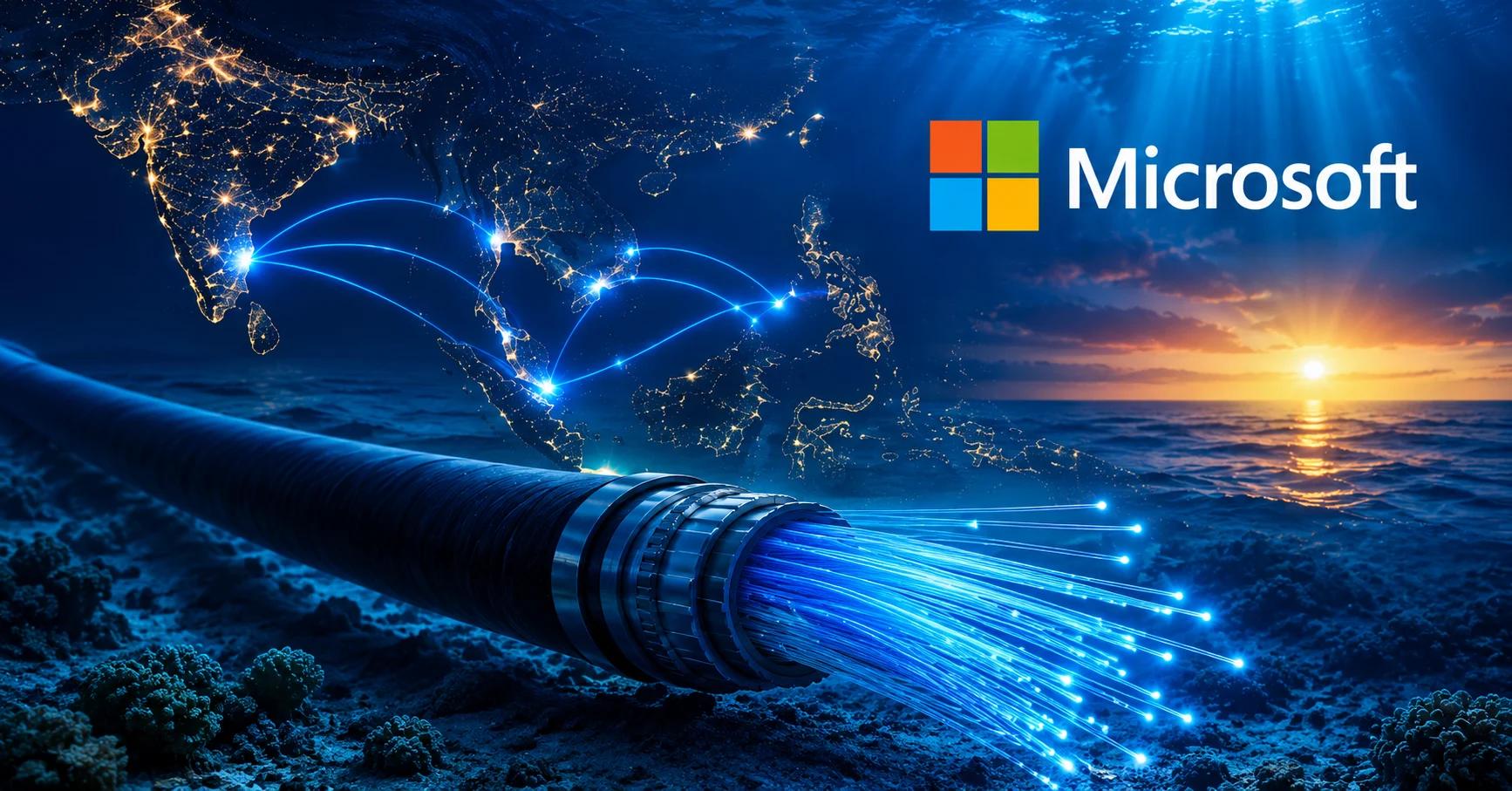
Microsoft has joined a consortium led by Singapore-based Lightstorm to build a new undersea cable called I-2SEA, connecting India, Malaysia, and Singapore.
The cable will span 3,600 km and is expected to be ready for service in the fourth quarter of 2029.
Other consortium members include Tata Communications, Singapore Telecommunications (Singtel), Singapore's ASEAN Cableship, and Japan's NEC Corporation.
Landing stations in India will be located at Machilipatnam, Andhra Pradesh — a site where Meta and Alphabet have already announced data centers.
The companies have not disclosed the investment size for the project.
India currently has 17 active submarine cables with a combined capacity of 960 terabits per second, and at least 10 more cables are already publicly announced, according to TeleGeography.
July 2, 2026: A consortium that includes Microsoft and telecom startup Lightstorm plans to build a new undersea cable linking India with Malaysia and Singapore. The move is part of a wider push by technology companies to expand AI and cloud infrastructure in India, one of the world's fastest-growing data markets.
The consortium confirmed the plan on Thursday but did not share the cost of the project. Lightstorm Group CEO and Managing Director Amajit Gupta told Reuters the cable, named I-2SEA, is expected to be operational by the fourth quarter of 2029 (Source: Reuters).
Rising demand for AI training and inference workloads needs more international bandwidth between India and Southeast Asia's cloud hubs.
India's east coast has historically had far fewer cable landing points than Mumbai and Chennai, creating a gap in capacity near new data center clusters.
Meta and Alphabet have already announced data centers near Machilipatnam, so a direct cable link to this location adds capacity where hyperscalers are already building.
Lightstorm says it plans to extend its existing terrestrial fibre network — which it states spans more than 30,000 km across India — to carry capacity from the new cable onward to Hyderabad, Mumbai, and over 80 data centers nationwide (company statement, reported by Fonearena).
In a company statement reported by Fonearena, Lightstorm describes the project as an extension of its existing network platform into the subsea domain, built to connect AI infrastructure across India, Malaysia, and Singapore. Gupta said Lightstorm's mission is "interconnecting intelligence" across the region, and framed I-2SEA as a natural extension of the company's existing data center connectivity platform into the subsea domain.
According to the same report, the project will be governed under a Joint Build Agreement between the four primary consortium members — Lightstorm, Microsoft, Singtel, and Tata Communications.
Detail | Figure |
Cable length | 3,600 km |
Expected ready-for-service date | Q4 2029 |
India landing point | Machilipatnam, Andhra Pradesh |
Southeast Asia landing points | Singapore, Kuala Lumpur (Malaysia) |
Lightstorm's existing terrestrial network (company-reported) | 30,000+ km, 80+ data centers in India |
India's current active submarine cables | 17, with 960 Tbps max capacity |
Additional cables already announced for India | At least 10 more |
Investment size | Not disclosed |
1. India's data center capacity is expanding fast. TRAI Chairman Anil Kumar Lahoti has stated that India's data center capacity grew from about 375 MW in 2020 to over 1,500 MW by 2025, with projections of around 8 GW by 2030 — a figure reported by India Unabridged, based on his public remarks and government statements to Parliament. This is an official's stated projection, not an independently audited figure.
2. Existing cable routes face real disruption risk. Lahoti has also said that around 60% of India's international internet traffic passes through the Red Sea corridor, which has faced repeated cable-cutting incidents since 2024 amid regional conflict — as reported by Communications Today from his March 2025 conference remarks.
3. Hyperscalers are actively diversifying landing points. Google announced its own America-India Connect plan in February 2026, adding new subsea paths through a Visakhapatnam gateway. Meta's Project Waterworth is a separate 50,000 km system also planned to land in India (Source: Communications Today, Developing Telecoms).
Project | Lead Companies | Length | Route | Status |
I-2SEA | Microsoft, Lightstorm, Tata Communications, Singtel, NEC | 3,600 km | India–Malaysia–Singapore | Announced July 2026, targeted Q4 2029 |
America-India Connect | Google, Airtel | Not fully disclosed | Visakhapatnam–Singapore–South Africa–Australia | Announced Feb 2026 |
Project Waterworth | Meta | 50,000 km | US–India–Brazil–South Africa (multi-continent) | In progress |
2Africa Pearls | Meta, Airtel, others | Part of 45,000 km 2Africa system | Africa–Middle East–India | Delayed due to regional conflict |
What is the total investment value of the I-2SEA project?
How will capacity be divided among the four core consortium members?
Will the Machilipatnam landing station be shared with other hyperscaler cable systems in the future?
How might regional weather or geopolitical risks affect the 2029 timeline?
Lightstorm is separately preparing for a stock market listing in India by mid-2027, according to Gupta, though further details were not shared. The company was reportedly seeking a valuation of up to $1.5 billion as of March 2026 (Source: Business Standard).
Construction timelines for I-2SEA are yet to be detailed publicly. For now, the announcement adds to a broader pattern of hyperscalers and telecom operators building new subsea capacity into India's east coast, alongside projects from Google and Meta, as AI and cloud demand continues to grow in the region.
While no company has released hiring figures tied to I-2SEA, projects of this scale typically require build-out and maintenance capacity across network engineering, subsea systems operations, and data center infrastructure roles. However, as both Microsoft, Google, and Meta continue to build up additional cabling and data center capabilities in the coastal region of India, there will be an increasing demand for telecommunications and cloud infrastructure specialists — though the scale, timeline, and specific roles created by any single project, including I-2SEA, have yet to be disclosed by the companies themselves. Readers who are following their career path in networking, cloud computing or data center management might be interested to watch this space as more details emerge.
Sources: Reuters, Fonearena, TeleGeography, Communications Today, Developing Telecoms, DataCenterDynamics
Stay updated with the latest news on Careerera. Get the latest Technology News, AI News, Business News and Higher Education News from around the world.
 Microsoft Joins 3,600 KM I-2SEA Undersea Cable Project Linking India and Southeast Asia
 Google Loses Final EU Appeal as Top Court Upholds €4.1 Billion Android Antitrust Fine
 OpenAI's $42 Billion Government Stake Proposal Could Reshape America's AI Strategy
 Anthropic's Claude Sonnet 5 Is Here With Smarter AI Agents and Lower Pricing
 AI Alone Won't Get You Promoted, Leadership Takes the Lead: GMAC Survey
  Meta Faces Gemini Access Limits as Google Struggles With Rising AI Capacity Demand
 South Korea Announces $336 Billion AI Strategy, Eyes $650 Billion Chip Expansion
Priyank is a Senior Content Developer and Strategist at SNVA Veranda. Earlier, he worked as a data scientist, where he gained extensive experience in developing data-driven solutions, advanced analytics, and strategic decision-making processes. His expertise includes data analysis, business intelligence, and implementing data-centric strategies that drive organizational growth and innovation. In addition to his data science experience, Priyank has over 10 years of experience in the banking and financial services sector. He has worked across various roles and operational levels, gaining in-depth knowledge of financial operations, customer service management, and business processes.