
Preparation Tips for RRB Assistant Loco Pilot (ALP) Exam 2026
RRB ALP 2026 Exam Overview
The Railways Recruitment Board (RRB) has put out 11,127 Assistant Loco Pilot posts across 21 zones this year. This is a real chance at a Central Government career, and if that interests you, then go to rrbapply.gov.in and apply. The RRB ALP exam registration window closes on June 14, 2026 — make sure you don't miss it.
As an ALP, you’ll be working right alongside a main Loco Pilot. You will make sure the train gets where it needs to go safely and on time. Your day to day work is basically about looking at instrument panels, calling out the signals as they appear, and doing a brake test before departure. It’s a reliable government role where you don't have to worry about job security, and there’s a clear path to get promoted over time.
|
Parameter |
Details |
|
Conducting Body |
Railway Recruitment Board (RRB) |
|
Post Name |
Assistant Loco Pilot (ALP) |
|
Advertisement No. |
CEN 01/2026 |
|
Total Vacancies |
11,127 |
|
Mode of Application |
Online — rrbapply.gov.in |
|
Application Window |
15 May to 14 June 2026 |
|
Education Qualification |
10th Pass + SSLC / ITI or Diploma/Degree in Engineering |
|
Age Limit |
18 to 30 years (as on 01 July 2026) |
|
Pay Level |
Level-2 (7th CPC) — Initial Pay ₹19,900 |
|
In-hand Salary |
Approx. ₹25,000 – ₹35,000/month |
|
Selection Process |
CBT 1 → CBT 2 → CBAT → DV → Medical |
|
Official Website |
rrbcdg.gov.in / rrbapply.gov.in |
What Has Actually Changed in the RRB ALP 2026 Exam?
If you're going through those old prep books, or coaching notes, read this section carefully. The new 2026 rules for ALP recruitment exam changed the whole exam pattern and also how the final scores are figured out. If you keep using outdated material then it will put you at a disadvantage from day one.
Critical 2026 Updates
Three changes in CEN 01/2026 directly affect how you should prepare: General Awareness removed from CBT 1, CBAT weight doubled to 50% in final merit, and 11,127 vacancies — the highest in recent years. Adjust your preparation strategy accordingly.
|
Feature |
RRB ALP 2025 (CEN 01/2025) |
RRB ALP 2026 (CEN 01/2026) |
|
CBT 1 Subjects |
Math, Reasoning, Science, General Awareness |
Math, Reasoning, Science only |
|
Final Merit — CBT 2 Part A |
70% weightage |
50% weightage |
|
Final Merit — CBAT |
30% weightage |
50% weightage |
|
Total Vacancies |
9,970 |
11,127 |
Two Recruitment Cycles Running Simultaneously
This is worth tracking if you have not applied yet. Result of CBT 1 for CEN 01/2025 cycle for 9,970 vacancies is still awaited, while the CEN 01/2026 for 11,127 vacancies is already open for applications until 14 June 2026. Both are independent recruitments, so aspirants who applied in the 2025 cycle can also apply for the 2026 cycle without waiting for previous results.
RRB ALP 2026 – Important Dates
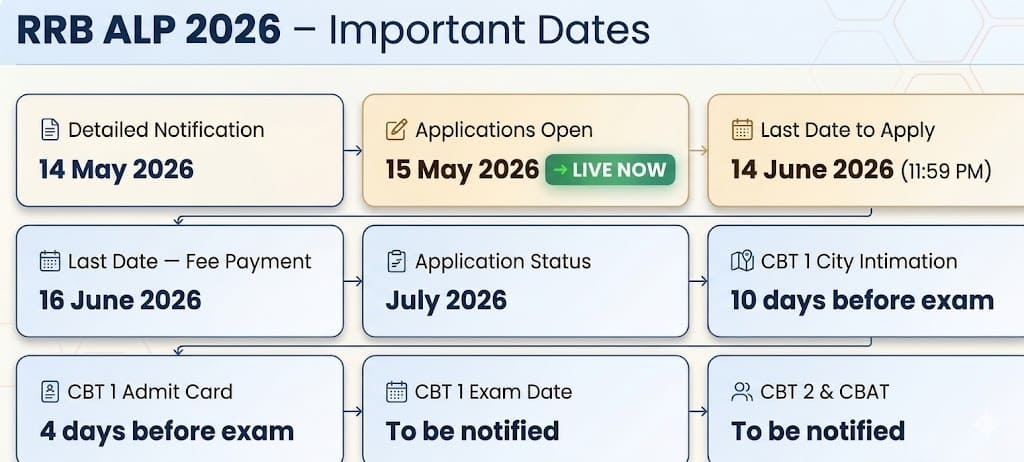
Please Note:
Remember that if you end up applying for more than one RRB, you will be disqualified. So go ahead and pick carefully which RRB and zone you truly like. Moreover, if you apply for any transfer, it is not taken into account for at least 5–10 years of service, even if you really want that change.
RRB ALP 2026 – Eligibility Criteria
Educational Qualification
Candidates must satisfy one of the following conditions:
- Matriculation / SSLC + ITI (NCVT/SCVT) in notified trades: Electrician, Fitter, Electronics Mechanic, Machinist, Mechanic Diesel, Mechanic Motor Vehicle, Turner, Wireman, Instrument Mechanic, Refrigeration & AC Mechanic, Tractor Mechanic, and others as specified.
- Matriculation / SSLC + Course Completed Act Apprenticeship in the notified trades.
- Three-year Diploma in Mechanical / Electrical / Electronics / Automobile Engineering from a recognised institution.
Age Limit (as on 01 July 2026)
|
Category |
Age Limit |
|
General (UR / EWS) |
18 – 30 years |
|
OBC (NCL) |
18 – 33 years (+3 years relaxation) |
|
SC / ST |
18 – 35 years (+5 years relaxation) |
|
PWD (General) |
Up to 40 years (+10 years) |
|
Ex-Servicemen |
Service period + 3 years (with conditions) |
|
J&K domicile (1980–1989) |
+5 years relaxation |
|
Railway Group C/D employees (3+ years service) |
UR: 40 | OBC: 43 | SC/ST: 45 |
How to Apply for RRB ALP 2026
The application window is live at rrbapply.gov.in from 15 May to 14 June 2026. Follow these steps:
- Visit rrbapply.gov.in and click on "CEN-01/2026 (ALP) — Pay Level-2 post of Assistant Loco Pilot".
- Click Apply → Create an Account. Fill in Personal Information, Aadhaar Verification, and Contact Details.
- Log in with your registered mobile number and password to complete the form.
- Select your preferred RRB, post, and railway zone preferences carefully.
- Enter educational qualification details and select your trade for CBT-2 Part B.
- Upload scanned photograph, signature, and category certificate (if applicable).
- Preview all details, exercise your order of post preference, and complete the declaration.
- Pay the application fee and download the confirmation page for your records.
RRB ALP 2026 – Selection Process
The selection follows a five-stage process. Each stage must be cleared to advance to the next. Only CBT 2 Part A and CBAT marks count in the final merit list.
|
Stage |
Test |
Nature |
Merit Weight |
|
Stage 1 |
CBT 1 — Computer-Based Test |
Screening only |
Not counted |
|
Stage 2 |
CBT 2 Part A — Technical + Core |
Merit-based |
50% |
|
Stage 2 |
CBT 2 Part B — Trade Specific |
Qualifying (min. 35%) |
Not counted |
|
Stage 3 |
CBAT — Aptitude Test |
Merit-based |
50% |
|
Stage 4 |
Document Verification |
Qualifying |
— |
|
Stage 5 |
Medical Examination |
Qualifying (A-1 standard) |
— |
Merit Formula
Final Merit = 50% marks (CBT-2 Part A) + 50% marks (CBAT)
CBT 1 marks are not counted. Shortlisting for CBT 2: 15 times the number of vacancies per RRB, based on normalised CBT 1 merit across shifts.
RRB ALP 2026 – Updated Exam Pattern
CBT 1 Pattern (General Awareness Removed)
The 2026 CBT 1 has been revised. General Awareness is no longer part of this stage. The 75 questions now come only from three subjects. CBT 1 is a screening exam — your marks here do not appear in your final merit list.
| Subject | Questions | Marks | Duration |
| Mathematics |
75
|
60 minutes
|
|
| General Intelligence & Reasoning | |||
| General Science | |||
| Marking: +1 correct | −⅓ wrong | Qualifying: UR/EWS 40%, OBC 30%, SC 30%, ST 25% | |||
CBAT — Computer-Based Aptitude Test
Applicable only for ALP posts. Candidates equal to 8 times the ALP vacancies are shortlisted for CBAT based on CBT 2 Part A performance.
|
Parameter |
Details |
|
Applicable For |
ALP posts only |
|
Negative Marking |
None |
|
Language |
Bilingual — English & Hindi |
|
Merit Weightage |
50% (increased from 30% in 2025) |
|
What It Tests |
Memory, Following Directions, Concentration, Perceptual Speed, Information Ordering, Depth Perception, Colour Discrimination |
|
Minimum Qualifying Score |
42 out of 70 in each test battery |
RRB ALP 2026 – Syllabus (CBT 1 & CBT 2)
CBT 1 Syllabus
|
Subject |
Key Topics |
|
Mathematics |
Number System, BODMAS, Decimals, Fractions, LCM & HCF, Ratio & Proportion, Percentages, Time & Work, Time & Distance, Simple & Compound Interest, Profit & Loss, Algebra, Geometry, Mensuration, Trigonometry, Statistics |
|
General Intelligence & Reasoning |
Analogies, Alphabetical & Number Series, Coding & Decoding, Mathematical Operations, Relationships, Syllogism, Jumbling, Venn Diagrams, Data Interpretation, Conclusion & Decision Making, Similarities & Differences, Analytical Reasoning, Classification |
|
General Science |
Physics, Chemistry, Life Sciences / Biology — all at Class 10 (NCERT) level |
CBT 2 Part A Syllabus (Higher Difficulty)
Same subjects as CBT 1 (Mathematics, Reasoning, General Science) at a higher conceptual level, plus Basic Science & Engineering and General Awareness.
|
Subject |
Key Topics |
|
Basic Science & Engineering |
Engineering Drawing, Units & Measurements, Mass, Weight & Density, Heat & Temperature, Basic Electricity, Levers & Machines, Occupational Safety, IT Fundamentals, Environment & Pollution Control |
|
General Awareness |
Current Affairs, General Knowledge, Science & Technology developments, Important Days, Indian Economy, Geography, History, Polity |
CBT 2 Part B — Trade Syllabus
Qualification-wise Syllabus (Grouping) for Part B
Questions will be based on the trade that the candidate selects — Electrician, Fitter, Mechanic Diesel, Electronics Mechanic, and so on.. The full trade wise syllabus is given in the official CEN 01/2026 notification PDF that you can download from the official site. Try to focus on the basic engineering ideas, not just theory, plus safety principles, tools, machines, electrical circuits , and workshop calculations that actually relate to your specific trade.
|
Candidate's Qualification |
Subjects/Trade |
|
Electrical Engineering and Combination of Varied Streams of Electrical Engineering |
Wireman |
|
Electrician |
|
|
Instrument Mechanic |
|
|
Armature and Coil Winder |
|
|
Refrigeration and Air-Conditioning Mechanic |
|
|
Electronics Engineering and Combination of Various Streams of Elec. Engg |
Electronics Mechanic |
|
Mechanic (Radio & TV) |
|
|
Mechanical Engineering and Combination of various streams of Mechanical Engineering |
Fiitter |
|
Mechanic (Motor Vehicle) |
|
|
Tractor Mechanic |
|
|
Mechanic (Diesel) |
|
|
Turner |
|
|
Machinist |
|
|
Refrigeration and Air-Conditioning Mechanic |
|
|
Heat Engine |
|
|
Millwright/ Maintenance Mechanic |
|
|
Automobile Engineering and Combination of Various Streams of Automobile Engineering |
Mechanic (Motor Vehicle) |
|
Tractor Mechanic |
|
|
Mechanic (Diesel) |
|
|
Heat Engine |
|
|
Refrigeration and Air-conditioning Mechanic |
Smart Preparation Strategy to Crack RRB ALP in 2026
You need to prepare smartly, rather than study for long hours, in case you want to crack the RRB ALP exam successfully. Every year a lot of candidates manage to finish the syllabus but still fail the exam, because their preparation has no direction. Instead of adding more hours, they actually need a more precise approach within each section. The gap between the candidates who clear all stages and those who don’t usually comes down to three things — proper structuring of the plan, steady repeated revision, and taking mock tests with honesty.
Understand Each Stage Before You Start Studying
One of the most common mistakes candidates make is jumping into preparation without understanding how the exam is structured. CBT 1 is purely a screening exam. Your marks here do not count in the final merit — only 15 times the number of vacancies per zone get shortlisted for CBT 2. This means you need to clear it efficiently, not top it.
Overinvesting in CBT 1 while underinvesting in CBT 2 and CBAT is a strategic error that costs candidates who otherwise have the ability. CBT 2 Part A is where your actual merit score is built. Part B is qualifying. And CBAT — now carrying 50% of your final rank — deserves as much preparation time as CBT 2.
Medical fitness is also not a formality to be checked at the end. The RRB ALP medical standard is A-1, and LASIK eye surgery disqualifies candidates. If you have concerns about vision, hearing, or colour perception, verify your eligibility before investing months of preparation.
Build Strong Basics Before Moving to Speed
Many aspirants immediately start attempting difficult mock tests without strengthening their basics. This creates confusion, reduces confidence, and makes speed practice ineffective. In the first phase of preparation, focus on conceptual clarity in high-frequency areas:
|
Subject |
High-Priority Topics |
Preparation Focus |
|
Mathematics |
Number System, BODMAS, LCM & HCF, Percentages, Ratio & Proportion, Average, Simplification, Time & Work, Pipes & Cisterns, Time & Distance, Simple & Compound Interest, Profit & Loss, Algebra, Geometry, Mensuration, Trigonometry, Statistics, Data Interpretation |
Focus on calculation speed, shortcut methods, and daily timed practice. Arithmetic topics dominate CBT 1, so accuracy and fast solving techniques are essential. |
|
General Intelligence & Reasoning |
Analogies, Number & Alphabetical Series, Coding-Decoding, Mathematical Operations, Blood Relations, Direction Sense, Syllogism, Venn Diagrams, Seating Arrangement, Puzzles, Statement & Conclusion, Non-Verbal Reasoning, Data Interpretation |
Practice reasoning questions regularly under time limits. Puzzle-solving, coding-decoding, and analytical reasoning require consistency to improve speed and accuracy. |
|
General Science (CBT 1) |
Motion, Force, Electricity, Work & Energy, Magnetism, Heat & Sound, Light, Chemical Reactions, Acids & Bases, Metals & Non-Metals, Human Body, Nutrition, Diseases, Environmental Science — Class 8–10 NCERT level |
Build conceptual clarity using NCERT-based preparation. Physics topics generally carry higher weightage, so formulas, diagrams, and numerical concepts should be revised consistently. |
|
Basic Science & Engineering (CBT 2) |
Engineering Drawing, Units & Measurements, Mass, Weight & Density, Heat & Temperature, Basic Electricity, Levers & Machines, Work Power Energy, Occupational Safety, IT Fundamentals, Environment & Pollution, Engineering Materials |
Focus on understanding engineering applications and fundamentals rather than rote learning. Numerical practice and diagram-based revision are important for CBT 2. |
|
CBT 2 Trade / Technical |
Based on ITI trade — Electrician, Fitter, Electronics Mechanic, Mechanic Diesel, Wireman, Turner, Machinist, etc. Refer to official trade-wise syllabus in notification PDF. |
Prepare according to the official trade syllabus and revise core ITI concepts regularly. Focus on tools, machines, circuits, measurements, troubleshooting, and safety concepts related to the trade. |
For General Science, NCERT Class 8–10 level understanding is sufficient for most CBT 1 questions. Physics carries disproportionately higher importance in the RRB ALP exam — particularly concepts related to motion, electricity, and mechanics. Candidates who cover NCERT Physics thoroughly are often better placed than those who spread attention thinly across all science sections.
Focus Equally on Speed and Accuracy
The RRB ALP exam is not only about knowing answers. It is also about solving questions quickly within a limited time. Many aspirants know concepts well but fail to attempt enough questions because they spend too much time on individual problems.
The right practice progression: start with topic-wise questions, then move to sectional timed tests, then full-length mocks. Never attempt full mocks before topic-level clarity is solid. And respect negative marking — three wrong attempts cancel one correct answer. A score of 45 correct with zero negatives consistently outperforms 60 attempts with 15 wrong guesses.
How to Prepare for CBAT — The Section Most Candidates Underestimate
The CBAT evaluates spatial ability, depth perception, colour and distance discrimination, memory, following directions, and concentration — all skills relevant to safely operating a locomotive. These are testable and trainable skills, not innate traits. The minimum qualifying score is 42 out of 70 in each test battery, and the overall score carries 50% of your final merit.
CBAT Preparation Advice
Begin CBAT battery practice from Month 2 of your preparation — not the final two weeks before the exam. Spatial reasoning, memory tasks, and perceptual speed all improve with daily repetition. Use RRB's official sample CBAT papers as your primary practice material. Psychometric test apps and aptitude battery simulators can supplement this but should not replace official samples.
Structure your CBAT preparation as follows: 30 minutes of aptitude battery practice daily, starting from your second month. Alternate between spatial tasks, memory recall exercises, and direction-following problems. In the final four weeks before CBAT, increase to a full timed practice session every alternate day.
Make Mock Tests a Diagnostic Tool, Not Just Practice
Most candidates take mock tests only to check their scores. Strong performers use them to identify mistakes and improve weak areas.
A low score during preparation is not a problem if you learn from it. It helps you understand where you need improvement before the actual exam. Candidates should aim to attempt at least 25–30 full-length mock tests before CBT 1 along with regular sectional tests.
After every mock test, spend time analyzing:
- which sections took the most time
- where mistakes happened despite confidence
- which topics repeatedly cause errors
- how many questions were skipped or guessed incorrectly
Candidates who review their mistakes regularly improve much faster than those who only keep attempting more tests. During the final weeks of preparation, mock tests should become a regular part of the daily routine.
Common Mistakes That Cost Candidates Their Rank
Knowing what to avoid is as valuable as knowing what to do. These mistakes repeatedly affect RRB ALP aspirants across cycles:
|
Mistake |
Why It Hurts |
What to Do Instead |
|
Studying without revision |
Candidates complete topics once and assume retention. Though, under timed exam pressure, recall sometimes fails. |
Revise every topic at least 2–3 times. Maintain short notes for quick review. |
|
Ignoring negative marking |
Three random guesses cancel one correct answer. Net scores drop significantly. |
Only attempt questions you are reasonably confident about. Skip and return if needed. |
|
Underestimating CBAT |
With 50% merit weight, poor CBAT performance cannot be compensated by CBT 2 alone. |
Begin CBAT battery practice from Month 2. 30 min/day consistently is enough. |
|
Too many study resources |
Spreading attention across 5–6 books/apps creates surface-level knowledge everywhere. |
Go deep on 1–2 reliable sources. Repeat them. Depth beats breadth for MCQ exams. |
|
Avoiding mock tests |
Without timed practice, speed and decision-making under pressure remain undeveloped. |
Start sectional mocks within Month 1. Full-length mocks from Month 2 onwards. |
|
Preparing CBT 1 and CBT 2 with the same strategy |
CBT 1 needs speed and breadth; CBT 2 needs depth and technical accuracy. They are different exams. |
Separate your preparation phases. Don't treat them as one continuous syllabus. |
Last-Minute Revision Tips for RRB ALP
- The final weeks before the RRB ALP exam should focus mainly on revision rather than learning new topics. Revise formulas, important concepts, shortcut methods, and technical notes regularly to improve retention.
- Divide your preparation time between revision, mock tests, previous-year papers, and mistake analysis. Focus more on topics where you repeatedly lose marks.
- Avoid switching between multiple study resources during the final phase. Stick to the material you have already practiced to maintain confidence and avoid confusion.
- Along with preparation, proper sleep, consistency, and a calm mindset are equally important for performing well in the exam.
Best Books for Overall RRB ALP Preparation
|
Purpose |
Recommended Books |
|
Complete Mathematics Preparation |
Rajesh Verma Arithmetic + RS Aggarwal |
|
Reasoning Practice |
MK Pandey + RS Aggarwal Reasoning |
|
General Science Preparation |
Lucent’s General Science + NCERT |
|
Current Affairs |
Monthly PDFs and Railway Exam Capsules |
|
Technical CBT 2 Preparation |
RK Jain + Trade-Specific ITI/Diploma Books |
|
Mock Tests & PYQs |
Previous-Year Railway Papers and Online Mock Test Series |
RRB ALP CBT 1 Previous Year Cut-off Marks
Reference data from 2024–25 cycle (CEN 01/2024). Actual 2026 cut-offs will depend on vacancy count, applicant pool, and paper difficulty. Use these as a benchmark, not a guarantee.
|
RRB Zone |
Type |
UR |
SC |
ST |
OBC |
EWS |
|
Ajmer |
Open |
54.33 |
36.19 |
27.99 |
39.27 |
40.18 |
|
Chandigarh |
Open |
40.09 |
30.01 |
25.02 |
30.01 |
— |
|
Mumbai |
Open |
57.17 |
36.68 |
30.48 |
44.08 |
40.17 |
|
Malda |
Open |
63.06 |
41.57 |
39.81 |
55.98 |
49.8 |
|
Ranchi |
Open |
61.61 |
39.67 |
31.05 |
48.47 |
40.44 |
|
Guwahati |
Open |
59.91 |
37.48 |
26.24 |
49.18 |
40.11 |
|
Bilaspur |
Open |
58.41 |
40.68 |
30.39 |
46.14 |
40 |
|
Thiruvananthapuram |
Open |
48.93 |
30.06 |
31.49 |
48.9 |
40.09 |
|
Chennai |
Open |
49.51 |
34.42 |
25.07 |
39.35 |
40.15 |
|
Kolkata |
Open |
63.44 |
45.73 |
34.71 |
46.82 |
40.05 |
|
Gorakhpur |
Open |
63.9 |
44.13 |
25.24 |
51.37 |
40.09 |
|
Ahmedabad |
Open |
54.54 |
36.01 |
28.67 |
41.38 |
40.01 |
|
Patna |
Open |
67.59 |
49.65 |
25.23 |
62.71 |
55.43 |
|
Bengaluru |
Open |
58.49 |
42.11 |
32.24 |
47.16 |
40.07 |
|
Prayagraj |
Open |
59.58 |
48.81 |
25 |
54.51 |
40.09 |
|
Bhubaneswar |
Open |
60.98 |
42.46 |
44.08 |
50.83 |
40.13 |
|
Jammu-Srinagar |
Open |
52.53 |
35.49 |
25.03 |
38.15 |
41.68 |
|
Bhopal |
Open |
45.53 |
31.53 |
27.59 |
38.9 |
40.02 |
|
Secunderabad |
Open |
56.2 |
38.27 |
32.32 |
43.81 |
40.09 |
|
Muzaffarpur |
Open |
72.09 |
50.45 |
32.11 |
66.26 |
56.3 |
Latest Jobs
10- MPSC Meghalaya Recruitment 03/2026 Application Form: 13 Vacancies
- AWEIL Recruitment 2026: Contractual Vacancy
- Yantra India Limited Company Secretary Recruitment 2026
- Mumbai Metro Rail Corporation Recruitment 2026: 24 Non-Executive Vacancies
- BSNL Recruitment 2026: 100 Telecom Officer Vacancies
- SAIL Recruitment 2026: 48 Young Professionals Vacancies
- RSSB Recruitment 2026: 3951 Computer Instructor Vacancies
- High Court of Punjab and Haryana Recruitment 2026: 1265 Clerks Vacancies
- UPSC Recruitment 05/ 2026 Application Form: 194 Vacancies
- Indian Air Force AFCAT 02/2026 Courses Commencing July 2027
Latest Articles
10- The WallStreet School: Best Finance and Accounting Training Institute
- SSC GD Constable Admit Card 2026-27
- How to Become an Odisha Police Constable/Sepoy in 2026?
- How to Prepare for RBI Office Attendant Exam 2026
- Telangana High Court Recruitment Exam 2026 Preparation Tips
- NABARD Development Assistant Recruitment Exam 2026 Preparation Tips
- Hindustan Urvarak and Rasayan Limited: Career Opportunities at HURL
- Railway Exam: RRB Annual Calendar 2026-27
- Sarkari Naukri in Rajasthan: The Mirage of Promises and the Dust of Reality
- Lakshadweep Scholarship Scheme 2025