

Humanities programs are no longer considered a fallback academic pursuit for students. They are now in mainstream popularity as a core discipline to study the various aspects of human society, culture, and experience using critical, interpretative or analytical methods.
Today, students with humanities backgrounds effectively represent their candidacy for different career pathways in the field of law & judiciary, psychology, journalism, civil services, public policy, creative fields, and diplomacy, etc.
Why does pursuing a humanities course matter?
Pursuing Humanities Programs will earn you proficiency in critical thinking, empathy, and creativity, enabling you to understand human values, culture and history. These learned skills essentially open different career roadways, including education, marketing, law, and media.
Understanding the Humanity Side of the Academic Program
The world we live in today requires critical thinkers, storytellers and problem-solvers, not only just scientific-minds pioneering innovations to make the world a better place.
Also, the way data and artificial technologies are robotizing the social ecosystem, we need to counterbalance it with skilled professionals with empathy, cultural understanding and creative thinking.
Though history or languages define the core aspects of humanities, it is also very important to understand people, society and the world at a deeper level. The essence of pursuing this course is to understand what it means to be a human by developing a deeper sense of self-awareness and ethical understanding, a valuable skillset in a world dominated by data and artificial technologies.
Top 10 Humanities Programs Leading to Better Career Pathways
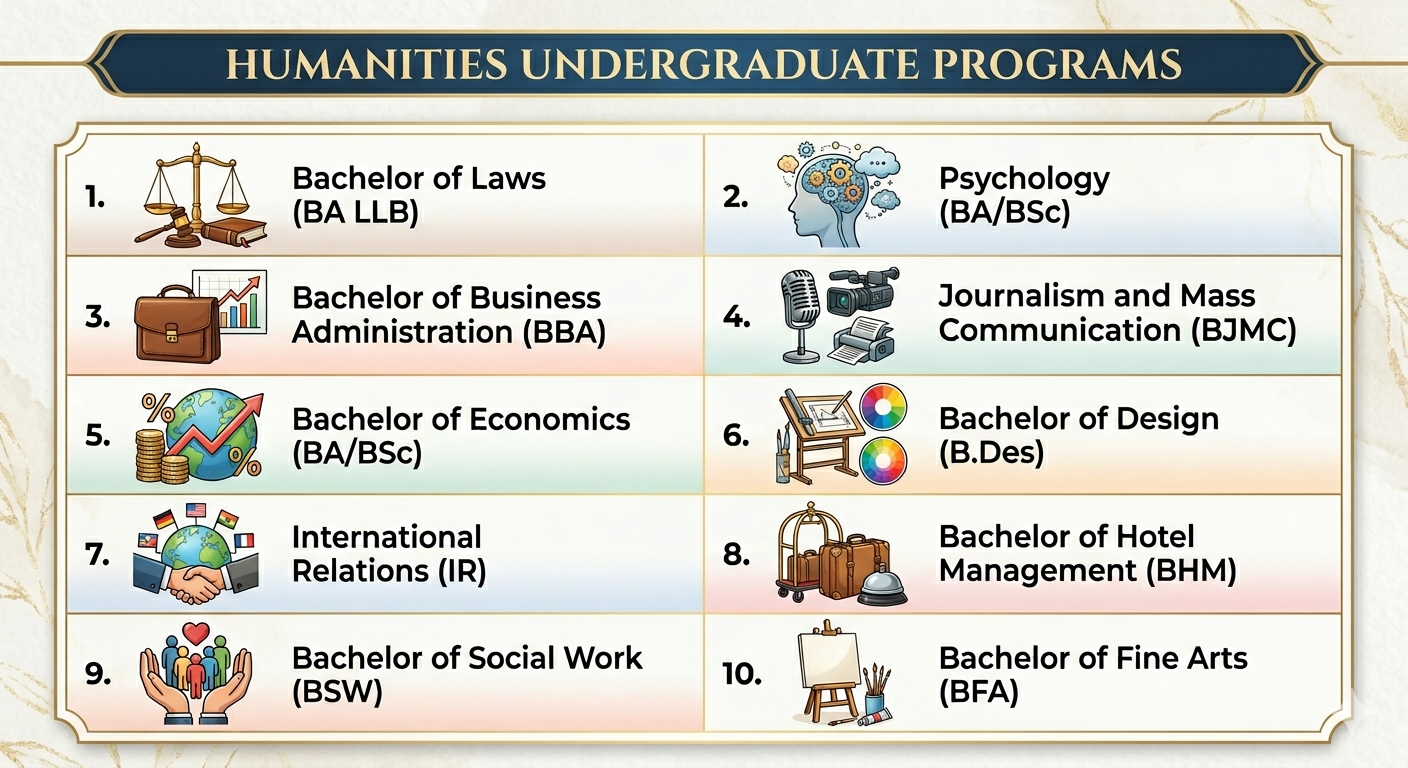
1. Bachelor of Laws (BA LLB)
This is one of the fantastic humanities courses that students can pursue after class 12th. It enhances your career potential in fields like corporate law, litigation, and judiciary. The duration for this course is 5 years, covering 10 semesters with key subjects like Political Science, Sociology, History, English, and Economics, coupled with core legal subjects.
2. Psychology (BA/BSc)
A psychology (BA/BSc) program in humanities is a 3-year undergraduate program divided into 6 semesters. It focuses on core areas like developmental/abnormal psychology, cognitive psychology and counselling techniques. Careers this course opens include counseling therapist, human resource specialist, school counsellor, educational psychologist, social worker, behavioral researcher, marketing specialists, etc.
3. Bachelor of Business Administration (BBA)
A bachelor of Business Administration is a 3-year undergraduate program divided into 6 semesters. The focused areas of the curriculum are human resource management, financial accounting, marketing management, organizational behaviors, etc. Careers include marketing managers, HR managers, financial analysts, operations managers, etc. The importance of this course lies in the belief that businesses need leaders who understand people.
4. Journalism and Mass Communication (BJMC)
This is a 3-year undergraduate program containing 6 semesters, focusing on print & broadcast journalism, digital media, new media, public relations, corporate communication, media law & ethics, mass communication theory, etc. The program emphasizes on building core skills like storytelling, audiovisual production, and soft skills like personality development, communication skills and interview techniques. Careers include journalists, reporters, news anchors, PR specialists, corporate communication managers, media relations specialists, content writers, social media managers, copywriters, creative directors, brand planners, etc.
5. Bachelor of Economics (BA/BSc)
The undergraduate program (3-years duration, divided into 6 semesters) focuses on understanding human behavior, social resource allocation and policy. While BA programs focus on historical and social implications of economic theory, the BSc emphasizes mathematical modeling and data analytics. Careers include data/business analyst, financial analyst, policy analyst, investment banking associate, market research analyst, actuarial analyst and economic journalist.
6. Bachelor of Design (B.Des)
Though not strictly a humanities program, B.Des is a 4-year undergraduate program structured over 8 semesters, focusing on building creative arts with social studies. Focus areas of the program include UX (user experience) and interaction design, communication design, cultural and critical studies in design, product system design, coupled with core components like foundational studies in basics of design, art, and theory. Careers after B.Des include graphic designer, UI/UX designer, fashion designer, interior designer, product designer, and communication designer.
7. International Relations (IR)
International relations in humanities is a 3-4 year undergraduate program divided into 6-8 semesters. The key areas of the program include diplomatic history, international law/ethics, intercultural communication, critical security studies, and foreign policy analysis. Careers after an IR degree in humanities include intelligence analysis, diplomacy, NGO management, policy research, and global business consulting.
8. Bachelor of Hotel Management (BHM)
A degree in humanities spanning 4 years of course duration structured over 8 semesters, BHM (Bachelor of Hotel Management) course covers areas like human resource management, guest relations and psychology, travel and tourism management, hospitality law and ethics, service management and marketing, hospitality marketing and communication. Careers after BHM in humanities land individuals in hotel management, with career roles like front office manager, housekeeping manager, front office manager, or general manager in luxury hotels. Other career options are in restaurant management, food critic, corporate event planner, travel consultants, tour managers, etc.
9. Bachelor of Social Work (BSW)
This undergraduate program is for the duration of 3 years, structured over 6 semesters, in humanities. It covers areas like sociology, psychology, and social work methods. The students are exposed to both theoretical and practical field training. The idea behind establishing the trust of this course in the context of humanities is that fieldwork with communities fosters practical skills. Careers after a BSW degree include different pathways. For example, a career in NGOs (non-governmental organisations) involves job roles as project coordinator and field officers working for organizations focusing on women empowerment. In the government sector, one can explore career roles like social welfare officers, whereas in the healthcare sector, one can explore career options like medical social workers.
10. Bachelor of Fine Arts (BFA)
A Bachelor of Fine Arts in humanities is an academic program for the duration of 4 years. It focuses on critical thinking with practice, and covers global contemporary art, south asian and western art history, post-colonial art practices, etc. The focus of the course is to impart theoretical, analytical, and contextual understanding of art within an expansive cultural framework. Some top career options after completing BFA include graphic designer, multimedia artist, art director, interior designer, photographer, art teacher, etc.
Other Honourable Mentions
BA in History - Good for students interested in archaeology, museology, or academic research. It prepares students for career roles in teaching, heritage management, and cultural policy.
Bachelor of Philosophy (B.Phil) - If you like reasoning and critical inquiry into life's questions, pursue B.Phil to get profoundly educated in metaphysics, and epistemology. Explore careers in teaching, civil services, or think tanks.
Bachelor of public administration (BPA) - This program prepares graduate students for working in bureaucratic institutions, NGOs, and public organizations based on skill building in leadership and policy research.
Bachelor of archaeology - Pursue this course if ancient history, cultures and excavation fascinates you. It prepares students for careers in heritage management, research and conservation, thereby helping students connect history with scientific analysis.
Final thoughts
Humanities programs pave your academic journey not only in holistic transformation of how you can represent your candidacy in different career roles, but also in the way you see, observe, interpret, and analyze people and society around you.
Program | Best For (Your Interest) | Career Path | Who Should Choose This |
BA LLB | Law, justice, debate, governance | Lawyer, corporate legal advisor, judiciary | Choose if you want high growth + prestige + strong ROI |
Psychology (BA/BSc) | Human behavior, mental health, counseling | Psychologist, HR, therapist | Choose if ready for master’s + long-term specialization. |
BBA | Business, management, leadership | Marketing, HR, operations | Best for corporate careers + MBA pathway. |
BJMC | Media, storytelling, content creation | Journalist, PR, content strategist | Choose if you have strong communication + creativity. |
Economics (BA/BSc) | Data, finance, analytics, policy | Analyst, banker, economist | Strong choice for high-paying analytical careers |
B.Des | Creativity, design, UX/UI | Designer, product creator | Choose if you want creative + high-demand digital roles. |
International Relations | Global politics, diplomacy | Policy analyst, diplomat, NGO roles | Best with postgraduate or global exposure |
BHM | Hospitality, travel, people interaction | Hotel manager, event planner | Good for service industry + global mobility. |
BSW | Social impact, community work | NGO, welfare officer | Choose if driven by purpose over pay |
BFA | Arts, creativity, expression | Artist, designer, art director | Best for passion-driven + portfolio careers. |
The soft-skill side of humanities programs is what underscores their significance. This is because we live in a world today driven by advanced technologies where skills to integrate human elements into technological advancements is must to ensure a better and safer society.
Rizwana Khan
Philosophy Master’s graduate, AI-certified professional, and content strategist with strong expertise in storytelling, audience psychology, and AI-assisted communication. Rizwana Khan specializes in prompt engineering, SEO content, thought leadership, and brand communication that feels natural, engaging, and audience-focused. Currently working as a Senior Content Executive at SNVA Veranda, she creates compelling content across artificial intelligence, humanities, data analytics, and emerging technology topics. Known for turning complicated ideas into relatable narratives, Rizwana combines creativity, strategy, and modern AI tools to build content that informs, connects, and performs.
Learn how we research, review, and update our content. Editorial Standards & Review Process.

Latest Blogs
8 PhD in Business Careers: Academic and Industry Paths After Graduation (2026 Guide)
 Is an Online DBA Worth It? Salary, ROI, and Career Benefits (2026 Guide)
 PhD vs DBA: Which Doctorate Is Right for You? (2026 Complete Guide)
 How to Compare Online DBA Programs: A Step-by-Step Guide Before You Apply
  Doctor of Business Administration Careers: Jobs, Salary & Growth in 2026
 Why Does a DBA Make More Sense Than a PhD?
 DBA vs PhD: Which Doctoral Degree Holds Higher Academic Value?
 Online DBA Degree Explained: Curriculum, Admission, and Career Opportunities (2026 Guide)
Featured Courses






Humanities programs are no longer considered a fallback academic pursuit for students. They are now in mainstream popularity as a core discipline to study the various aspects of human society, culture, and experience using critical, interpretative or analytical methods.
Today, students with humanities backgrounds effectively represent their candidacy for different career pathways in the field of law & judiciary, psychology, journalism, civil services, public policy, creative fields, and diplomacy, etc.
Why does pursuing a humanities course matter?
Pursuing Humanities Programs will earn you proficiency in critical thinking, empathy, and creativity, enabling you to understand human values, culture and history. These learned skills essentially open different career roadways, including education, marketing, law, and media.
Understanding the Humanity Side of the Academic Program
The world we live in today requires critical thinkers, storytellers and problem-solvers, not only just scientific-minds pioneering innovations to make the world a better place.
Also, the way data and artificial technologies are robotizing the social ecosystem, we need to counterbalance it with skilled professionals with empathy, cultural understanding and creative thinking.
Though history or languages define the core aspects of humanities, it is also very important to understand people, society and the world at a deeper level. The essence of pursuing this course is to understand what it means to be a human by developing a deeper sense of self-awareness and ethical understanding, a valuable skillset in a world dominated by data and artificial technologies.
Top 10 Humanities Programs Leading to Better Career Pathways
1. Bachelor of Laws (BA LLB)
This is one of the fantastic humanities courses that students can pursue after class 12th. It enhances your career potential in fields like corporate law, litigation, and judiciary. The duration for this course is 5 years, covering 10 semesters with key subjects like Political Science, Sociology, History, English, and Economics, coupled with core legal subjects.
2. Psychology (BA/BSc)
A psychology (BA/BSc) program in humanities is a 3-year undergraduate program divided into 6 semesters. It focuses on core areas like developmental/abnormal psychology, cognitive psychology and counselling techniques. Careers this course opens include counseling therapist, human resource specialist, school counsellor, educational psychologist, social worker, behavioral researcher, marketing specialists, etc.
3. Bachelor of Business Administration (BBA)
A bachelor of Business Administration is a 3-year undergraduate program divided into 6 semesters. The focused areas of the curriculum are human resource management, financial accounting, marketing management, organizational behaviors, etc. Careers include marketing managers, HR managers, financial analysts, operations managers, etc. The importance of this course lies in the belief that businesses need leaders who understand people.
4. Journalism and Mass Communication (BJMC)
This is a 3-year undergraduate program containing 6 semesters, focusing on print & broadcast journalism, digital media, new media, public relations, corporate communication, media law & ethics, mass communication theory, etc. The program emphasizes on building core skills like storytelling, audiovisual production, and soft skills like personality development, communication skills and interview techniques. Careers include journalists, reporters, news anchors, PR specialists, corporate communication managers, media relations specialists, content writers, social media managers, copywriters, creative directors, brand planners, etc.
5. Bachelor of Economics (BA/BSc)
The undergraduate program (3-years duration, divided into 6 semesters) focuses on understanding human behavior, social resource allocation and policy. While BA programs focus on historical and social implications of economic theory, the BSc emphasizes mathematical modeling and data analytics. Careers include data/business analyst, financial analyst, policy analyst, investment banking associate, market research analyst, actuarial analyst and economic journalist.
6. Bachelor of Design (B.Des)
Though not strictly a humanities program, B.Des is a 4-year undergraduate program structured over 8 semesters, focusing on building creative arts with social studies. Focus areas of the program include UX (user experience) and interaction design, communication design, cultural and critical studies in design, product system design, coupled with core components like foundational studies in basics of design, art, and theory. Careers after B.Des include graphic designer, UI/UX designer, fashion designer, interior designer, product designer, and communication designer.
7. International Relations (IR)
International relations in humanities is a 3-4 year undergraduate program divided into 6-8 semesters. The key areas of the program include diplomatic history, international law/ethics, intercultural communication, critical security studies, and foreign policy analysis. Careers after an IR degree in humanities include intelligence analysis, diplomacy, NGO management, policy research, and global business consulting.
8. Bachelor of Hotel Management (BHM)
A degree in humanities spanning 4 years of course duration structured over 8 semesters, BHM (Bachelor of Hotel Management) course covers areas like human resource management, guest relations and psychology, travel and tourism management, hospitality law and ethics, service management and marketing, hospitality marketing and communication. Careers after BHM in humanities land individuals in hotel management, with career roles like front office manager, housekeeping manager, front office manager, or general manager in luxury hotels. Other career options are in restaurant management, food critic, corporate event planner, travel consultants, tour managers, etc.
9. Bachelor of Social Work (BSW)
This undergraduate program is for the duration of 3 years, structured over 6 semesters, in humanities. It covers areas like sociology, psychology, and social work methods. The students are exposed to both theoretical and practical field training. The idea behind establishing the trust of this course in the context of humanities is that fieldwork with communities fosters practical skills. Careers after a BSW degree include different pathways. For example, a career in NGOs (non-governmental organisations) involves job roles as project coordinator and field officers working for organizations focusing on women empowerment. In the government sector, one can explore career roles like social welfare officers, whereas in the healthcare sector, one can explore career options like medical social workers.
10. Bachelor of Fine Arts (BFA)
A Bachelor of Fine Arts in humanities is an academic program for the duration of 4 years. It focuses on critical thinking with practice, and covers global contemporary art, south asian and western art history, post-colonial art practices, etc. The focus of the course is to impart theoretical, analytical, and contextual understanding of art within an expansive cultural framework. Some top career options after completing BFA include graphic designer, multimedia artist, art director, interior designer, photographer, art teacher, etc.
Other Honourable Mentions
BA in History - Good for students interested in archaeology, museology, or academic research. It prepares students for career roles in teaching, heritage management, and cultural policy.
Bachelor of Philosophy (B.Phil) - If you like reasoning and critical inquiry into life's questions, pursue B.Phil to get profoundly educated in metaphysics, and epistemology. Explore careers in teaching, civil services, or think tanks.
Bachelor of public administration (BPA) - This program prepares graduate students for working in bureaucratic institutions, NGOs, and public organizations based on skill building in leadership and policy research.
Bachelor of archaeology - Pursue this course if ancient history, cultures and excavation fascinates you. It prepares students for careers in heritage management, research and conservation, thereby helping students connect history with scientific analysis.
Final thoughts
Humanities programs pave your academic journey not only in holistic transformation of how you can represent your candidacy in different career roles, but also in the way you see, observe, interpret, and analyze people and society around you.
Program | Best For (Your Interest) | Career Path | Who Should Choose This |
BA LLB | Law, justice, debate, governance | Lawyer, corporate legal advisor, judiciary | Choose if you want high growth + prestige + strong ROI |
Psychology (BA/BSc) | Human behavior, mental health, counseling | Psychologist, HR, therapist | Choose if ready for master’s + long-term specialization. |
BBA | Business, management, leadership | Marketing, HR, operations | Best for corporate careers + MBA pathway. |
BJMC | Media, storytelling, content creation | Journalist, PR, content strategist | Choose if you have strong communication + creativity. |
Economics (BA/BSc) | Data, finance, analytics, policy | Analyst, banker, economist | Strong choice for high-paying analytical careers |
B.Des | Creativity, design, UX/UI | Designer, product creator | Choose if you want creative + high-demand digital roles. |
International Relations | Global politics, diplomacy | Policy analyst, diplomat, NGO roles | Best with postgraduate or global exposure |
BHM | Hospitality, travel, people interaction | Hotel manager, event planner | Good for service industry + global mobility. |
BSW | Social impact, community work | NGO, welfare officer | Choose if driven by purpose over pay |
BFA | Arts, creativity, expression | Artist, designer, art director | Best for passion-driven + portfolio careers. |
The soft-skill side of humanities programs is what underscores their significance. This is because we live in a world today driven by advanced technologies where skills to integrate human elements into technological advancements is must to ensure a better and safer society.
Latest Blogs
8- PhD in Business Careers: Academic and Industry Paths After Graduation (2026 Guide)
- Is an Online DBA Worth It? Salary, ROI, and Career Benefits (2026 Guide)
- PhD vs DBA: Which Doctorate Is Right for You? (2026 Complete Guide)
- How to Compare Online DBA Programs: A Step-by-Step Guide Before You Apply
- Doctor of Business Administration Careers: Jobs, Salary & Growth in 2026
- Why Does a DBA Make More Sense Than a PhD?
- DBA vs PhD: Which Doctoral Degree Holds Higher Academic Value?
- Online DBA Degree Explained: Curriculum, Admission, and Career Opportunities (2026 Guide)
Rizwana Khan
Philosophy Master’s graduate, AI-certified professional, and content strategist with strong expertise in storytelling, audience psychology, and AI-assisted communication. Rizwana Khan specializes in prompt engineering, SEO content, thought leadership, and brand communication that feels natural, engaging, and audience-focused. Currently working as a Senior Content Executive at SNVA Veranda, she creates compelling content across artificial intelligence, humanities, data analytics, and emerging technology topics. Known for turning complicated ideas into relatable narratives, Rizwana combines creativity, strategy, and modern AI tools to build content that informs, connects, and performs.
Learn how we research, review, and update our content. Editorial Standards & Review Process.