

In this article:
The 2026 AI Job Market — What the Data Actually Shows
Every AI Career Path, Including the Non-Technical Ones
How Domain Expertise Can Give You Advantage in AI Careers
Step-by-Step Learning Roadmap with Real Time Estimates
Portfolio Projects That Get You Hired in 2026
How to Get an AI Job Through the Hidden Job Market
How to Negotiate Salary — Specific Tactics That Work
How to Stay Relevant in AI Without Information Overload
Conclusion
The 2026 AI Job Market — What the Data Actually Shows
Before you spend months learning, you need to understand what the market actually looks like. The picture is quite promising, but it is more specific than most headlines suggest. AI hiring is booming in certain roles and falling in others. Hence, where you aim matters a great deal.
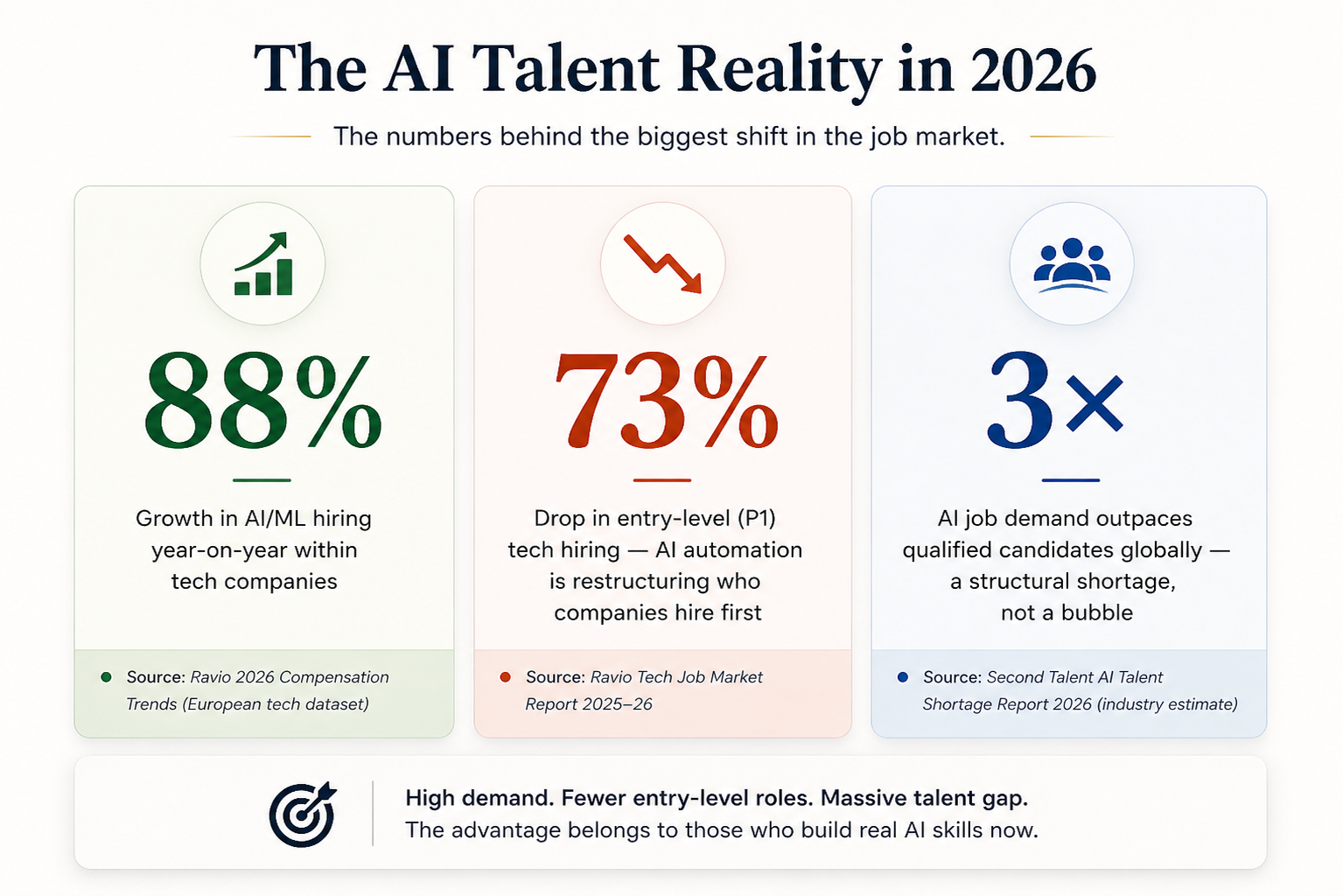
The figure in the above image is of importance but the one that rarely gets discussed: while companies are aggressively hiring experienced AI practitioners, entry-level hiring across tech fell by roughly 73% year-on-year, according to Ravio's compensation dataset of European tech companies. That gap between surging demand for senior AI skills and collapsing demand for generic junior roles — is the central reality of the market in 2026.
What this means for someone starting out is not that there are no opportunities. It means that the path to getting hired looks different than it did five years ago. You cannot simply send applications and wait. You need to demonstrate that you can build real things before you walk through the door.
"Every company is either hiring for AI talent or upskilling existing teams. The companies that balance being lean with rewarding high-impact AI talent are the ones attracting both funding and the right people."
— Ravio 2026 Compensation Trends Report
There's also a caveat worth stating clearly: the Ravio figures come primarily from European tech companies, not a global workforce census. In India and Southeast Asia, the AI talent market behaves differently — salaries are lower in absolute terms but growing fast, and remote work is increasingly allowing professionals in those regions to access global rates. In the United States, KORE1's live signed-offer data shows AI engineering base salaries clustering between $155,000 and $200,000 at mid-level, with total compensation regularly exceeding $250,000 at senior levels.
Why This is Structural Demand, Not a Hype Bubble
A reasonable concern is whether AI salaries represent a temporary bubble driven by investor enthusiasm. The evidence suggests they do not. Industries most exposed to AI saw productivity growth nearly quadruple since 2022, according to PwC research — from 7% to 27%. That is the economic engine behind the salaries. Companies paying $200,000 for AI engineers are not being irrational; they are responding to the measurable productivity gains those engineers generate. The BLS projects computer and IT occupations will grow much faster than average through 2034, with 317,700 new openings projected each year.
Every AI Career Path — Including the Non-Technical Ones
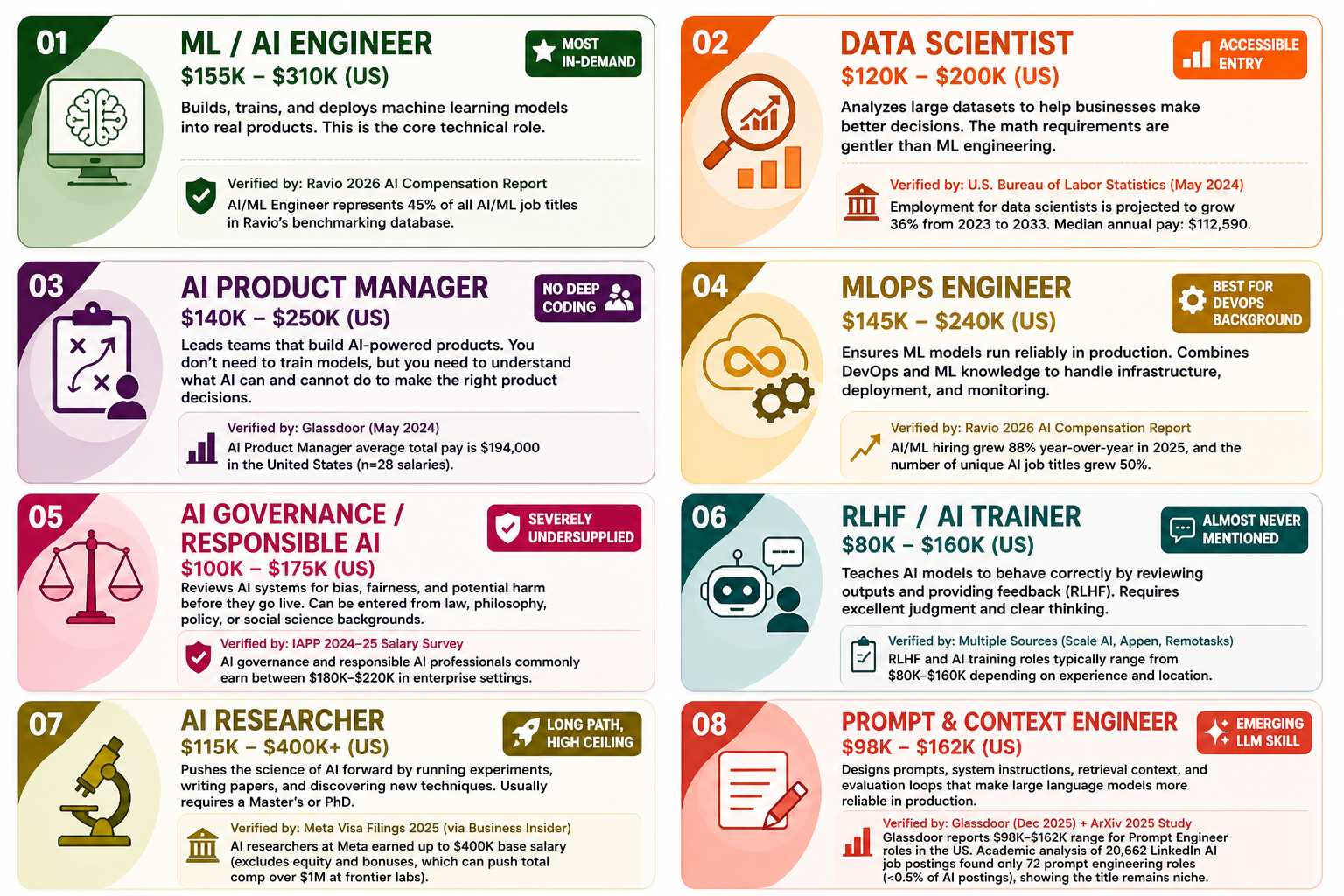
One thing not often mentioned in content related to AI careers is that AI is much bigger than just one role. Many people only hear about Machine Learning Engineers, but there are several real paths into AI. Please find below main career options, along with a glimpse of what each role looks like in day-to-day work.
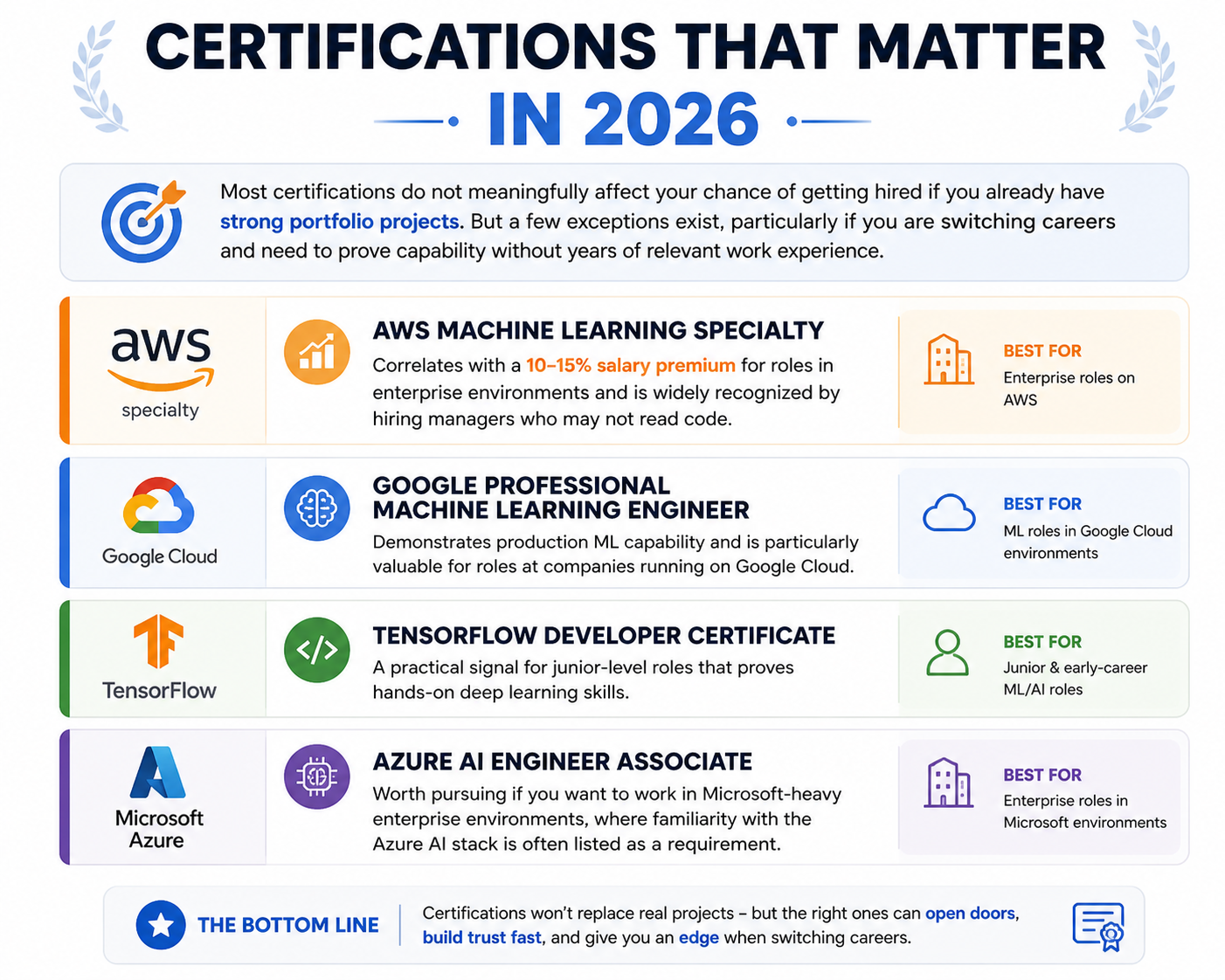
Read Also: Top Artificial Intelligence Certification Programs
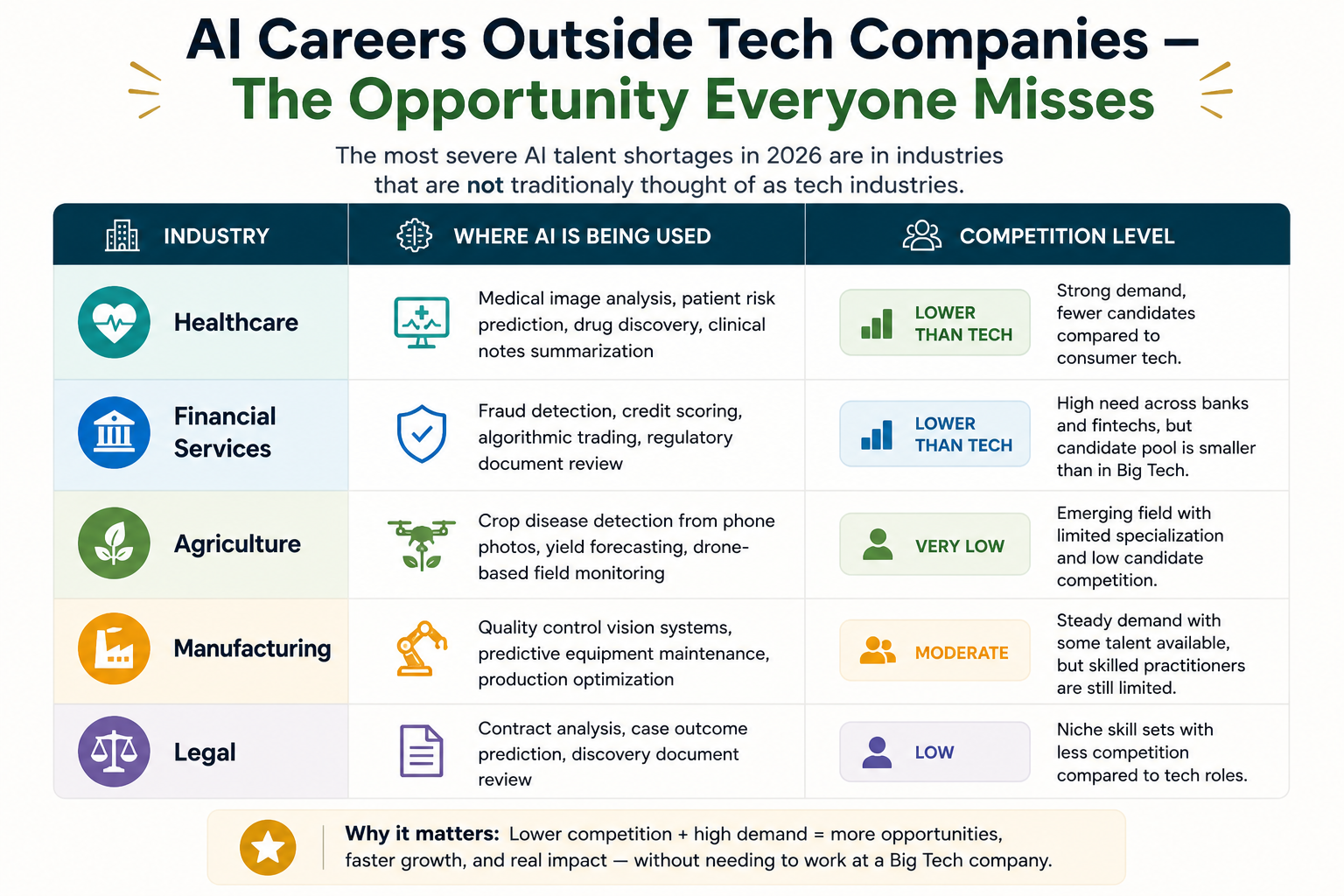
AI Careers Outside Tech Companies — The Opportunity Everyone Misses
Most career guides write as though AI jobs only exist at Google, Microsoft, and Series B startups. This is incorrect, and it is costing people opportunities. The most severe AI talent shortages in 2026 are in industries that are not traditionally thought of as tech industries.
How Domain Expertise Can Give You Advantage in AI Careers
There is one advantage in AI that holds immense value but is underrated due to its great potential: a person who already has deep knowledge of a specific industry and then adds AI skills is often more valuable than a computer science graduate competing against hundreds of other computer science graduates for the same roles.
Think about a banker who knows how to code in Python, understand machine learning algorithms and make a prediction regarding loan default risk based on financial data. He brings something a CS graduate often cannot: he understands which financial indicators actually matter in credit decisions, he knows what a model getting something wrong can cost in terms of regulatory risk, customer trust, and financial losses. Moreover, he can speak directly with risk teams, compliance officers, and executives who need to trust the system before it is deployed. More than the soft skills, these are actual competitive advantages that organizations in financial AI are willing to pay significantly more to find.
The same logic applies to a financial analyst who adds ML skills, a lawyer who learns to work with document AI, or a civil engineer who gets into computer vision for infrastructure inspection. It is usually a more expedient and better-paid path — specialize in AI in an area that you are already familiar with like medicine, finance, agriculture, law, logistics, and education, rather than starting entirely from scratch in a crowded general market.
Read Also: The History of Artificial Intelligence 1950s To 2025s
Step-by-Step Learning Roadmap with Real Time Estimates
The vast majority of resources recommend that you first learn Python, followed by mathematics and then machine learning, but never mention how long it will take to complete these steps and in what order things actually logically fit together. This roadmap is designed for studying around 10 to 15 hours per week alongside other commitments. If you have more time, you can move faster. If you already have a background in statistics, IT, or software, then several phases will be shorter for you.
Phase 1 | Weeks 1–6 | ~90 Hours Total
Python & Data Fundamentals
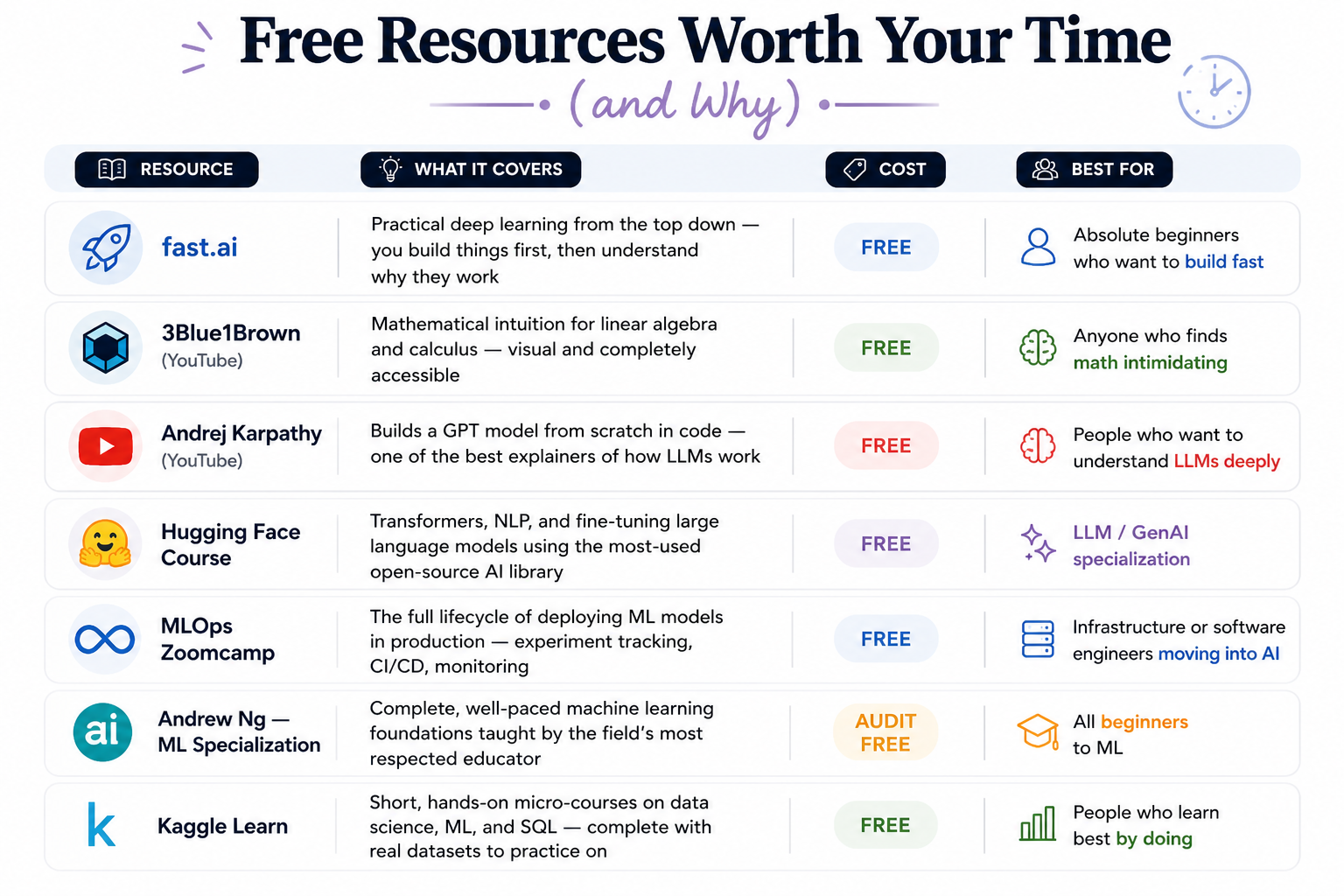
Learn Python syntax, functions, loops, and data structures. Then move to NumPy for numerical operations and Pandas for handling tabular data. You do not need to master every feature — you need to be comfortable enough to work with real datasets without stopping to look up basic things. The best free starting point is Python for Everyone on Coursera, which you can audit for free. Do not try to learn everything at once; build your way through it by working on small data problems as you go.
Phase 2 | Weeks 7–14 | ~120 Hours Total
The Math You Actually Need
You do not need a mathematics degree. Instead, you need intuition for three things: linear algebra (what a vector and matrix are, and why they are important for data), basic statistics, (distributions, probability, variance, and what they tell you about your data), and calculus at the conceptual level (what a derivative means, not how to compute them hand by hand). The best resource ever made for this, available free on YouTube, is 3Blue1Brown's Essence of Linear Algebra and Essence of Calculus series. After watching those, work through Khan Academy's Statistics and Probability course.
Phase 3 | Weeks 15–26 | ~180 Hours Total
Machine Learning Core Skills
Learn how models work: linear regression, decision trees, and neural networks. Use scikit-learn for classical models and then PyTorch for neural networks. Andrew Ng's ML Specialization on Coursera is the gold standard for this phase. The most important habit here is to build a small project after every concept you learn. Watching videos without building anything is the most common reason people stall at this stage. Aim to have two or three small working projects before you move to phase 4.
Phase 4 | Weeks 27–38 | ~165 Hours Total
Choose and Go Deep on Your Specialization
This is the step that is mostly skipped by learners, and it is the most important one. Based on your background, your interests, and the market you want to enter, pick one specialization and go deep into it. The four in-demand specializations in 2026 are: LLM and Generative AI engineering (for people who want to work with LLMs, RAG pipelines, and fine-tuning), Computer Vision (for those interested in image and video applications), MLOps (for people with existing professional experience in other fields).
Phase 5 | Weeks 39–52 | Ongoing
Build Your Portfolio and Start Applying
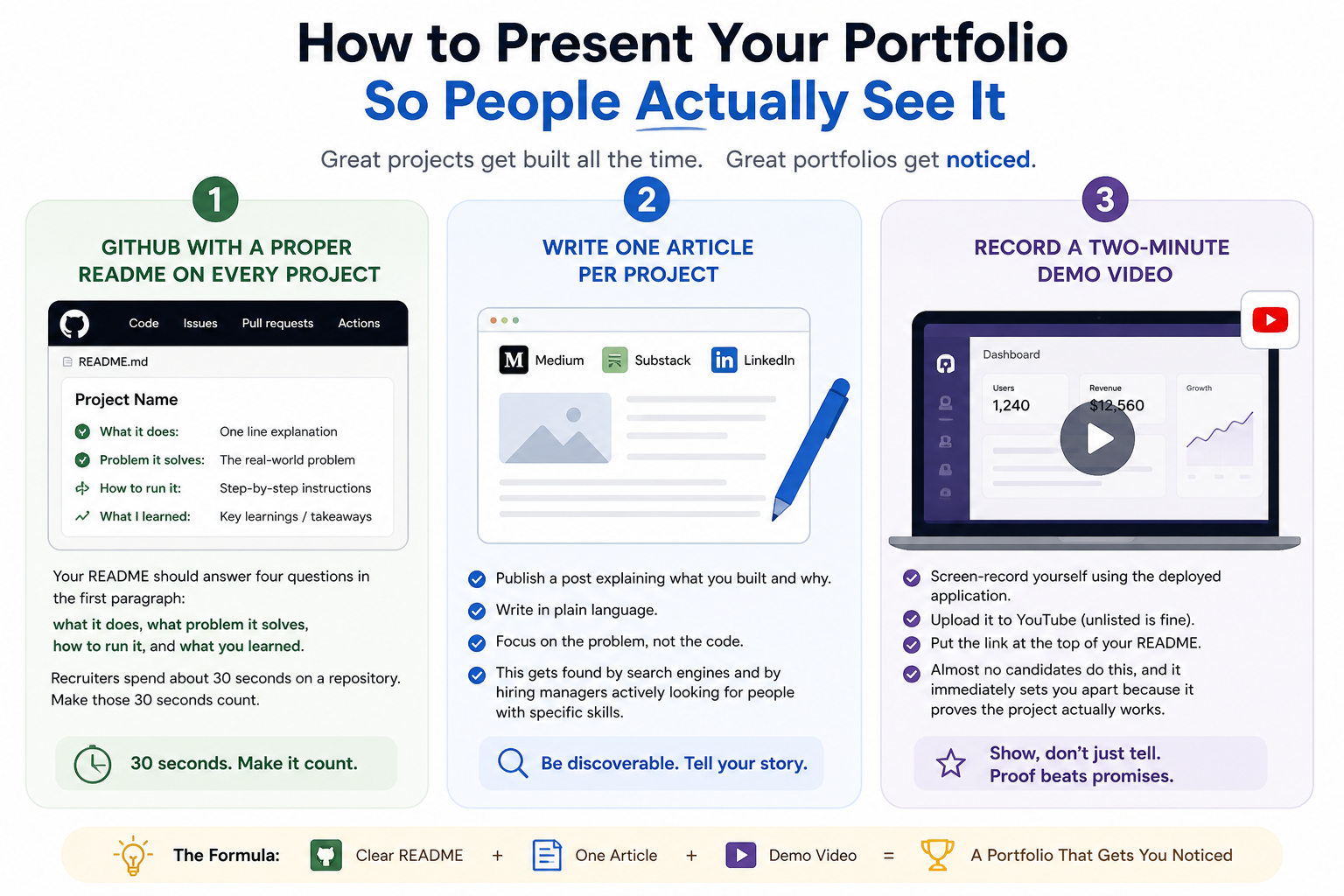
Stop learning new things and start developing prototypes. Build two or three strong portfolio projects specifically in your chosen specialization (see the next section for what "strong" means in 2026). Write publicly about what you built. Apply to jobs, attend meetups, and reach out directly to people whose work you find interesting. Your first AI job search will take three to six months — that is completely normal and is not a sign that something is wrong with your approach. Consistent effort over that period is what leads to the job offer.
Portfolio Projects That Actually Get You Hired in 2026
Building a classifier on the MNIST handwriting dataset will not impress anyone in 2026. Every candidate who has taken an ML course has done that project. Hiring managers have seen it hundreds of times, and it tells them nothing about whether you can build something useful. Here is what actually gets attention.
The Rule that Separates Good Projects from the Forgettable Ones
The best portfolio projects solve a problem that a real person or business actually has. Not an academic exercise, not a benchmark challenge that has been solved many times before, but something that someone could potentially use. The moment you can demo a project and a non-technical person says "that would actually help me," you have something worth putting on a resume.
1. A RAG System Built on a Real Document Collection (LLM / GenAI Specialization)
Build a system that lets someone have a conversation with a set of documents — a company's internal wiki, a legal database, a research paper archive, a government policy document set, or a set of technical manuals. Use LangChain or LlamaIndex for the orchestration layer, a vector database such as Chroma or Pinecone for semantic search, and deploy it as a working web application. This single project demonstrates LLM integration, vector search, deployment skills, and genuine product thinking — all in one.
2. Object Detection for a Specific Industry Problem (Computer Vision Specialization)
Do not build a cat versus dog classifier. Develop something that detects crop disease from photos taken on a phone, or counts vehicles in a parking lot to estimate capacity, or identifies surface defects in manufactured components. Use YOLOv8 or a fine-tuned ResNet architecture, and deploy it as a simple web application using Gradio or Streamlit so anyone can use it from a browser.
3. An End-to-End ML Pipeline (MLOps Specialization)
Take any ML model and build the complete production infrastructure around it. That means data versioning with DVC, experiment tracking with MLflow or Weights and Biases, a CI/CD pipeline that runs tests automatically when code changes, automated retraining logic and a monitoring dashboard that tracks model performance over time. This project tells an MLOps interviewer that you understand the full lifecycle of a machine learning system, not just the training step.
4. A Model Plus a Business Impact Analysis (Data Science or Business AI)
Find a public dataset from a real industry — Kaggle has thousands of them. Develop a model, then write a 1,000–word business report explaining what you found, what it means for a business operating in that space, and what specific decisions you would recommend based on the results. Most data scientists are excellent at building models and terrible at communicating what those models mean. Writing a clear business report, devoid of jargon, that a non-technical manager could act on is a skill that will separate you from the majority of applicants.
How to Get an AI Job Through the Hidden Job Market
A significant share of AI roles are filled before they are ever posted publicly. Companies working in fast-moving AI teams trust their networks and hire quickly. By the time a role appears on LinkedIn with hundreds of applicants, the people who were referred through relationships already have a competitive advantage.
"AI/ML hiring grew 88% year-on-year, while the talent shortage continue across critical sectors. Recruiter placement data suggests AI roles in healthcare and financial services can take 6-7 months to fill."
— Ravio Hiring Data 2026 + Second Talent AI Talent Shortage Report 2026 (industry estimate).
A. Warm Outreach to Practitioners Already Doing the Work (Most Effective Path)
Find ten people on LinkedIn who currently hold the AI role you want. Read their recent posts and GitHub repositories carefully. Then send a short, specific message — not "I'm looking for a job," but "I tried the RAG pipeline approach you described in your post and ran into a problem with chunk sizing. How did you handle that?" Such type of genuine, specific engagement leads to real conversations, which lead to referrals. Most AI hires happen through relationships, not cold applications to job boards.
B. Kaggle Competitions and Open-Source Contributions (High Return on Effort)
Finishing in the top 100 of a Kaggle competition is a signal that hiring managers actively search for. Contributing meaningfully to an open-source AI library — LangChain, Hugging Face Transformers, scikit-learn — puts your name and GitHub profile in front of thousands of developers, including the people at those organizations who are also hiring. Even a single thoughtful pull request that fixes a real issue can start a conversation with someone who has influence over hiring decisions.
C. AI-Specific Job Boards Instead of Only LinkedIn (Underused by Most Candidates)
LinkedIn and Indeed are the right places to look, but they are also where every other candidate looks. Supplement them with: ai-jobs.net, Wellfound for YC and venture-backed startups, the Hugging Face jobs page, and industry-specific job boards in the vertical you are targeting. Employers posting on specialized boards tend to be more serious about the AI work — they are not just adding "AI" to a generic software role to attract applicants.
D. Building in Public on LinkedIn or X (The Long Game — Works Better Than Most People Expect)
Post once per week about what you are learning and building. Be specific and honest — not "AI is changing everything!" but "I tried fine-tuning a small LLM on customer support data this week and here's what I learned about catastrophic forgetting." Over three to six months, this habit builds a visible track record that recruiters and hiring managers find. Several people land mid-career AI roles without ever submitting a formal application because their consistent public work made them findable.
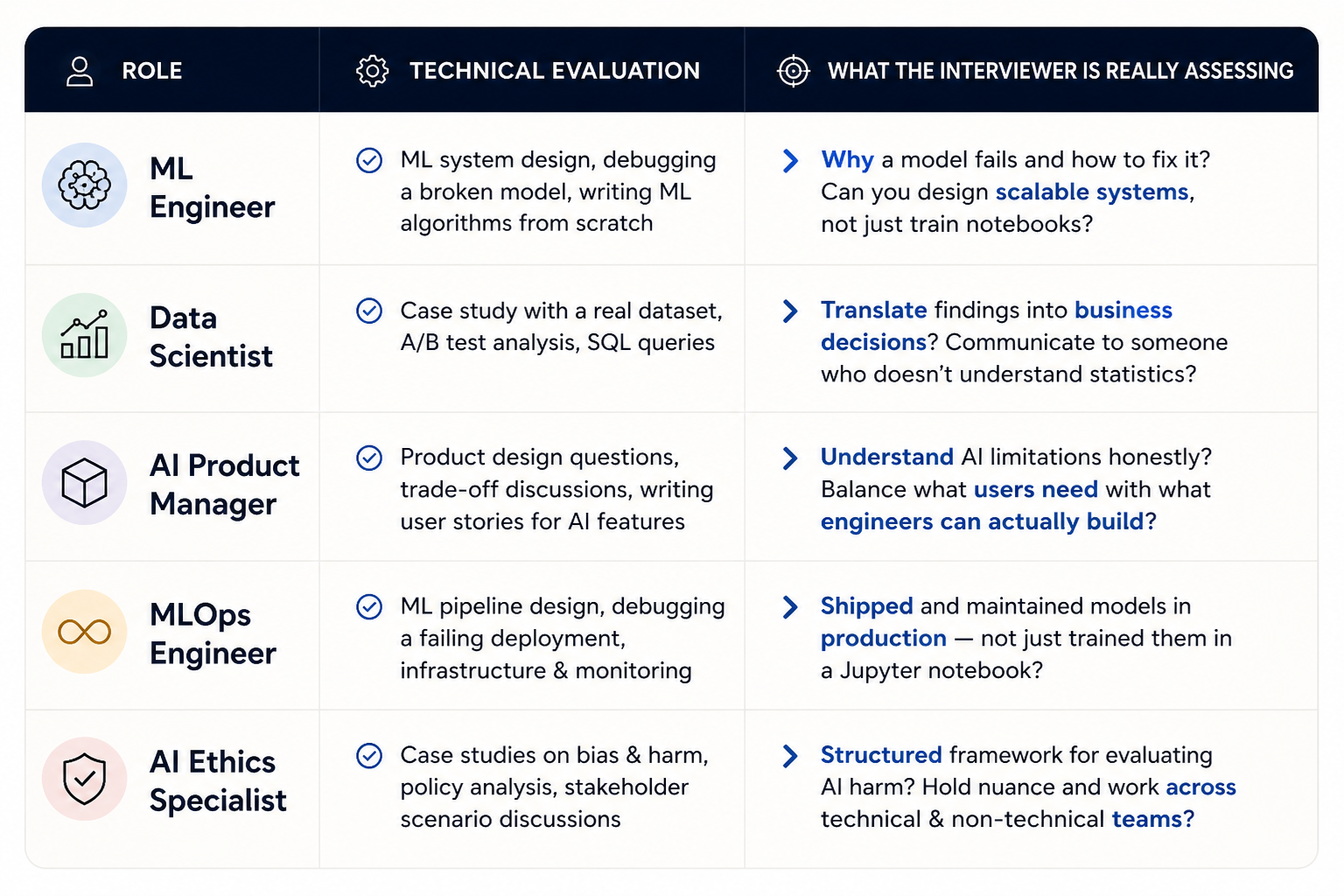
What AI Interviews Actually Test in 2026
Studying algorithms and data structures will help you in some AI interviews. But it is not the full picture. Here is what you are actually being evaluated on by role.
The number that changes interviews
In every AI interview, talk in terms of business impact. Do not say "I built a model with 94% accuracy." Say "I built a model that reduced customer churn by 18%, which translated to an estimated $2M in retained revenue per year." Numbers tied to real outcomes are what get you hired — and promoted once you are inside.
How to Negotiate Salary — Specific Tactics That Work
Despite the fact that most people leave $15,000 to $50,000 on the table in their first offer simply because they do not know how to ask for more. Here are some points that you can keep in mind while negotiating your salary package:
Never give your expected salary number first. When a recruiter asks what you are looking for, say: "I'd love to understand the full scope of the role first. Can you share the budgeted range for this position?" Most companies will share it. If they push harder, say: "I'm targeting market rate for this level and specialization, and I'd be happy to discuss once I understand the complete package." You lose negotiating power the moment you anchor first.
Use a competing offer, even if it is not your preferred role. A less interesting offer from another company still gives you real leverage. You can say: "I have an offer at $X from another company, but this role is my first choice because of the problem you're solving. Is there flexibility to get closer to $X in the package?" You do not need to be willing to take the competing offer — you need to have it.
Negotiate everything, not just base salary. Signing bonus, equity grant size, remote work flexibility, conference budget, hardware budget, and extra vacation days are all negotiable. A $10,000 signing bonus is one sentence in an email and takes 30 seconds to ask for. Most companies expect it.
Specialization justifies a premium — name it explicitly. AI/ML roles command a 12% salary premium over general engineering roles at the individual contributor level, according to Ravio's 2026 dataset. LLM fine-tuning and NLP specializations can command 30–60% above general AI engineering rates. If you have specialized skills, say so directly and reference market data. "Given the current demand for LLM fine-tuning experience, I'm seeing market rates of $X for this specialization and would want to be in that range."
Negotiate after the written offer, not before. Once they have extended an offer, they want you. Your leverage is at its highest at that moment. Negotiate before the offer arrives and you are guessing what they will accept; negotiate after it and you know they are committed to hiring you.
Read Also: The Age of AI Acceleration: Strategic Adaptation in a Transforming World
How to Stay Relevant in AI Without Information Overload
The AI field moves fast — new models, new frameworks, new benchmarks appear every few weeks. Many people working in AI develop a persistent anxiety about falling behind that eventually leads to burnout. A practical system for staying current, one that takes about two to three hours per week, is more valuable than any single piece of technical knowledge.
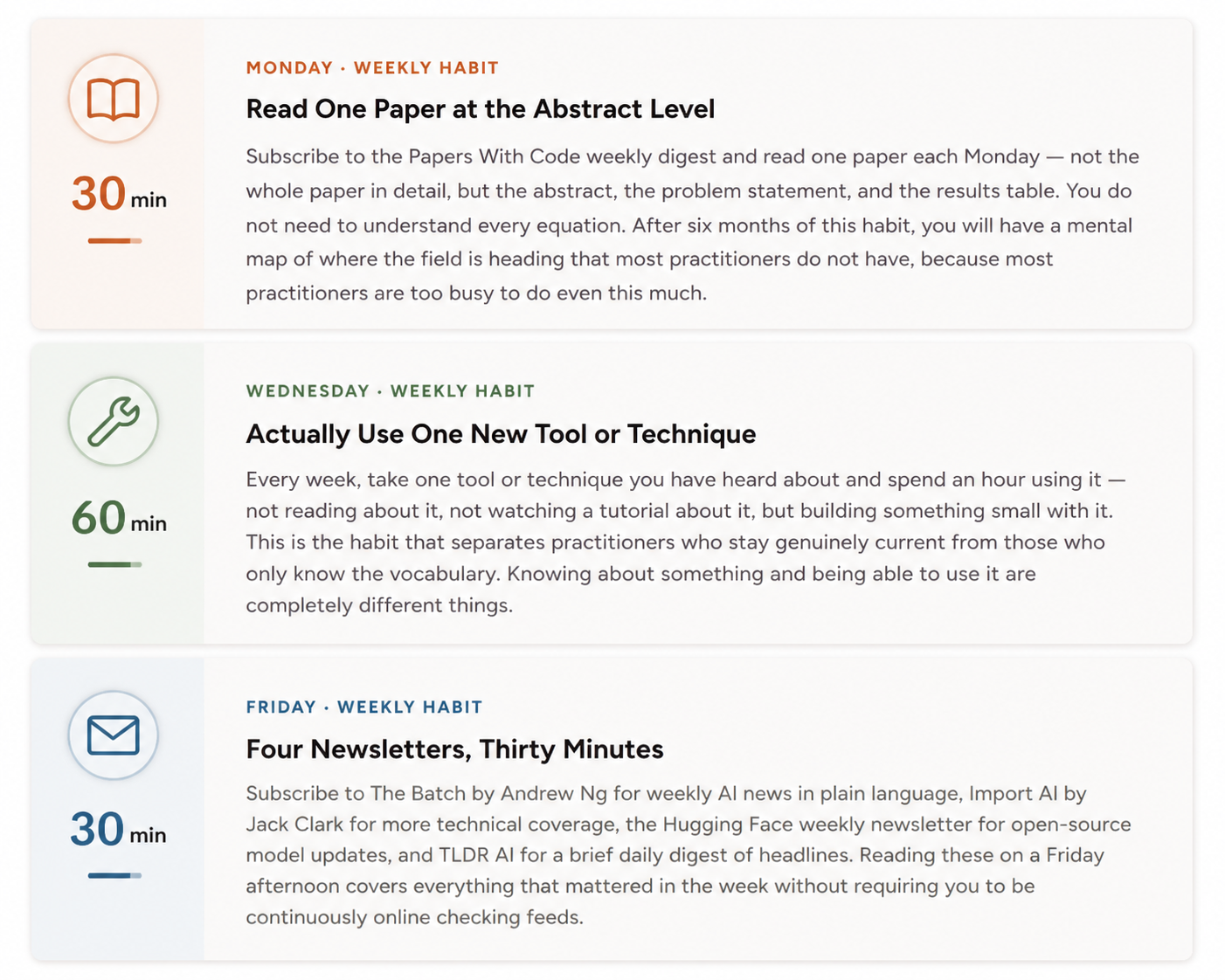
The principle that fixes this
You do not need to know every new model. You need to deeply understand the core principles that do not change much — how attention mechanisms work, how gradients flow through a network, how to design an honest evaluation. Those fundamentals remain true regardless of what new tool ships next week. The people who thrive long-term in this field are not the ones who know everything about every new release. They are the ones who have built such strong foundations that they can learn any new thing quickly when it matters.
Communities That Are Actually Worth Joining
Hugging Face Discord — active, technically serious, focused on practical LLM work. One of the highest signal-to-noise communities in AI. Free to join.
MLOps Community on Slack — the best place to find experienced practitioners discussing real production ML problems. Senior engineers share genuine challenges here, which makes it unusually educational.
Fast.ai Forums — one of the few places online where asking basic questions is genuinely welcomed and answered thoughtfully. Beginner-friendly in a field that can feel intimidating.
AI Alignment Forum — if you are interested in AI safety, AI ethics, or the longer-term implications of AI development, this is where the serious work gets discussed by the people doing it.
Local AI meetups on Meetup.com — search for "machine learning" or "AI" in your city. In-person connections lead to job referrals faster than any online platform. Many people receive their first AI job offer from someone they met at a meetup rather than through a job board.
Conclusion
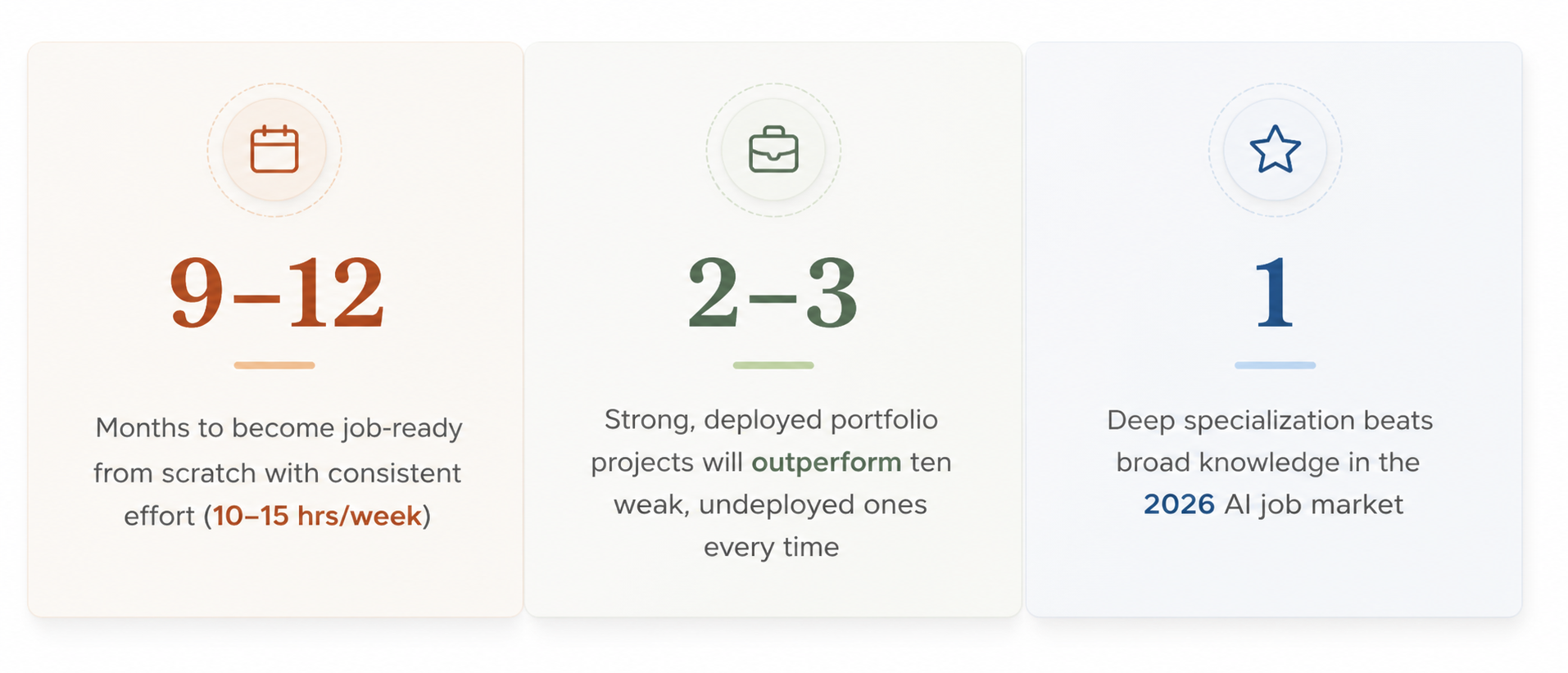
The AI job market in 2026 is genuinely full of opportunity. The data on hiring growth, talent shortages, and salary premiums is real. But the market has also grown more discerning. Companies are no longer impressed by people who simply know the vocabulary of AI. They want people who have built things that work, debugged things that broke, and learned from what went wrong.
The path to an AI career is not as linear as most guides suggest. Your existing background in another field, your ability to communicate clearly, and your willingness to build real things in public are as valuable as any technical credential. Pick a direction, learn consistently, build a portfolio that proves you can solve real problems, and go find the people who are working on the things you care about. That is how careers in AI actually happen.
Latest Blogs
8 $100 Billion AI Automation Boom: Why Businesses Are Investing More in 2026
 CISSP vs. CISA: Which Cybersecurity Certification Controls Your Career?
 What is Continual Learning in AI and Machine Learning?
  What are the Major Benefits of Online DBA Programs?
 CMAT 2027: Exam Date, Syllabus, Exam Pattern, Preparation Tips & FAQs
 Why Is Nursing in Demand in 2026? Trends Driving the Need for More Nurses
 Why more Indian Students are Opting for Doctoral Degrees
 ChatGPT Vs Claude (2026 Guide)

Priyank Jha
Priyank is a Senior Content Developer and Strategist at SNVA Veranda. Earlier, he worked as a data scientist, where he gained extensive experience in developing data-driven solutions, advanced analytics, and strategic decision-making processes. His expertise includes data analysis, business intelligence, and implementing data-centric strategies that drive organizational growth and innovation. In addition to his data science experience, Priyank has over 10 years of experience in the banking and financial services sector. He has worked across various roles and operational levels, gaining in-depth knowledge of financial operations, customer service management, and business processes.