


If you are considering a career as a DevOps engineer, it is a smart move. The global DevOps market is projected to surge from $10.4 billion in 2023 to $25.5 billion by 2028. Companies everywhere – from scrappy startups to Fortune 500s – are hiring DevOps engineers at a faster rate than they can find them.
But the common problem that most guides fail to explain to you: DevOps is not just a set of tools. It's a mindset, a culture, and a skill set that takes deliberate steps to build.
This guide provides a clear, step-by-step roadmap to become a job-ready DevOps engineer in 2026 — whether you're starting from scratch or transitioning from a developer or sysadmin role.
What Does a DevOps Engineer Actually Do?
Before we proceed with how to become a DevOps engineer, let's be clear about what a DevOps engineer actually does.
A DevOps engineer collaborates with developers to build an efficient system that tests and deploys code while managing the infrastructure that supports application operations. The process requires multiple tasks, which include cloud environment setup and configurations, implementation of security best practices, optimization of deployment pipelines, and setting up observability tools to monitor performance. Pursuing a DevOps Certification further enhances these skills, validating expertise and improving career opportunities in modern IT environments.
A DevOps engineer handles the complete process of transforming code created by developers into operational production systems through secure and efficient methods. They build the bridges between the team that writes code and the team that runs it. From a tooling perspective, the DevOps Engineer role requires expertise in operating systems, networking, automation tools, CI tools, version control systems, monitoring and observability tools, infrastructure as code, and programming/scripting.
Now, let's walk through how to actually build those skills.
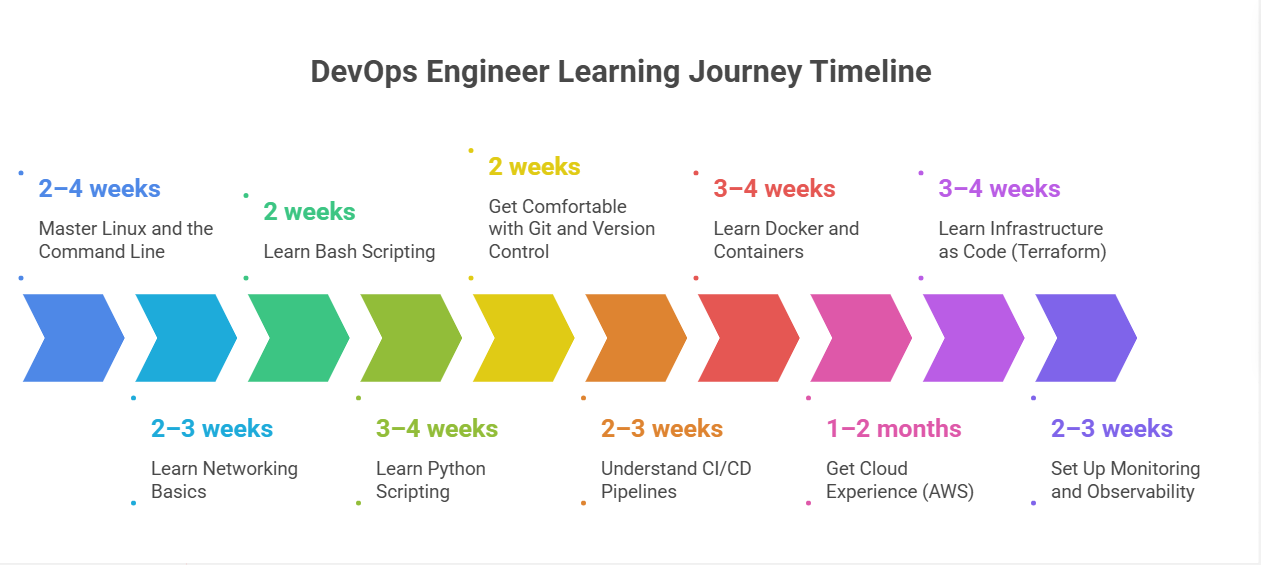
Step 1: Master Linux and the Command Line
This is where every DevOps journey begins — and most beginners want to bypass it. Don't.
A DevOps Engineer should understand the operating system. Since, most of the servers out there use Linux, it's vital for infrastructure management and troubleshooting to have the knowledge of how to handle Linux operating system.
You don't have to be a Linux expert from day one. Just master basic skills first:
Working in the file system (cd, ls, pwd, find)
Handling permissions and working with users (chmod, chown, sudo)
Managing processes (ps, kill, top, htop)
Using grep, sed, and awk for text processing
The command line interface is your primary workspace as a DevOps engineer. While GUI tools might come in handy sometimes, but the CLI terminal is where the real work of automation, configuration, and troubleshooting happens — because of its speed, versatility, and ability to be used in scripts.
What to do: You can spend 2–4 weeks on Linux fundamentals. Use free resources like Linux Journey or The Odin Project. Practice daily in a terminal, not just by reading.
Step 2: Learn Networking Basics
There is no requirement to be a network engineer. However, there's a need to have an understanding of how data flows between various systems.
Important topics to focus would include topics such as the OSI model, IP addressing, ports, DNS, HTTP/HTTPS, and protocols like TCP/UDP. Tools like ping, traceroute, and curl are examples of important tools that help troubleshoot various issues.
Why does this matter? The reason for this is because network-related issues are the most common types of deployment failures; things like a misconfiguration of the DNS, blocking of a certain port or the API gateway. Without such knowledge, you would not even know where to start troubleshooting.
What to do: You can learn basics from Professor Messer's free CompTIA Network+ videos or Cisco's Networking Basics on Coursera. Two or three weeks is enough for networking basics.
Step 3: Learn a Scripting Language — Python or Bash
For a DevOps Engineer, scripting is essential. Presently, every decent company has a preliminary scripting/coding round in DevOps interviews.
The two languages you should focus on are Python and Bash.
Bash is perfect for automating system tasks — file operations, cron jobs, deployment scripts.
Python is more powerful and versatile — great for writing tools, interacting with APIs, and building automation workflows.
Python's versatility makes it ideal for configuration management, monitoring scripts, and API integrations. Bash scripting excels in system administration tasks, file manipulation, and environment setup.
You don't need to become a full-stack developer. You need to write clean, working scripts that automate repetitive work. That's it.
What to do: Learn Bash first (2 weeks), then Python basics (3–4 weeks). Try building small projects — automate a backup script, write a system health checker, parse log files.
Step 4: Get Comfortable with Git and Version Control
Consider Git as mandatory because this is where every DevOps workflow begins.
You will have to get familiar with creating repos, branching, merging, conflict resolutions, and working on a shared codebase. Most CI/CD processes start from Git events like pushing to master, submitting pull requests, making tags. Not being proficient in Git will cause problems all around.
Concepts to learn: branching models (GitFlow vs. trunk-based), pull requests, merge conflicts, gitignore, rebasing, and tags.
Knowledge of tools: GitHub, GitLab, or Bitbucket. Choose your favourite and master it.
What to do: Spend two weeks on it. Go through Learn Git Branching (freely available, interactive, great course). Commit changes to actual projects.
Step 5: Understand CI/CD Pipelines
This is one of the key skills possessed by a DevOps engineer.
Continuous Integration and Continuous Delivery (Deployment) can be abbreviated as CI/CD. CI is an automated testing of each code modification, while CD stands for automated delivery of modifications either to the staging or production environment.
CI/CD consists of the following skills: programming, creating config files and working with Git. It doesn't require learning any new skills because you can train yourself using GitHub Actions. There is a set of tutorials in GitHub Actions aimed at developing a basic understanding of CI/CD.
Most popular CI/CD tools in 2026: GitHub Actions (the best to start), GitLab CI, Jenkins, and CircleCI.
What to do: First of all, try using GitHub Actions. Set up a pipeline that will run tests on each pull request and deploy a simple application when merging it. This project will make you gain more knowledge than any course.
Step 6: Learn Docker and Containers
For absolute beginners, the learning path goes as follows: Linux basics → networking basics → programming languages → versioning control → Docker → CI/CD pipelines. It will take between 12 to 18 months to become employment-ready.
Docker is the point where everything starts to click. The containers allow bundling the application along with its dependencies into a single unit that runs uniformly across any environment, including your local computer, a remote server, and the cloud.
What to learn: writing Docker files; building and running Docker images; using Docker Compose for applications requiring multiple containers; uploading the built images to Docker Hub and private repositories.
Following an understanding of how Docker works, it is time to go for Kubernetes — the solution for managing and orchestrating containers in a large-scale system. Kubernetes is more complex, but it's one of the most in-demand skills in DevOps today.
What to do: Getting started with Docker (3 to 4 weeks) followed by learning about Kubernetes basics with Minikube. Aim to have your multi-service application deployed to Kubernetes on your local machine.
Step 7: Get Cloud Experience — Pick One Platform
To become a DevOps engineer in 2026, you must be proficient in cloud. The need for Cloud DevOps engineers is rising, especially with the growing number of companies undergoing digital transformations. The three most popular cloud providers are AWS, Azure, and Google Cloud.
Begin with AWS, the most prevalent and having the largest number of job postings. Start with the basics; every DevOps engineer should know these services:
EC2 — Virtual Machines
S3 — Object Storage
VPC — Virtual Networking
IAM — Identity & Access Management
ECS/EKS — Container Orchestration
CloudWatch — Monitoring & Logging
Practice using the AWS free tier. It's not enough to simply watch videos; build and deploy real things.
What to do: One to two months in AWS hands-on. Create a project that deploys a containerized application in ECS or EKS through a CI/CD pipeline triggered by GitHub Actions.
Step 8: Learn infrastructure as Code (IaC)
Using IaC tools such as Terraform and Amazon Cloud CDK enables the ops team to deploy infrastructure using simple configurations files, allowing easier management and scalability of applications.
You no longer need to interact with the AWS Console; instead, you code your infrastructure and commit it into Git where it undergoes code reviews just like any other code. It can then be deployed, updated, or deleted in one command.
The industry standard is Terraform. Therefore, it is beneficial to learn Terraform. You'll use .tf files to define your servers, network, database, and permissions, and then Terraform creates all of it for you.
What to do: Take 3-4 weeks learning Terraform. Build a project where you deploy an entire AWS environment (VPC, EC2, RDS) using Terraform alone, without any manual clicks.
Step 9: Set Up Monitoring and Observability
You have developed the pipeline. You have deployed the application also. So now, how do you know whether everything is functioning smoothly?
Important tools are Prometheus for monitoring and ELK Stack (Elasticsearch, Logstash, Kibana) for logging. You must ensure that there is proper handling of secrets and alerts for any spike in CPU usage.
You need to be well-versed in Grafana for visualization and alerting. The idea here is to ensure observability in your systems such that issues are identified even before they impact the user experience — and know the root cause when something goes wrong.
What to do: Install Prometheus with Grafana on your Kubernetes cluster. Make a dashboard to monitor CPU, memory, rate of requests, and rate of errors. Generate at least three meaningful alerts.
Step 10: Get Certified
While certifications will never substitute for experience, they demonstrate competence to employers, particularly in your early career stages.
Some popular certifications for 2026 are AWS Certified DevOps Engineer, Azure DevOps Engineer Expert, and Google Cloud Professional Cloud DevOps Engineer. These qualifications demonstrate knowledge and competence in the DevOps process from both a theoretical and practical perspective.
Another valuable certification to consider after gaining proficiency in Kubernetes is the Certified Kubernetes Administrator (CKA).
Recommended certification order: AWS Solutions Architect Associate > CKA > AWS DevOps Engineer Professional.
Your 12-Month DevOps Roadmap at a Glance
Timeline | Focus Area | What You'll Learn | Goal to Hit |
Weeks 1– 4 | Linux & Bash Scripting | File system, permissions, process management, shell scripting | Automate a common sysadmin task with a Bash script |
Weeks 5–8 | Docker & Containers | Dockerfiles, images, Docker Compose, container networking | Containerize an existing app and run it locally |
Weeks 9–12 | Cloud Basics (AWS) | EC2, S3, VPC, IAM — using the AWS Free tier | Deploy a containerized app to AWS manually |
Month 4 | Kubernetes | Pods, deployments, services, Minikube setup | Deploy a multi-service app to a local Kubernetes cluster |
Month 5 | Terraform & IaC | HCL syntax, resource provisioning, state management | Provision a full AWS environment (VPC + EC2 + RDS) via code — zero manual clicks |
Month 6 | CI/CD Pipelines | GitHub Actions, pipeline triggers, automated testing & deploys | Build a full CI/CD pipeline from pull request to production |
Month 7 | Monitoring & Observability | Prometheus, Grafana dashboards, alerting rules | Live dashboard with CPU, memory, error rate — and 3 working alerts |
Month 8 | Incident Response | Runbooks, on-call basics, post-mortems, RCA | Write runbooks for your 3 most common alert scenarios |
Month 9 | SLOs & Error Budgets | SLIs, SLOs, SLAs, reliability targets | Define measurable SLOs for your project and track them |
Months 10–12 | Certifications & Job Hunt | AWS Solutions Architect or CKA prep | Pass your first cert and start applying for junior DevOps roles |
Conclusion
Becoming a DevOps engineer in 2026 is possible with dedication and perseverance. Proceed in small steps and work hard to achieve mastery at each level before proceeding. Do not try to learn everything instantly; instead, proceed gradually, taking one step after another. The industry seeks DevOps engineers that have conceptual knowledge, problem-solving skills, troubleshoot errors and the ability to work well with developers and operations professionals.

Careerera Content Team
The Careerera Team is a talented collective of experienced content writers, researchers, and industry contributors passionate about creating insightful and engaging content for today’s learners and professionals. With expertise spanning trending technologies, AI, ML, data science, cybersecurity, management, business, and humanities, our writers bring deep subject knowledge and practical industry perspective to every piece they publish.
With extensive experience in content writing, the team excels at transforming complex subjects into clear, engaging, and reader-centric content. Careerera’s skilled writers are dedicated to creating high-quality resources that educate, inspire, and empower professionals worldwide.
Learn how we research, review, and update our content. Editorial Standards & Review Process.

Latest Blogs
8 Why Your PMO Is Dying, and How PRINCE2 7 Could Save It
 Is PRINCE2 Certification Still Worth It in 2026? An Honest ROI Breakdown
 Top 20 Toughest Exams in the World 2026: Students Guide
 $100 Billion AI Automation Boom: Why Businesses Are Investing More in 2026
 CISSP vs. CISA: Which Cybersecurity Certification Controls Your Career?
 What is Continual Learning in AI and Machine Learning?
  What are the Major Benefits of Online DBA Programs?
 CMAT 2027: Exam Date, Syllabus, Exam Pattern, Preparation Tips & FAQs
If you are considering a career as a DevOps engineer, it is a smart move. The global DevOps market is projected to surge from $10.4 billion in 2023 to $25.5 billion by 2028. Companies everywhere – from scrappy startups to Fortune 500s – are hiring DevOps engineers at a faster rate than they can find them.
But the common problem that most guides fail to explain to you: DevOps is not just a set of tools. It's a mindset, a culture, and a skill set that takes deliberate steps to build.
This guide provides a clear, step-by-step roadmap to become a job-ready DevOps engineer in 2026 — whether you're starting from scratch or transitioning from a developer or sysadmin role.
What Does a DevOps Engineer Actually Do?
Before we proceed with how to become a DevOps engineer, let's be clear about what a DevOps engineer actually does.
A DevOps engineer collaborates with developers to build an efficient system that tests and deploys code while managing the infrastructure that supports application operations. The process requires multiple tasks, which include cloud environment setup and configurations, implementation of security best practices, optimization of deployment pipelines, and setting up observability tools to monitor performance. Pursuing a DevOps Certification further enhances these skills, validating expertise and improving career opportunities in modern IT environments.
A DevOps engineer handles the complete process of transforming code created by developers into operational production systems through secure and efficient methods. They build the bridges between the team that writes code and the team that runs it. From a tooling perspective, the DevOps Engineer role requires expertise in operating systems, networking, automation tools, CI tools, version control systems, monitoring and observability tools, infrastructure as code, and programming/scripting.
Now, let's walk through how to actually build those skills.
Step 1: Master Linux and the Command Line
This is where every DevOps journey begins — and most beginners want to bypass it. Don't.
A DevOps Engineer should understand the operating system. Since, most of the servers out there use Linux, it's vital for infrastructure management and troubleshooting to have the knowledge of how to handle Linux operating system.
You don't have to be a Linux expert from day one. Just master basic skills first:
Working in the file system (cd, ls, pwd, find)
Handling permissions and working with users (chmod, chown, sudo)
Managing processes (ps, kill, top, htop)
Using grep, sed, and awk for text processing
The command line interface is your primary workspace as a DevOps engineer. While GUI tools might come in handy sometimes, but the CLI terminal is where the real work of automation, configuration, and troubleshooting happens — because of its speed, versatility, and ability to be used in scripts.
What to do: You can spend 2–4 weeks on Linux fundamentals. Use free resources like Linux Journey or The Odin Project. Practice daily in a terminal, not just by reading.
Step 2: Learn Networking Basics
There is no requirement to be a network engineer. However, there's a need to have an understanding of how data flows between various systems.
Important topics to focus would include topics such as the OSI model, IP addressing, ports, DNS, HTTP/HTTPS, and protocols like TCP/UDP. Tools like ping, traceroute, and curl are examples of important tools that help troubleshoot various issues.
Why does this matter? The reason for this is because network-related issues are the most common types of deployment failures; things like a misconfiguration of the DNS, blocking of a certain port or the API gateway. Without such knowledge, you would not even know where to start troubleshooting.
What to do: You can learn basics from Professor Messer's free CompTIA Network+ videos or Cisco's Networking Basics on Coursera. Two or three weeks is enough for networking basics.
Step 3: Learn a Scripting Language — Python or Bash
For a DevOps Engineer, scripting is essential. Presently, every decent company has a preliminary scripting/coding round in DevOps interviews.
The two languages you should focus on are Python and Bash.
Bash is perfect for automating system tasks — file operations, cron jobs, deployment scripts.
Python is more powerful and versatile — great for writing tools, interacting with APIs, and building automation workflows.
Python's versatility makes it ideal for configuration management, monitoring scripts, and API integrations. Bash scripting excels in system administration tasks, file manipulation, and environment setup.
You don't need to become a full-stack developer. You need to write clean, working scripts that automate repetitive work. That's it.
What to do: Learn Bash first (2 weeks), then Python basics (3–4 weeks). Try building small projects — automate a backup script, write a system health checker, parse log files.
Step 4: Get Comfortable with Git and Version Control
Consider Git as mandatory because this is where every DevOps workflow begins.
You will have to get familiar with creating repos, branching, merging, conflict resolutions, and working on a shared codebase. Most CI/CD processes start from Git events like pushing to master, submitting pull requests, making tags. Not being proficient in Git will cause problems all around.
Concepts to learn: branching models (GitFlow vs. trunk-based), pull requests, merge conflicts, gitignore, rebasing, and tags.
Knowledge of tools: GitHub, GitLab, or Bitbucket. Choose your favourite and master it.
What to do: Spend two weeks on it. Go through Learn Git Branching (freely available, interactive, great course). Commit changes to actual projects.
Step 5: Understand CI/CD Pipelines
This is one of the key skills possessed by a DevOps engineer.
Continuous Integration and Continuous Delivery (Deployment) can be abbreviated as CI/CD. CI is an automated testing of each code modification, while CD stands for automated delivery of modifications either to the staging or production environment.
CI/CD consists of the following skills: programming, creating config files and working with Git. It doesn't require learning any new skills because you can train yourself using GitHub Actions. There is a set of tutorials in GitHub Actions aimed at developing a basic understanding of CI/CD.
Most popular CI/CD tools in 2026: GitHub Actions (the best to start), GitLab CI, Jenkins, and CircleCI.
What to do: First of all, try using GitHub Actions. Set up a pipeline that will run tests on each pull request and deploy a simple application when merging it. This project will make you gain more knowledge than any course.
Step 6: Learn Docker and Containers
For absolute beginners, the learning path goes as follows: Linux basics → networking basics → programming languages → versioning control → Docker → CI/CD pipelines. It will take between 12 to 18 months to become employment-ready.
Docker is the point where everything starts to click. The containers allow bundling the application along with its dependencies into a single unit that runs uniformly across any environment, including your local computer, a remote server, and the cloud.
What to learn: writing Docker files; building and running Docker images; using Docker Compose for applications requiring multiple containers; uploading the built images to Docker Hub and private repositories.
Following an understanding of how Docker works, it is time to go for Kubernetes — the solution for managing and orchestrating containers in a large-scale system. Kubernetes is more complex, but it's one of the most in-demand skills in DevOps today.
What to do: Getting started with Docker (3 to 4 weeks) followed by learning about Kubernetes basics with Minikube. Aim to have your multi-service application deployed to Kubernetes on your local machine.
Step 7: Get Cloud Experience — Pick One Platform
To become a DevOps engineer in 2026, you must be proficient in cloud. The need for Cloud DevOps engineers is rising, especially with the growing number of companies undergoing digital transformations. The three most popular cloud providers are AWS, Azure, and Google Cloud.
Begin with AWS, the most prevalent and having the largest number of job postings. Start with the basics; every DevOps engineer should know these services:
EC2 — Virtual Machines
S3 — Object Storage
VPC — Virtual Networking
IAM — Identity & Access Management
ECS/EKS — Container Orchestration
CloudWatch — Monitoring & Logging
Practice using the AWS free tier. It's not enough to simply watch videos; build and deploy real things.
What to do: One to two months in AWS hands-on. Create a project that deploys a containerized application in ECS or EKS through a CI/CD pipeline triggered by GitHub Actions.
Step 8: Learn infrastructure as Code (IaC)
Using IaC tools such as Terraform and Amazon Cloud CDK enables the ops team to deploy infrastructure using simple configurations files, allowing easier management and scalability of applications.
You no longer need to interact with the AWS Console; instead, you code your infrastructure and commit it into Git where it undergoes code reviews just like any other code. It can then be deployed, updated, or deleted in one command.
The industry standard is Terraform. Therefore, it is beneficial to learn Terraform. You'll use .tf files to define your servers, network, database, and permissions, and then Terraform creates all of it for you.
What to do: Take 3-4 weeks learning Terraform. Build a project where you deploy an entire AWS environment (VPC, EC2, RDS) using Terraform alone, without any manual clicks.
Step 9: Set Up Monitoring and Observability
You have developed the pipeline. You have deployed the application also. So now, how do you know whether everything is functioning smoothly?
Important tools are Prometheus for monitoring and ELK Stack (Elasticsearch, Logstash, Kibana) for logging. You must ensure that there is proper handling of secrets and alerts for any spike in CPU usage.
You need to be well-versed in Grafana for visualization and alerting. The idea here is to ensure observability in your systems such that issues are identified even before they impact the user experience — and know the root cause when something goes wrong.
What to do: Install Prometheus with Grafana on your Kubernetes cluster. Make a dashboard to monitor CPU, memory, rate of requests, and rate of errors. Generate at least three meaningful alerts.
Step 10: Get Certified
While certifications will never substitute for experience, they demonstrate competence to employers, particularly in your early career stages.
Some popular certifications for 2026 are AWS Certified DevOps Engineer, Azure DevOps Engineer Expert, and Google Cloud Professional Cloud DevOps Engineer. These qualifications demonstrate knowledge and competence in the DevOps process from both a theoretical and practical perspective.
Another valuable certification to consider after gaining proficiency in Kubernetes is the Certified Kubernetes Administrator (CKA).
Recommended certification order: AWS Solutions Architect Associate > CKA > AWS DevOps Engineer Professional.
Your 12-Month DevOps Roadmap at a Glance
Timeline | Focus Area | What You'll Learn | Goal to Hit |
Weeks 1– 4 | Linux & Bash Scripting | File system, permissions, process management, shell scripting | Automate a common sysadmin task with a Bash script |
Weeks 5–8 | Docker & Containers | Dockerfiles, images, Docker Compose, container networking | Containerize an existing app and run it locally |
Weeks 9–12 | Cloud Basics (AWS) | EC2, S3, VPC, IAM — using the AWS Free tier | Deploy a containerized app to AWS manually |
Month 4 | Kubernetes | Pods, deployments, services, Minikube setup | Deploy a multi-service app to a local Kubernetes cluster |
Month 5 | Terraform & IaC | HCL syntax, resource provisioning, state management | Provision a full AWS environment (VPC + EC2 + RDS) via code — zero manual clicks |
Month 6 | CI/CD Pipelines | GitHub Actions, pipeline triggers, automated testing & deploys | Build a full CI/CD pipeline from pull request to production |
Month 7 | Monitoring & Observability | Prometheus, Grafana dashboards, alerting rules | Live dashboard with CPU, memory, error rate — and 3 working alerts |
Month 8 | Incident Response | Runbooks, on-call basics, post-mortems, RCA | Write runbooks for your 3 most common alert scenarios |
Month 9 | SLOs & Error Budgets | SLIs, SLOs, SLAs, reliability targets | Define measurable SLOs for your project and track them |
Months 10–12 | Certifications & Job Hunt | AWS Solutions Architect or CKA prep | Pass your first cert and start applying for junior DevOps roles |
Conclusion
Becoming a DevOps engineer in 2026 is possible with dedication and perseverance. Proceed in small steps and work hard to achieve mastery at each level before proceeding. Do not try to learn everything instantly; instead, proceed gradually, taking one step after another. The industry seeks DevOps engineers that have conceptual knowledge, problem-solving skills, troubleshoot errors and the ability to work well with developers and operations professionals.
Latest Blogs
8- Why Your PMO Is Dying, and How PRINCE2 7 Could Save It
- Is PRINCE2 Certification Still Worth It in 2026? An Honest ROI Breakdown
- Top 20 Toughest Exams in the World 2026: Students Guide
- $100 Billion AI Automation Boom: Why Businesses Are Investing More in 2026
- CISSP vs. CISA: Which Cybersecurity Certification Controls Your Career?
- What is Continual Learning in AI and Machine Learning?
- What are the Major Benefits of Online DBA Programs?
- CMAT 2027: Exam Date, Syllabus, Exam Pattern, Preparation Tips & FAQs
Careerera Content Team
The Careerera Team is a talented collective of experienced content writers, researchers, and industry contributors passionate about creating insightful and engaging content for today’s learners and professionals. With expertise spanning trending technologies, AI, ML, data science, cybersecurity, management, business, and humanities, our writers bring deep subject knowledge and practical industry perspective to every piece they publish.
With extensive experience in content writing, the team excels at transforming complex subjects into clear, engaging, and reader-centric content. Careerera’s skilled writers are dedicated to creating high-quality resources that educate, inspire, and empower professionals worldwide.
Learn how we research, review, and update our content. Editorial Standards & Review Process.