

DevOps is a software development methodology consisting of diverse practices, tools, and a cultural philosophy, all boiling down to delivering high-quality software faster by reducing the development lifecycle. It doesn't promote the concept of siloed working but cross-team collaboration and communication, encouraging automation and shared responsibility to improve reliability and speed.
Why learn DevOps tools?
DevOps practices emphasize collaboration and iterative improvement between software development (Dev) and operations (Ops) teams. Therefore, learning DevOps tools and pursuing a DevOps Certification is essential for automating repetitive tasks, deploying software faster, fostering better collaboration between teams, and integrating security practices directly into the software development lifecycle.
Guide to the 15 Most Popular DevOps Tools to Learn in 2026
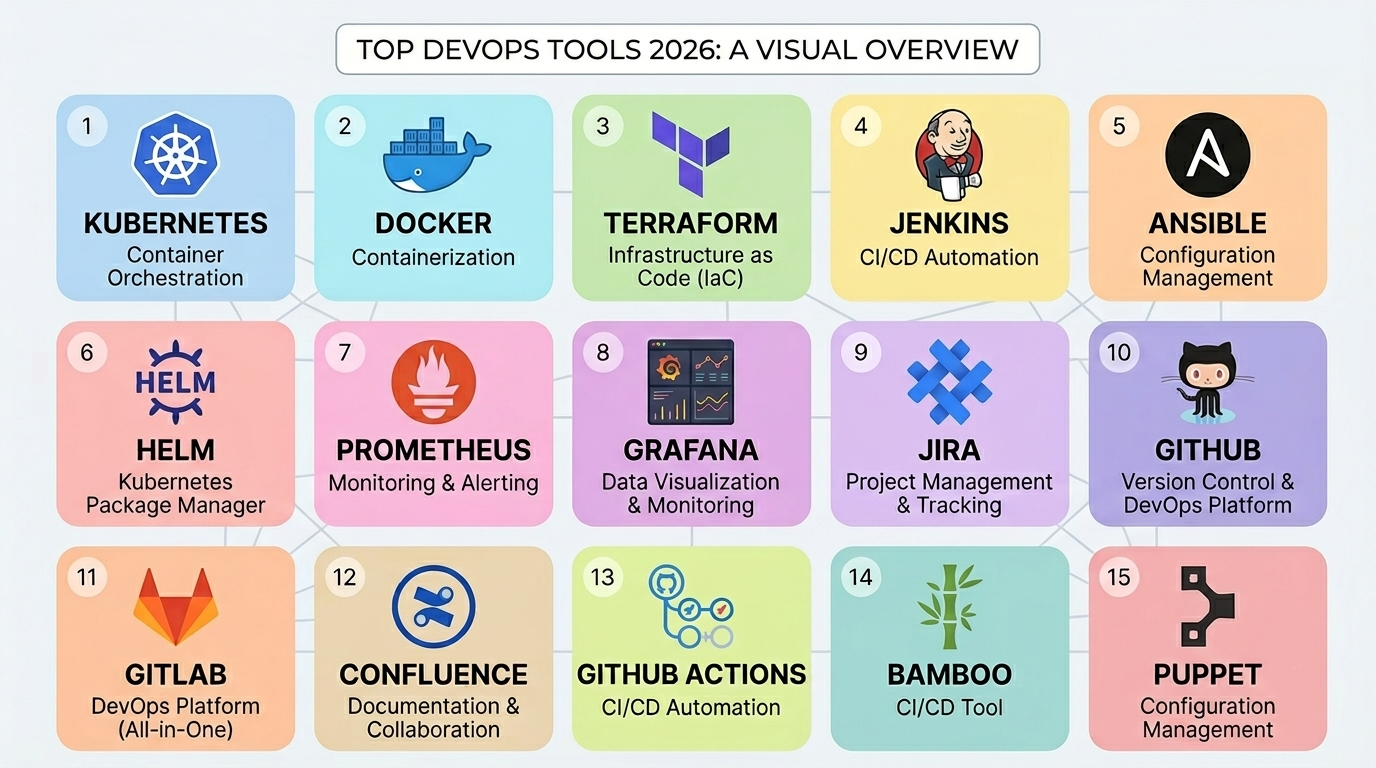
1. Kubernetes (K8s)
When it comes to automating, deploying, scaling and managing containerized applications, an open-source platform like Kubernetes serves as a robust tool for the task. Learning this core DevOps tool matters because it is a genuine standard to manage distributed systems. It is also a career accelerator for roles in SRE (Site Reliability Engineering) and platform engineering. Learning this tool means sharpening your skills in designing scalable, resilient systems, making it one of the most impactful technologies to study.
Key features:
Automates deployment and updates.
Automates rollouts and rollbacks for updates.
Scales resources and applications in real-time.
Self-monitor containers and nodes to drive traffic to healthy pods.
Robust storage orchestration.
2. Docker
It is an OS-level virtualization or containerization platform, providing an efficient way to run apps by virtualizing the operating system rather than the physical hardware. Docker is a base for contemporary DevOps practices.
Learning this DevOps tool matters because it is considered foundational skills for modern software development. Docker is a core component of CI/CD (continuous integration and continuous deployment) and is a key prerequisite for learning advanced orchestration tools like Kubernetes.
Key features:
Lightweight containerization
Portable across local machines and cloud platforms
Version control using Docker files/images
3. Terraform
With this Infrastructure as Code (IaC) tool, you can build, change, and version cloud and on-premises resources efficiently. Learning this tool matters in the context of enabling IaC to automate, manage, and reproduce infrastructure across different cloud providers like AWS, with the use of simple configuration files.
Key features:
Manage any infrastructure.
Write your own code.
Keep track of real infrastructure in a state file.
No need to write step by step instructions to create resources.
4. Jenkins
This open source automation server features multiple plugins to build, deploy, and automate projects, reducing manual effort and expediting development cycles for developers. For DevOps professionals, learning Jenkins would mean mastering to automate the whole software development lifecycle. The tool is still used by organizations to manage complex, legacy, and modern pipelines. Automating repetitive tasks like building, testing and deploying code is one of the abilities of the tool.
Key features:
Extensive plugins (e.g. over 1,800+plugins).
Easy OS installation and configuration.
Distribute builds across machines by using a master-agent architecture.
5. Ansible
An open-source automation engine, Ansible ensures its application for organizations in managing IT infrastructure, deploying applications, and orchestrating workflows. In other words, the tool enables simplification of complex tasks like application deployment and configuration management. Learning Ansible means boosting your productivity in application deployment and coordinated execution of different IT automation tasks or processes (known as task orchestration). The relevancy of the tool is tied to being agentless architecture and extensive module library.
Key features:
Agentless architecture.
Simple syntax (e.g. human-readable YAML).
SSH & WinRM connectivity.
6. Helm
As a package manager for Kubernetes, Helm is designed to simplify the way you install and manage software on a cluster. For Kubernetes users, learning Helm is like gaining the skill to manage and simplify deployment, and sharing of complex applications.
Key features:
Dependency management.
Easy rollback to previous versions.
Template-based customization.
7. Prometheus
Prometheus is an open-source, CNCF-graduated toolkit for monitoring and alerting. Mostly used in DevOps, the application of the toolkit involves tracking applications and infrastructure health in real-time. It is considered an industry standard for monitoring Kubernetes and microservices. Learning Prometheus ensures gaining skills in core functionality of the tool like scraping, time series database, and PromQL.
Key features:
Multi-dimensional data model allowing detailed data slicing.
PromQL for advanced aggregation, slicing, and dicing of metrics.
Scraps pull metrics for dynamic services.
8. Grafana
Grafana is an open-source tool that turns raw data from different databases into visual dashboards and charts. It allows users to add, remove, and rearrange panels so that dashboards can be adapted as data needs evolve. Learning this tool will enable you to turn raw data metrics into actionable dashboards.
Moreover, being a powerful data visualization tool, one can learn to create customizable dashboards to make data easy to interpret. It is best to learn for DevOps professionals to monitor app performance. Often paired with Prometheus, Grafana is used by nearly three quarters of DevOps teams in production.
Key features
A de facto standard for observability.
Allows users to consolidate data from multiple sources like Prometheus, MySQL, and Kubernetes.
Strong plugin ecosystem and robust alerting.
Customizable, dynamic and interactive dashboards.
Faster root-cause analysis and incident resolution.
9. Jira
Jira is a software development tool within DevOps workflows used for project management and issue tracking. The software development teams use this agile project management tool to plan, track, release software projects. It also allows for managing tasks, bugs and other types of issues as a centralised platform, enabling teams to organize and priorities their works.
As a platform-independent tool, Jira supports multiple languages, including English, French, etc. For DevOps professionals, learning Jira is like gaining the skill to bridge the gap between software development and IT operations. Learners gain proficiency in creating and managing Epics, configure Scrum boards, and creating visual timelines to map out long-term objectives.
Key features:
Advanced reporting.
Integration with DevOps tools.
Detailed issue tracking and management.
Pre-built reports for insightful decisions.
Customizable user permissions for enhanced data security.
10. GitHub
GitHub is considered a full-fledged DevOps platform supporting the entire SDLC (software development life cycle) using different tools. As a unified platform for hosting software development projects, GitHub facilitates simultaneous project development by offering tools for code review, issue tracking and merging changes. Learning GitHub is a non-negotiable skill for DevOps professionals, as this automation platform earns you proficiency in managing IaC or version tracking for configs and project tracking.
Key features
Distributed version control.
AI-powered coding assistance.
Collaborative coding.
Safe development of new features without affecting the main codebase.
Tools for tracking bugs, tasks, feature requests.
Automates CI/CD workflows (e.g. automating testing and deployment).
11. GitLab
A web-based DevOps platform, GitLab is used to manage the entire SDLC (Software Development Life Cycle). One can gain access to its repository hosting, built-in tools for version control, and CI/CD pipelines, issue tracking, and project management. One of the benefits of using this platform is facilitating streamlined workflows and thoroughly assessing code changes to ensure better code quality and reduce bugs. Learning this platform is gaining proficiency in maximising this all-in-one DevOps platform, immersing you in the world of modern SDLC that goes beyond writing code.
Key features
Automated CI/CD pipelines.
AI-powered coding assistance (GitLab Duo).
Flexible SaaS deployment options.
Code Review Analytics for data-driven decisions.
12. Confluence
This documentation and collaboration tool is heavily used in DevOps as a single source for truth because of its ability to centralize documentation, runbooks, and CI/CD pipeline details.
This precludes information silos paving the path for easy access to consistent, team-wide data.
Key features:
Hierarchical management of Pages to create organized document libraries.
Massive storage of ready-to-use templates.
Real-time, team-wide collaboration.
13. GitHub Actions
GitHub Actions was introduced as a platform-native automation tool in 2018. The primary use of this tool is CI/CD automation, allowing users to automate their build, test, and deployment pipeline.
Key features:
Configurable automated processes.
Reusable units of code performing repetitive tasks.
Hosted runners for OSs (e.g. Linux, Windows, macOS).
14. Bamboo
An Atlassian's CI/CD tool, Bamboo is a popular commercial DevOps tool designed for simplicity, security and out-of-the-box automation for teams. It allows automation of the entire SDLC (software development life cycle) by integrating with Git, Bitbucket and Jira, offering tight integration with the entire Atlassian ecosystem.
Key features:
A robust CI/CD tool to automate software building, testing, and deployment.
Atlassian ecosystem integration, allowing total traceability of issues and releases.
Enables parallel testing across multiple build agents.
15. Puppet
An open-source configuration management tool, Puppet is used to automate tasks such as software installation, applying security patches, and modifying database settings. System administrators and developers use this tool to ensure consistency across servers, helping them avoid manual configuration or tasks.
Key features
Uses a declarative approach for configuration management.
An idempotent language to simulate resource changes without altering the system.
Enables server configuration, management, deployment, and orchestration as an open-source configuration management tool.
Stateless agent/server API ruling out synchronization of data or resolution of conflicts between masters.
Supports reusable modules so the teams can use pre-written configurations for services like MySQL.
Read Also: How to Become a DevOps Engineer in 2026 (Step-by-Step Guide)
Final Words
The above-listed DevOps tools serve as a guidebook to learn and build insightful understanding about DevOps tools. You get to know how implementing the right DevOps tool streamlines the entire SDLC (software development life cycle) and enhances team collaboration effectively.
No. | Tool | Key Takeaway | 🌍 Global Salary Insight |
1 | Kubernetes | Automate, scale, and self-heal distributed systems with zero downtime. | $108K–$180K globally; adds +$25K–$40K premium to salaries (Glassdoor) |
2 | Docker | Package applications once and run them consistently anywhere. | Core DevOps skill; contributes to overall avg $135K salary (DevOpsSalary.com) |
3 | Terraform | Build and manage complete infrastructure using simple code. | Adds +$18K–$28K salary premium; $33k avg in India (DevOpsSalary.com) |
4 | Jenkins | Automate development workflows to save time and reduce manual effort. | Widely used CI/CD skill influencing mid–senior DevOps pay ($100K+) (DevOpsSalary.com) |
5 | Ansible | Simplify deployment and configuration with human-readable automation. | Strong demand in automation roles; boosts salary in DevOps stacks (DevOpsSalary.com) |
6 | Helm | Manage complex Kubernetes applications with easy installs and rollbacks. | Niche Kubernetes skill contributing to high-paying platform roles (DevOpsSalary.com) |
7 | Prometheus | Monitor systems in real-time and detect issues proactively. | Observability skills add $15K–$22K salary premium (DevOpsSalary.com) |
8 | Grafana | Transform raw data into interactive, actionable dashboards. | High demand in monitoring stacks; paired skills increase compensation (DevOpsSalary.com) |
9 | Jira | Plan, track, and manage projects with clarity and structure. | Common across roles; indirect impact on DevOps salary bands (DevOpsSalary.com) |
10 | GitHub | Collaborate on code and automate development workflows seamlessly. | Essential skill in roles averaging $111K–$170K globally (aijobs.net) |
11 | GitLab | Handle the entire DevOps lifecycle within a single platform. | Full-stack DevOps skills command higher salary brackets ($125K+) (aijobs.net) |
12 | Confluence | Centralise documentation and enable team-wide knowledge sharing. | Supporting tool; enhances productivity rather than direct salary impact. |
13 | GitHub Actions | Automate CI/CD pipelines directly within your code repository. | CI/CD expertise strongly linked to higher-paying DevOps roles (DevOpsSalary.com) |
14 | Bamboo | Streamline build, test, and deployment processes efficiently. | Enterprise CI/CD tools contribute to senior-level salary growth. |
15 | Puppet | Ensure consistent system configurations across multiple servers. | Configuration management skills increase demand in enterprise DevOps roles. |
Learning DevOps tools can serve as a career slingshot to better career opportunities. For example, a skilled professional in DevOps or DevOps engineers get $125,000/yr average salary compared to traditional IT roles. Some of the career roles for skilled DevOps professionals are:
Site Reliability Engineer (SRE)
DevOps Architect
Platform Engineer
DevSecOps Specialist.
MLOps Engineer
Learning DevOps tools can lay the background for gaining profound knowledge and skills in these software applications. From skilling you in cutting-edge technologies to exposing yourself to different career opportunities, familiarity with the right DevOps tools helps teams improve collaboration, automate tasks, and know the working mechanism of the entire software development lifecycle from planning stage to deployment, testing and monitoring.

Careerera Editorial Team
The Careerera Editorial Team is a collaborative group of education writers, researchers, editors, content strategists, and subject matter experts dedicated to creating accurate, well-researched, and learner-focused content across technology, business, and professional education. Every article follows a structured editorial process that includes research, source verification, editorial review, and quality assurance before publication. The team references recognized academic institutions, certification bodies, industry research, and authoritative publications to deliver trusted content that helps learners and professionals make informed education and career decisions.
Learn how we research, review, and update our content. Editorial Standards & Review Process.

Latest Blogs
8 Why Your PMO Is Dying, and How PRINCE2 7 Could Save It
 Is PRINCE2 Certification Still Worth It in 2026? An Honest ROI Breakdown
 Top 20 Toughest Exams in the World 2026: Students Guide
 $100 Billion AI Automation Boom: Why Businesses Are Investing More in 2026
 CISSP vs. CISA: Which Cybersecurity Certification Controls Your Career?
 What is Continual Learning in AI and Machine Learning?
  What are the Major Benefits of Online DBA Programs?
 CMAT 2027: Exam Date, Syllabus, Exam Pattern, Preparation Tips & FAQs
DevOps is a software development methodology consisting of diverse practices, tools, and a cultural philosophy, all boiling down to delivering high-quality software faster by reducing the development lifecycle. It doesn't promote the concept of siloed working but cross-team collaboration and communication, encouraging automation and shared responsibility to improve reliability and speed.
Why learn DevOps tools?
DevOps practices emphasize collaboration and iterative improvement between software development (Dev) and operations (Ops) teams. Therefore, learning DevOps tools and pursuing a DevOps Certification is essential for automating repetitive tasks, deploying software faster, fostering better collaboration between teams, and integrating security practices directly into the software development lifecycle.
Guide to the 15 Most Popular DevOps Tools to Learn in 2026
1. Kubernetes (K8s)
When it comes to automating, deploying, scaling and managing containerized applications, an open-source platform like Kubernetes serves as a robust tool for the task. Learning this core DevOps tool matters because it is a genuine standard to manage distributed systems. It is also a career accelerator for roles in SRE (Site Reliability Engineering) and platform engineering. Learning this tool means sharpening your skills in designing scalable, resilient systems, making it one of the most impactful technologies to study.
Key features:
Automates deployment and updates.
Automates rollouts and rollbacks for updates.
Scales resources and applications in real-time.
Self-monitor containers and nodes to drive traffic to healthy pods.
Robust storage orchestration.
2. Docker
It is an OS-level virtualization or containerization platform, providing an efficient way to run apps by virtualizing the operating system rather than the physical hardware. Docker is a base for contemporary DevOps practices.
Learning this DevOps tool matters because it is considered foundational skills for modern software development. Docker is a core component of CI/CD (continuous integration and continuous deployment) and is a key prerequisite for learning advanced orchestration tools like Kubernetes.
Key features:
Lightweight containerization
Portable across local machines and cloud platforms
Version control using Docker files/images
3. Terraform
With this Infrastructure as Code (IaC) tool, you can build, change, and version cloud and on-premises resources efficiently. Learning this tool matters in the context of enabling IaC to automate, manage, and reproduce infrastructure across different cloud providers like AWS, with the use of simple configuration files.
Key features:
Manage any infrastructure.
Write your own code.
Keep track of real infrastructure in a state file.
No need to write step by step instructions to create resources.
4. Jenkins
This open source automation server features multiple plugins to build, deploy, and automate projects, reducing manual effort and expediting development cycles for developers. For DevOps professionals, learning Jenkins would mean mastering to automate the whole software development lifecycle. The tool is still used by organizations to manage complex, legacy, and modern pipelines. Automating repetitive tasks like building, testing and deploying code is one of the abilities of the tool.
Key features:
Extensive plugins (e.g. over 1,800+plugins).
Easy OS installation and configuration.
Distribute builds across machines by using a master-agent architecture.
5. Ansible
An open-source automation engine, Ansible ensures its application for organizations in managing IT infrastructure, deploying applications, and orchestrating workflows. In other words, the tool enables simplification of complex tasks like application deployment and configuration management. Learning Ansible means boosting your productivity in application deployment and coordinated execution of different IT automation tasks or processes (known as task orchestration). The relevancy of the tool is tied to being agentless architecture and extensive module library.
Key features:
Agentless architecture.
Simple syntax (e.g. human-readable YAML).
SSH & WinRM connectivity.
6. Helm
As a package manager for Kubernetes, Helm is designed to simplify the way you install and manage software on a cluster. For Kubernetes users, learning Helm is like gaining the skill to manage and simplify deployment, and sharing of complex applications.
Key features:
Dependency management.
Easy rollback to previous versions.
Template-based customization.
7. Prometheus
Prometheus is an open-source, CNCF-graduated toolkit for monitoring and alerting. Mostly used in DevOps, the application of the toolkit involves tracking applications and infrastructure health in real-time. It is considered an industry standard for monitoring Kubernetes and microservices. Learning Prometheus ensures gaining skills in core functionality of the tool like scraping, time series database, and PromQL.
Key features:
Multi-dimensional data model allowing detailed data slicing.
PromQL for advanced aggregation, slicing, and dicing of metrics.
Scraps pull metrics for dynamic services.
8. Grafana
Grafana is an open-source tool that turns raw data from different databases into visual dashboards and charts. It allows users to add, remove, and rearrange panels so that dashboards can be adapted as data needs evolve. Learning this tool will enable you to turn raw data metrics into actionable dashboards.
Moreover, being a powerful data visualization tool, one can learn to create customizable dashboards to make data easy to interpret. It is best to learn for DevOps professionals to monitor app performance. Often paired with Prometheus, Grafana is used by nearly three quarters of DevOps teams in production.
Key features
A de facto standard for observability.
Allows users to consolidate data from multiple sources like Prometheus, MySQL, and Kubernetes.
Strong plugin ecosystem and robust alerting.
Customizable, dynamic and interactive dashboards.
Faster root-cause analysis and incident resolution.
9. Jira
Jira is a software development tool within DevOps workflows used for project management and issue tracking. The software development teams use this agile project management tool to plan, track, release software projects. It also allows for managing tasks, bugs and other types of issues as a centralised platform, enabling teams to organize and priorities their works.
As a platform-independent tool, Jira supports multiple languages, including English, French, etc. For DevOps professionals, learning Jira is like gaining the skill to bridge the gap between software development and IT operations. Learners gain proficiency in creating and managing Epics, configure Scrum boards, and creating visual timelines to map out long-term objectives.
Key features:
Advanced reporting.
Integration with DevOps tools.
Detailed issue tracking and management.
Pre-built reports for insightful decisions.
Customizable user permissions for enhanced data security.
10. GitHub
GitHub is considered a full-fledged DevOps platform supporting the entire SDLC (software development life cycle) using different tools. As a unified platform for hosting software development projects, GitHub facilitates simultaneous project development by offering tools for code review, issue tracking and merging changes. Learning GitHub is a non-negotiable skill for DevOps professionals, as this automation platform earns you proficiency in managing IaC or version tracking for configs and project tracking.
Key features
Distributed version control.
AI-powered coding assistance.
Collaborative coding.
Safe development of new features without affecting the main codebase.
Tools for tracking bugs, tasks, feature requests.
Automates CI/CD workflows (e.g. automating testing and deployment).
11. GitLab
A web-based DevOps platform, GitLab is used to manage the entire SDLC (Software Development Life Cycle). One can gain access to its repository hosting, built-in tools for version control, and CI/CD pipelines, issue tracking, and project management. One of the benefits of using this platform is facilitating streamlined workflows and thoroughly assessing code changes to ensure better code quality and reduce bugs. Learning this platform is gaining proficiency in maximising this all-in-one DevOps platform, immersing you in the world of modern SDLC that goes beyond writing code.
Key features
Automated CI/CD pipelines.
AI-powered coding assistance (GitLab Duo).
Flexible SaaS deployment options.
Code Review Analytics for data-driven decisions.
12. Confluence
This documentation and collaboration tool is heavily used in DevOps as a single source for truth because of its ability to centralize documentation, runbooks, and CI/CD pipeline details.
This precludes information silos paving the path for easy access to consistent, team-wide data.
Key features:
Hierarchical management of Pages to create organized document libraries.
Massive storage of ready-to-use templates.
Real-time, team-wide collaboration.
13. GitHub Actions
GitHub Actions was introduced as a platform-native automation tool in 2018. The primary use of this tool is CI/CD automation, allowing users to automate their build, test, and deployment pipeline.
Key features:
Configurable automated processes.
Reusable units of code performing repetitive tasks.
Hosted runners for OSs (e.g. Linux, Windows, macOS).
14. Bamboo
An Atlassian's CI/CD tool, Bamboo is a popular commercial DevOps tool designed for simplicity, security and out-of-the-box automation for teams. It allows automation of the entire SDLC (software development life cycle) by integrating with Git, Bitbucket and Jira, offering tight integration with the entire Atlassian ecosystem.
Key features:
A robust CI/CD tool to automate software building, testing, and deployment.
Atlassian ecosystem integration, allowing total traceability of issues and releases.
Enables parallel testing across multiple build agents.
15. Puppet
An open-source configuration management tool, Puppet is used to automate tasks such as software installation, applying security patches, and modifying database settings. System administrators and developers use this tool to ensure consistency across servers, helping them avoid manual configuration or tasks.
Key features
Uses a declarative approach for configuration management.
An idempotent language to simulate resource changes without altering the system.
Enables server configuration, management, deployment, and orchestration as an open-source configuration management tool.
Stateless agent/server API ruling out synchronization of data or resolution of conflicts between masters.
Supports reusable modules so the teams can use pre-written configurations for services like MySQL.
Read Also: How to Become a DevOps Engineer in 2026 (Step-by-Step Guide)
Final Words
The above-listed DevOps tools serve as a guidebook to learn and build insightful understanding about DevOps tools. You get to know how implementing the right DevOps tool streamlines the entire SDLC (software development life cycle) and enhances team collaboration effectively.
No. | Tool | Key Takeaway | 🌍 Global Salary Insight |
1 | Kubernetes | Automate, scale, and self-heal distributed systems with zero downtime. | $108K–$180K globally; adds +$25K–$40K premium to salaries (Glassdoor) |
2 | Docker | Package applications once and run them consistently anywhere. | Core DevOps skill; contributes to overall avg $135K salary (DevOpsSalary.com) |
3 | Terraform | Build and manage complete infrastructure using simple code. | Adds +$18K–$28K salary premium; $33k avg in India (DevOpsSalary.com) |
4 | Jenkins | Automate development workflows to save time and reduce manual effort. | Widely used CI/CD skill influencing mid–senior DevOps pay ($100K+) (DevOpsSalary.com) |
5 | Ansible | Simplify deployment and configuration with human-readable automation. | Strong demand in automation roles; boosts salary in DevOps stacks (DevOpsSalary.com) |
6 | Helm | Manage complex Kubernetes applications with easy installs and rollbacks. | Niche Kubernetes skill contributing to high-paying platform roles (DevOpsSalary.com) |
7 | Prometheus | Monitor systems in real-time and detect issues proactively. | Observability skills add $15K–$22K salary premium (DevOpsSalary.com) |
8 | Grafana | Transform raw data into interactive, actionable dashboards. | High demand in monitoring stacks; paired skills increase compensation (DevOpsSalary.com) |
9 | Jira | Plan, track, and manage projects with clarity and structure. | Common across roles; indirect impact on DevOps salary bands (DevOpsSalary.com) |
10 | GitHub | Collaborate on code and automate development workflows seamlessly. | Essential skill in roles averaging $111K–$170K globally (aijobs.net) |
11 | GitLab | Handle the entire DevOps lifecycle within a single platform. | Full-stack DevOps skills command higher salary brackets ($125K+) (aijobs.net) |
12 | Confluence | Centralise documentation and enable team-wide knowledge sharing. | Supporting tool; enhances productivity rather than direct salary impact. |
13 | GitHub Actions | Automate CI/CD pipelines directly within your code repository. | CI/CD expertise strongly linked to higher-paying DevOps roles (DevOpsSalary.com) |
14 | Bamboo | Streamline build, test, and deployment processes efficiently. | Enterprise CI/CD tools contribute to senior-level salary growth. |
15 | Puppet | Ensure consistent system configurations across multiple servers. | Configuration management skills increase demand in enterprise DevOps roles. |
Learning DevOps tools can serve as a career slingshot to better career opportunities. For example, a skilled professional in DevOps or DevOps engineers get $125,000/yr average salary compared to traditional IT roles. Some of the career roles for skilled DevOps professionals are:
Site Reliability Engineer (SRE)
DevOps Architect
Platform Engineer
DevSecOps Specialist.
MLOps Engineer
Learning DevOps tools can lay the background for gaining profound knowledge and skills in these software applications. From skilling you in cutting-edge technologies to exposing yourself to different career opportunities, familiarity with the right DevOps tools helps teams improve collaboration, automate tasks, and know the working mechanism of the entire software development lifecycle from planning stage to deployment, testing and monitoring.
Latest Blogs
8- Why Your PMO Is Dying, and How PRINCE2 7 Could Save It
- Is PRINCE2 Certification Still Worth It in 2026? An Honest ROI Breakdown
- Top 20 Toughest Exams in the World 2026: Students Guide
- $100 Billion AI Automation Boom: Why Businesses Are Investing More in 2026
- CISSP vs. CISA: Which Cybersecurity Certification Controls Your Career?
- What is Continual Learning in AI and Machine Learning?
- What are the Major Benefits of Online DBA Programs?
- CMAT 2027: Exam Date, Syllabus, Exam Pattern, Preparation Tips & FAQs
Careerera Editorial Team
The Careerera Editorial Team is a collaborative group of education writers, researchers, editors, content strategists, and subject matter experts dedicated to creating accurate, well-researched, and learner-focused content across technology, business, and professional education. Every article follows a structured editorial process that includes research, source verification, editorial review, and quality assurance before publication. The team references recognized academic institutions, certification bodies, industry research, and authoritative publications to deliver trusted content that helps learners and professionals make informed education and career decisions.
Learn how we research, review, and update our content. Editorial Standards & Review Process.