
How to Prepare for RRB Technician Exam 2026
Expert Strategy to Crack the RRB Technician Exam 2026, Study Plan, Books & Syllabus
The Railway Recruitment Board (RRB) has just recently announced the RRB Technician Exam for 2026. If you have been waiting for the Railway Recruitment Board to open Technician seats, your wait is finally over. RRB has officially released CEN No. 02/2026 with 6,565 vacancies — so basically this is one of the bigger technical opportunities coming up in 2026, and the competition is going to feel pretty tough. Still the good news is, with the right strategy and the right attitude, breaking this exam is completely possible for any dedicated candidate.
Key Dates You Must Not Forget
If you miss any of these dates, then you miss the whole opportunity. Set them into your phone’s calendar now, and put reminders two days before every deadline. Don’t wait, or you might end up forgetting it.
|
Event |
Date |
|
Notification Released On |
23 May 2026 |
|
Online Application Opens |
30 June 2026 |
|
Last Date to Submit Application |
29 July 2026 (11:59 PM) |
|
Age Reckoning Date |
01 July 2026 |
|
Official Application Portal |
|
|
CBT Exam Date |
To Be Announced (Expected: Late 2026) |
Understanding the Exam Pattern — What Exactly Will Come in the Paper?
A lot of students sit down to prepare without even knowing the proper exam structure. That is the first big mistake. The RRB Technician exam is mostly conducted as a Computer-Based Test (CBT) for both Grade I and Grade III positions. In the RRB Technician CBT (Computer Based Test), the real exam pattern is not the same for both posts, even though a few subjects feel similar. And once you understand it clearly, you will know exactly where to put your energy and where not to waste time.
RRB Technician Exam Pattern for Grade I Signal:
In line with the RRB Technician Grade 1 Exam Pattern, the exam is done online and it has 100 multiple-choice questions, each question is of 1 mark. For incorrect answers there is a negative marking of 1/3rd mark, but if a question is left unanswered no marks are deducted, which is sort of a relief. The total time provided is 90 minutes, and PwBD candidates are given an extra 30 minutes too.
The table below shows the RRB Technician Exam Pattern for the Grade 1 Signal post.
|
Subject |
No. of Questions |
Total Marks |
Duration |
|
Basics of Computers and Applications |
20 |
20 |
90 Minutes |
|
General Awareness |
10 |
10 |
|
|
General Intelligence & Reasoning |
15 |
15 |
|
|
Basic Science and Engineering |
35 |
35 |
|
|
Mathematics |
20 |
20 |
|
|
Total |
100 |
100 |
RRB Technician Exam Pattern for Grade III:
Like the Grade 1 exam, the RRB Technician Grade III exam is also conducted in CBT mode, and includes 100 multiple-choice questions that carry 100 marks. For every wrong answer, a negative marking of 1/3rd mark is applied, so that tends to matter a lot.
As per the RRB Technician Grade III Exam Pattern, the minimum qualifying marks are set at 40% for UR & EWS, 30% for OBC (NCL) & SC, and 25% for ST candidates.
The table below presents the RRB Technician Exam Pattern for the Grade III post.
|
Subjects |
No. of Questions |
Total Marks |
Duration |
|
General Science |
40 |
40 |
90 Minutes |
|
Mathematics |
25 |
25 |
|
|
General Intelligence & Reasoning |
25 |
25 |
|
|
General Awareness |
10 |
10 |
|
|
Total |
100 |
100 |
One thing to notice here is that General Science has the highest weightage with 40 marks. This includes Physics, Chemistry, and Life Sciences up to 10th standard level. Most students who prepare well for General Science are the ones who end up clearing the cutoff comfortably. Mathematics is also a sure scoring section if you practice regularly. Do not leave it thinking it is difficult — most of the questions are basic 8th and 10th standard maths only.
RRB Technician 2026 Detailed Syllabus & Preparation Strategy — What Topics Do You Actually Need to Study?
A lot of students make one common mistake during their RRB preparation. They just start studying before they really understand the syllabus properly. It ends up wasting time, creates confusion, and makes revision difficult later. The RRB technician CBT syllabus is not that hard to manage if you prepare subject–wise and focus on one topic at a time. The exam mostly checks class 9th and 10th level concepts. Instead of trying to cover everything in one go, focus more on the important segments that are frequently asked in RRB exams every year.
Railway Technician Syllabus for Grade III
RRB Technician Grade III Syllabus 2026 includes some key topics like Mathematics, Basic Science, General Awareness, and General Intelligence & Reasoning. If candidates understand the full syllabus properly they can plan their study in a better way for every subject and also give more time to the high-weightage parts that are asked frequently in the examination.
The detailed subject-wise Railway Technician Grade III Syllabus is given below:
|
Subject |
Important Topics |
|
Mathematics |
Number System, BODMAS, Decimals, Fractions, LCM & HCF, Ratio & Proportion, Percentages, Mensuration, Time & Work, Time & Distance, Simple & Compound Interest, Profit & Loss, Algebra, Geometry, Trigonometry, Elementary Statistics, Square Root, Age Calculations, Calendar & Clock, Pipes & Cisterns |
|
Basic Science |
Units & Measurements, Mass, Weight & Density, Work, Power & Energy, Speed & Velocity, Heat & Temperature, Basic Electricity, Levers & Simple Machines, Occupational Safety & Health, Environmental Education, IT Literacy |
|
General Awareness |
Current Affairs, Science & Technology, Sports, Culture, Important Personalities, Economics, Politics, and other important national and international topics |
|
General Intelligence & Reasoning |
Analogies, Number & Alphabet Series, Coding-Decoding, Mathematical Operations, Relationships, Syllogism, Jumbling, Venn Diagrams, Data Interpretation, Decision Making, Similarities & Differences, Analytical Reasoning, Classification, Directions, Statement-Arguments & Assumptions |
- General Science — Your Biggest Scoring Opportunity
General Science section has the highest weightage in the RRB Technician exam. That’s why you should give it your maximum attention during preparation. Usually, most questions are picked from the 9th and 10th standard NCERT Science, like Physics, Chemistry, and Biology. Hence, if you focus there it will work better for you. Start from NCERT books and understand every concept. Do not just memorize definitions. Understand what is happening in each reaction, each formula, each law. Questions about electricity, force, acids and bases, carbon compounds, life processes — these are kind of regular topics that show up almost every year frequently, even when you think it’s different.
Major topics include:
|
Subject |
Topics |
|
Physics |
Motion and Laws of Motion, Work, Power and Energy, Gravitation, Sound, Light, Electricity, Magnetism, Heat, Force and Pressure |
|
Chemistry |
Chemical Reactions, Acids, Bases and Salts, Metals and Non-Metals, Carbon and Its Compounds, Periodic Classification of Elements, Atoms and Molecules, Physical and Chemical Changes |
|
Biology |
Cell Structure, Human Body Systems, Nutrition, Respiration, Diseases and Immunity, Reproduction, Life Processes, Plant and Animal Classification |
Students who revise NCERT diagrams, formulas, definitions, and examples carefully usually perform extremely well in this section.
- Mathematics — Consistency is the Key
In the Mathematics section, RRB mainly checks your speed and accuracy while solving basic numerical problems. The level is not that of IIT–JEE but it does require regular practice. The topics that come most often are:
|
Subject |
Topics |
|
Mathematics |
Number System, BODMAS and Simplification, LCM and HCF, Percentage, Ratio and Proportion, Average, Profit and Loss, Simple Interest and Compound Interest, Time and Work, Time, Speed and Distance, Pipes and Cisterns, Algebra Basics, Geometry, Mensuration, Trigonometry Basics, Data Interpretation |
The best approach is to solve 20 to 25 maths questions every single day without fail. Even if you are tired, even if you feel like the chapter is boring — practice regularly. This helps in gaining both speed and accuracy which matter in the final exam because you get only 90 minutes for all 100 questions. That means you need to solve each question in roughly 54 seconds on average. Practice timed sets so that you are not slow on exam day.
- General Intelligence & Reasoning — Easy Marks If You Know the Tricks
Reasoning is a section that many students either love or completely ignore. The ones who spend some regular time on it always end up scoring well. This section checks how quickly your mind can identify patterns, relationships, sequences, and logical connections. This section becomes very scoring once you understand the tricks behind each question type.
Topics asked in RRB exams from this section include:
|
Subject |
Topics |
|
Reasoning |
Analogies, Coding-Decoding, Number Series, Alphabet Series, Blood Relations, Direction Sense, Classification, Syllogism, Seating Arrangement, Venn Diagrams, Puzzle-Based Questions, Statement and Conclusion, Mathematical Operations, Mirror Images, Paper Folding, Non-Verbal Reasoning |
The trick here is to learn the shortcut methods and pattern recognition. Do not try to solve reasoning by sitting and thinking for 3–4 minutes per question. That approach will kill your time. Solve previous year papers, watch solved examples, and once you understand the logic behind each question type, answering becomes fast and automatic.
- General Awareness & Current Affairs — Stay Updated Daily
This section has only 10 marks, but they are easy 10 marks that are entirely based on how informed you are. The questions generally cover:
|
Subject |
Topics |
|
General Awareness |
National Current Affairs, International Events, Railway News, Government Schemes, Indian Economy Basics, Sports News, Awards and Honours, Important Days and Dates, Science and Technology Updates, Books and Authors, Indian Polity Basics, Famous Personalities |
The practical way to handle this section is to spend just 15–20 minutes every morning reading one reliable current affairs source — whether that is a newspaper, a trusted YouTube channel, or a daily GK app. Build this as a daily habit from today itself. By exam time, you will have thousands of small facts stored in your mind and answering these 10 questions will feel effortless.
RRB Technician Grade 1 Syllabus 2026
RRB Technician Grade 1 Syllabus 2026 includes a few important subject areas such as General Awareness, Mathematics, Basic Science and Engineering, Basics of Computers & Applications, and General Intelligence with Reasoning. Getting the full syllabus right helps aspirants prepare in a more organized way, and it also makes it easier to focus on the most crucial topics for the examination. The detailed subject wise syllabus is given in the table below
|
Subject |
Important Topics |
|
General Awareness |
Current Affairs, Indian Geography, Indian Culture & History, Freedom Struggle, Indian Polity & Constitution, Indian Economy, Environmental Issues, Sports, Scientific and Technological Developments |
|
Mathematics |
Number System, Rational & Irrational Numbers, BODMAS, Quadratic Equations, Arithmetic Progression, Similar Triangles, Pythagoras Theorem, Coordinate Geometry, Trigonometry, Heights & Distances, Surface Area & Volume, Sets & Venn Diagrams, Statistics, Probability |
|
Basic Science & Engineering |
Units & Measurements, Mass, Weight, Density, Work, Power, Energy, Heat & Temperature, Electricity & Magnetism, Electric Circuits, Ohm’s Law, Electromagnetic Induction, Electronics, Digital Electronics, Microcontroller, Microprocessor, Electronic Measurements, CRO, LCD, LED, Transducers |
|
Basics of Computers & Applications |
Computer Architecture, Input & Output Devices, Storage Devices, Networking, Operating Systems, MS Office, Data Representation, Internet, Email, Websites, Web Browsers, Computer Virus |
|
General Intelligence & Reasoning |
Analogies, Number & Alphabet Series, Coding-Decoding, Mathematical Operations, Relationships, Syllogism, Venn Diagram, Data Interpretation, Decision Making, Similarities & Differences, Analytical Reasoning, Classification, Directions, Statement & Arguments |
Your 90-Day Study Plan — Week by Week
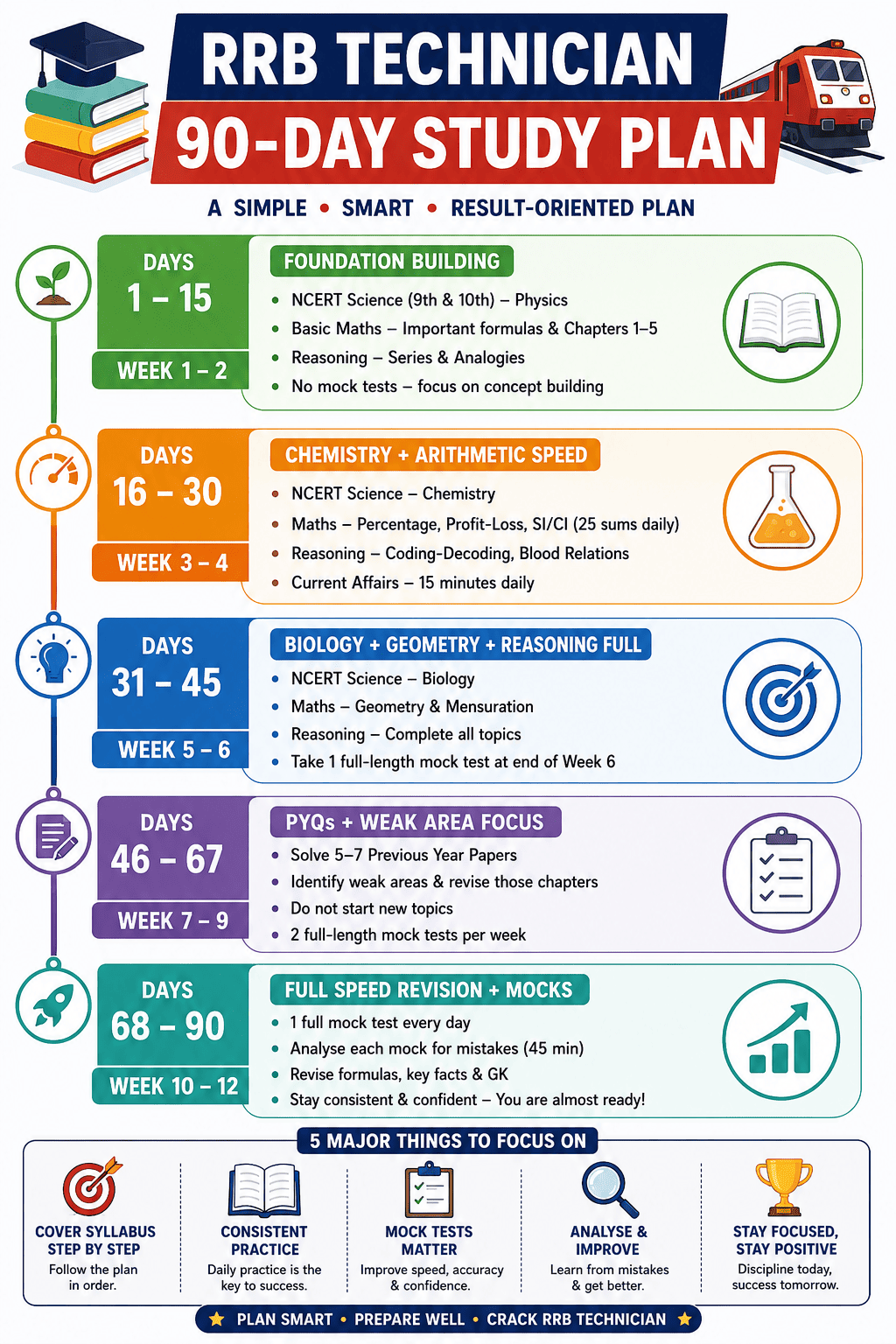
Preparing for the RRB exam without a concrete plan is like throwing effort everywhere randomly. Here’s a realistic and more structured study routine that a working student or a full-time aspirant can honestly follow for about 90 days, so you’re actually exam-ready. You do not have to clock in 12 hours a day; that’s unnecessary in most cases. Usually, three to four focused hours each day is enough if you use it properly and stay consistent.
10 Expert Tips That Toppers Follow for RRB Technician Preparation
Preparing for the RRB Technician exam becomes much easier when you follow a proper strategy instead of studying without a proper plan. Since the syllabus for Grade 1 and Grade 3 is different, candidates should first understand the syllabus of the post they are preparing for. Once your topics are clear, planning preparation becomes much more effective.
1. Prepare a Proper Study Routine
Start with a decent Study routine, make it realistic at least in your day to day plan, and keep the syllabus right there so you don’t really skip an important topic during preparation.
2. Focus More on High-Weightage Subjects
Put more attention to the high weightage sections, give extra time to subjects that carry higher marks, especially Science and the Technical segments, because they strongly affect the final score.
3. Follow a Subject-wise Preparation Strategy
Use a subject–wise strategy, do Mathematics and Reasoning every day, revise Science ideas regularly and also keep an eye on Current Affairs so you stay updated.
4. Solve Previous Year Papers Regularly
Keep solving previous year papers consistently, these help you figure out what repeats, what questions are usually asked and even the real exam difficulty level.
5. Attempt at Least 20 Full-Length Mock Tests
Try to attempt at least 20 full length mock tests, students who take regular CBT mocks often do better because practice improves speed, time-handling and a bit of exam confidence too.
6. Work on Accuracy Along with Speed
Fast solving is important, but accuracy matters more because negative marking can reduce your overall score badly.
7. Study NCERT Science Books Properly
Class 9 and 10 NCERT books help build strong fundamentals in Physics, Chemistry, and Biology commonly asked in Railway exams.
8. Use the Elimination Method in MCQs
In difficult questions, first remove obviously wrong options. This increases the chances of selecting the correct answer logically instead of guessing blindly.
9. Revise Regularly Using Short Notes and Formula Notebook
Maintain a separate notebook for formulas, Science laws, shortcuts, and important facts. Revise it weekly and use it for quick revision before the exam.
10. Avoid Learning New Topics Before the Exam and Track Weak Areas
In the final days, focus on revision and mock analysis instead of starting new chapters. Identify weak subjects from mock tests and improve them regularly for better overall performance.
Best Books and Study Resources for RRB Technician 2026 Preparation
Many students end up doing the mistake of collecting far too many books while they are in preparation. It usually brings confusion rather than improving their performance. For RRB Technician preparation, it is better to keep a few reliable resources, with steady revision plus regular practice, which is enough to help them score well in the exam.
|
Subject |
Recommended Book / Resource |
Why It Is Helpful |
|
General Science |
NCERT Science Books – Class 9 & 10 |
Helps build strong basics in Physics, Chemistry, and Biology concepts asked in Railway exams. |
|
Mathematics |
RS Aggarwal – Quantitative Aptitude |
Useful for practicing arithmetic topics, formulas, and calculation-based questions. |
|
Reasoning |
RS Aggarwal – Verbal & Non-Verbal Reasoning |
Helps improve reasoning skills and question-solving accuracy. |
|
General Awareness |
Lucent General Knowledge + Daily Current Affairs |
Useful for static GK, current affairs, government schemes, sports, and important events. |
|
Previous Year Papers |
Kiran or Arihant RRB Technician Papers |
Helps understand exam pattern, repeated questions, and difficulty level. |
|
Mock Test Practice |
Online CBT Mock Tests |
Improves speed, time management, and exam confidence. |
How to Use These Resources Properly
- Try to use NCERT books, for concept clarity, even if it feels a bit basic at first.
- Keep practicing aptitude and reasoning questions every day, not just when you have time.
- Also solve previous year papers regularly, because that pattern helps you get used to the real style.
- Attempt mock tests every week, and treat them like you mean it.
- For revision, make short notes, so you can quickly re-visit key ideas later.
One more thing, students should avoid changing books repeatedly during preparation. In the long run, consistent revision and steady practice matter more than collecting too many study materials or switching sources too often.
Common Mistakes That Stop Many Students from Clearing RRB Technician
Many students prepare seriously for Railway exams but still end up failing because of a few common preparation hicupps. If they understand these mistakes earlier, they can shape their approach better and avoid wasting time.
- Starting preparation without really understanding the syllabus
Many students just jump into random topics, without checking the syllabus properly, and honestly it all feels confusing, the preparation planning also becomes weak.
- Ignoring NCERT Science books
Some candidates say NCERT is too basic, but in Railway exams they often ask direct concept based questions, from Class 9 and Class 10 Science, not just “tricks”.
- Focusing only on favourite subjects
Students sometimes stick to Mathematics only or technical stuff, while skipping the other parts like Current Affairs, and Reasoning, and then they wonder why marks dont come.
- Avoiding mock tests due to fear
Many aspirants postpone mock tests because of low scores. But mock tests are needed, for increasing speed, improving accuracy and even better time management, even when the result looks rough.
- Studying without regular revision
Studying new chapters every day without revision means students forget older ideas fast, especially formulas and the Science basics..
- Making random guesses despite negative marking
Careless guessing can actually reduce marks quite a bit, so try to attempt questions with more attention and aim for accuracy first.
- Depending only on YouTube lectures
Just watching videos by itself is not enough. Real progress tends to come when you solve questions, practice regularly, and then go back to analyze the mistakes you made, step by step.
- Ignoring health and sleep
Poor sleep and unhealthy daily habits mess with your concentration, memory, and overall exam results, especially when you’re in the middle of preparation.
- Comparing preparation with others
Constant comparison with friends, Telegram groups, or social media builds unnecessary stress and slowly reduces confidence, even if you’re doing fine.
- Waiting for the perfect time to start
Some students keep postponing preparation for “better books”, coaching, or extra motivation. Usually, successful candidates just begin with what they already have, and they adjust along the way.
Syllabus for CBT Technician Grade I For Pay Level 5
| Subjects | Topics | Number of Questions (Tentative) | Marks (tentative) |
| General Awareness | Knowledge of current Affairs | 10 | 10 |
| Indian Geography | |||
| Environmental Issues of India and World | |||
| Culture and History of India, including freedom struggle | |||
| Indian Polity and Constitution | |||
| Indian Economy | |||
| Sports | |||
| General Scientific and Technological Developments | |||
| General Intelligence and Reasoning | Analogies | 15 | 15 |
| Alphabetical and Number Series | |||
| Coding and Decoding | |||
| Mathematical Operations | |||
| Relationships | |||
| Syllogism | |||
| Jumbling | |||
| Venn Diagram | |||
| Data Interpretation and Sufficiency | |||
| Conclusion | |||
| Directions | |||
| Statement - Arguments and Assumptions, etc | |||
| Basics of Computers and Applications | Architecture of Computers | 20 | 20 |
| Input and Output devices | |||
| Storage Devices | |||
| Networking | |||
| Operating System like Windows | |||
| Unix and Linux | |||
| MS Office | |||
| Various data representation | |||
| Internet and Email | |||
| Websites and Web Browsers | |||
| Computer Virus | |||
| Mathematics | Number system | 20 | 20 |
| rational and Irrational Numbers | |||
| BODMAS Rule | |||
| Quadratic Equations | |||
| Arithmetic progression | |||
| Similar Triangles | |||
| Pythagoras Theorem | |||
| Co-ordinate Geometry | |||
| Trigonometrical ratios | |||
| Heights and Distances | |||
| Surface area and Volume | |||
| Sets: sets and their representations, Empty set, Finite and Infinite sets, Subsets, Subsets of a set of real numbers, Universal Set, Venn diagrams, Union and Intersection of sets, Difference of sets, Complement of a set, Properties of a complement | |||
| Statistics: Measures of Dispersion, Range, Mean deviation, Variance and Standard Deviation of grouped/Ungrouped data | |||
| Probability occurrence of events, Exhaustive events, Mutually exclusive events | |||
| Basic Science and Engineering | Physical Fundamentals- Units, Measurement, Mass, Weight, Density, Work, Power and Energy, Speed and velocity, Heat and Temperature | 35 | 35 |
| Electricity and Magnetism-Electric charge, Field and Intensity, Electric Potential and Potential Difference, Simple Electric Circuits, Conductors, Non-Conductors/Insulators, Ohm's Law and its Limitations, Resistances in Series and Parallel of a Circuit and Specific Resistance, Relation between Electric Potential Energy and Power (Wattage), Ampere's Law, Magnetic Force on Moving Charged Particle and Long Straight Conductors, Electromagnetic Induction, Faraday's Law, Electromagnetic Flux, Magnetic Field, Magnetic Induction | |||
| Electronics and Measurements- Basic Electronics, Digital Electronics, Electronic Devices and Circuits, Microcontroller, Microprocessor, Electronic Measurements, Measuring Systems and Principles, Range Extension Methods, Cathode Ray Oscilloscope, LCD, LED Panel, Transducers | |||
| Total | 100 | 100 |
Syllabus for CBT Technician Grade III For pay Level 2
| Subject | Key Topics | Number of Questions (tentative) | Marks |
| Mathematics | Number system | 25 | 25 |
| BODMAS | |||
| Decimals | |||
| Fraction | |||
| LCM and HCF | |||
| Ration and Proportion | |||
| Percentages | |||
| Mensuration | |||
| Time and Work | |||
| Time and Distance | |||
| Simple and Compound Interest | |||
| Profit and Loss | |||
| Algebra | |||
| Geometry and Trigonometry | |||
| Elementary Statistics | |||
| Square Root | |||
| Age Calculations | |||
| Calendar and Clock | |||
| Pipes and Cistern | |||
| General Intelligence and Reasoning | Analogies | 25 | 25 |
| Alphabetical and Number Series | |||
| Coding and Decoding | |||
| Mathematical Operations | |||
| Relationships | |||
| Syllogism | |||
| Jumbling | |||
| Venn Diagram | |||
| Data Interpretation and Sufficiency | |||
| Conclusion and Decision making | |||
| Similarities and Differences | |||
| Analytical reasoning | |||
| Classification | |||
| Directions | |||
| Statement - Arguments and Assumptions | |||
| General Science Topics covered will be of 10th Standard |
Physics | 40 | 40 |
| Chemistry | |||
| Life Sciences | |||
| General Awareness | Current Affairs in Science and technology, | 10 | 10 |
| Sports | |||
| Culture | |||
| Personality | |||
| Politics | |||
| Economics and any other subject of importance | |||
| Total - 100 | 100 |
Key Info for Document Verification (DV)
Candidates who qualify for CBT test will be shortlisted for document verification for the respective Grades. In the event of two or more candidates scoring equal marks, the oldest candidates among the two/more will be given the merit position. The shortlisted candidates are further required to go through a physical test with the RRB outlining the standard criteria to be considered qualified for the posts. The final list of the merit candidates will be shortlisted by taking into account the candidate CBT test performance, verification of essential documents/antecedents/character and physical fitness of the candidate.
Medical Standard for Physical Fitness
Candidates who are shortlisted for document verification must also ensure physical fitness in all aspects. The Visual Acuity Standard is of major importance for the RRB Technician posts, and candidates shortlisted must ensure they fulfil the standard criteria. Candidates who have undergone any surgical treatments like LASIK surgery, etc. for correcting refractory error are not eligible for the posts that demands A3 standards in the recruitment.
Below is the standard for the vision test.
| Standards of test | Meaning/Interpretation | Vision Standard |
| A3 | Physically fit in all respects | Must pass several tests for vision, including colour vision, night vision, mesopic vision and binocular vision |
| Near Vision of Sn: 0.6, 0.6 with or without glasses | ||
| Distance Vision of 6/9, 6/9 with or without glasses (contact lenses power not exceeding 2D) | ||
| B1 | Physically fit in all respects | Must pass several vision tests including colour vision, night vision, mesopic vision and binocular vision |
| Near Vision of Sn: 0.6,0.6 with or without glasses while reading or performing close work | ||
| Distance Vision of 6/9. 6/12 with or without glasses (Contact lenses power must not exceed 4D) | ||
| B2 | Physically fit in all respects | Must pass Binocular vision test |
| Near Vision of 0.6,0.6 with or without glasses while reading or performing close tasks | ||
| Distance Vision of 6/9,6/12 with or without glasses (contact lenses power must not exceed 4D) |
Latest Jobs
10- SPSC Recruitment 2026: 50 Accounts Clerk/ Junior Storekeeper Vacancies
- APSC Recruitment 2026: Assistant Mining Engineer Vacancies
- APSC Recruitment 2026: 02 Chemist Vacancies
- RBI Recruitment 2026: 12 Young Professional Vacancies
- UPSC Recruitment 06/ 2026 Application Form: 420 Vacancies
- NHSRCL Recruitment 2026: 209 Junior and Deputy Engineer Positions
- AIIMS Jammu Non-Teaching Recruitment 2026: 29 Vacancies
- BEL Panchkula Recruitment 2026: 07 Engineering Assistant Trainee, Technician Vacancies
- Central Sanskrit University Teaching Recruitment 2026: 90 Vacancies
- Allahabad High Court Recruitment 2026: 543 Assistant Review Officer Vacancies
Latest Articles
10- The WallStreet School: Best Finance and Accounting Training Institute
- SSC GD Constable Admit Card 2026-27
- How to Become an Odisha Police Constable/Sepoy in 2026?
- How to Prepare for RBI Office Attendant Exam 2026
- Telangana High Court Recruitment Exam 2026 Preparation Tips
- NABARD Development Assistant Recruitment Exam 2026 Preparation Tips
- Hindustan Urvarak and Rasayan Limited: Career Opportunities at HURL
- Railway Exam: RRB Annual Calendar 2026-27
- Sarkari Naukri in Rajasthan: The Mirage of Promises and the Dust of Reality
- Lakshadweep Scholarship Scheme 2025